Dong Catherine, Condat Bertrand, Picon-Coste Magalie, Chrétien Yves, Potier Pascal, Noblinski Béatrice, Arrivé Lionel, Hauuy Marie-Pierre, Barbu Véronique, Maftouh Anware, Gaouar Farid, Ben Belkacem Karima, Housset Chantal, Poupon Raoul, Zanditenas David, Chazouillères Olivier, Corpechot Christophe
Reference Center for Inflammatory Biliary Diseases and Autoimmune Hepatitis, ERN RARE-LIVER, Saint-Antoine Hospital, Assistance Publique-Hôpitaux de Paris, Sorbonne University, Paris, France.
Division of Gastroenterology and Hepatology, French Polynesia Hospital, Pirae, French Polynesia.
JHEP Rep. 2020 Nov 6;3(2):100201. doi: 10.1016/j.jhepr.2020.100201. eCollection 2021 Apr.
BACKGROUND & AIMS: Low-phospholipid-associated cholelithiasis (LPAC) syndrome, a rare genetic form of intrahepatic cholelithiasis in adults, is still poorly understood. We report the results of the largest-ever case-control study of patients with LPAC syndrome aiming to assess the prevalence, clinical features, and comorbidities of the disease.
We included all LPAC cases diagnosed between 2001 and 2016 in 11 French centres. Controls consisted of all patients who underwent a cholecystectomy for common gallstone disease in a single non-academic centre over 1 year. A logistic regression analysis was used to identify the clinical features associated with LPAC syndrome across several patient strata with increasing levels of diagnostic confidence. The ratio between the incident cases of LPAC syndrome and the total number of cholecystectomies for gallstones was used to assess the relative prevalence of the disease.
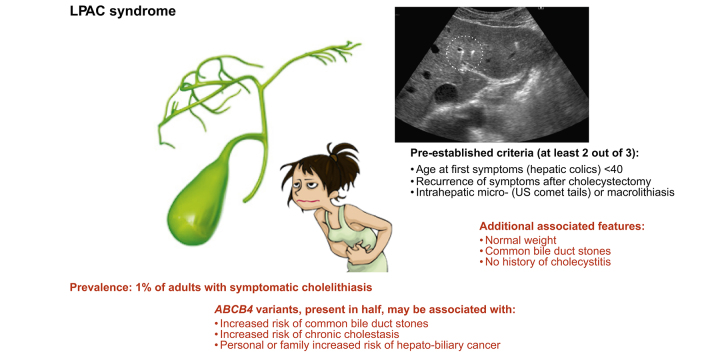
In this study, 308 cases and 206 controls were included. LPAC syndrome accounted for 0.5-1.9% of all patients admitted with symptomatic gallstone disease. Age at first symptoms <40 years, absence of overweight, persistence of symptoms after cholecystectomy, intrahepatic micro- or macrolithiasis, common bile duct (CBD) lithiasis, and no history of cholecystitis were independently associated with LPAC diagnosis. ATP-binding cassette subfamily B member 4 () variants, present in 46% of cases, were associated with CBD lithiasis, chronic elevation of gamma-glutamyltransferase (GGT), and personal or family history of hepato-biliary cancer.
In this case-control study, LPAC syndrome accounted for approximately 1% of symptomatic cholelithiasis in adults. In addition to pre-established diagnostic criteria, normal weight, CBD lithiasis, and no history of cholecystitis were significantly associated with the syndrome. gene variations in patients with LPAC were associated with CBD lithiasis, chronic cholestasis, and a personal or family history of hepato-biliary cancer.
In the largest case-control study ever conducted in patients with LPAC syndrome, a rare genetic form of intrahepatic cholelithiasis in young adults, LPAC syndrome was found in approximately 1% of all patients admitted to the hospital for symptomatic gallstones and, in addition to the pre-established characteristics of the syndrome (age at first symptoms <40 years, recurrence of symptoms after cholecystectomy, and/or imaging evidence of intrahepatic microlithiasis), was associated with lower BMI, higher prevalence of common bile duct stones, and lower incidence of acute cholecystitis. gene variants, which were detected in about half of cases, were associated with common bile duct stones and a personal or family history of hepato-biliary cancer.
低磷脂相关胆石症(LPAC)综合征是成人肝内胆石症的一种罕见遗传形式,目前人们对其了解仍较少。我们报告了有史以来规模最大的LPAC综合征患者病例对照研究结果,旨在评估该疾病的患病率、临床特征和合并症。
我们纳入了2001年至2016年间在法国11个中心诊断的所有LPAC病例。对照组由在一个非学术中心1年多时间内因普通胆结石疾病接受胆囊切除术的所有患者组成。采用逻辑回归分析来确定在诊断置信度不断提高的几个患者分层中与LPAC综合征相关的临床特征。LPAC综合征的发病病例数与胆结石胆囊切除术总数的比值用于评估该疾病的相对患病率。
本研究纳入了308例病例和206例对照。LPAC综合征占所有因有症状胆结石疾病入院患者的0.5 - 1.9%。首次出现症状时年龄<40岁、无超重、胆囊切除术后症状持续、肝内微结石或大结石、胆总管(CBD)结石以及无胆囊炎病史与LPAC诊断独立相关。46%的病例中存在ATP结合盒亚家族B成员4()变异,其与CBD结石、γ-谷氨酰转移酶(GGT)慢性升高以及肝胆癌个人或家族史相关。
在本病例对照研究中,LPAC综合征约占成人有症状胆石症的1%。除既定的诊断标准外,体重正常、CBD结石和无胆囊炎病史与该综合征显著相关。LPAC患者的基因变异与CBD结石、慢性胆汁淤积以及肝胆癌个人或家族史相关。
在有史以来针对LPAC综合征患者进行的最大规模病例对照研究中,LPAC综合征是年轻成人肝内胆石症的一种罕见遗传形式,在所有因有症状胆结石入院的患者中约1%被发现,除了该综合征既定特征(首次出现症状时年龄<40岁、胆囊切除术后症状复发和/或肝内微结石的影像学证据)外,还与较低的体重指数、较高的胆总管结石患病率和较低的急性胆囊炎发病率相关。约一半病例中检测到的基因变异与胆总管结石以及肝胆癌个人或家族史相关。