Department of Surgery, Charité-Universitätsmedizin Berlin, corporate member of Freie Universität Berlin, Humboldt-Universität zu Berlin, and Berlin Institute of Health, Charité Campus Mitte, Campus Virchow Klinikum, Charitéplatz 1, 10117, Berlin, Germany.
Hernia. 2021 Oct;25(5):1129-1135. doi: 10.1007/s10029-021-02372-1. Epub 2021 Feb 8.
As in the rest of the world, in Germany, inguinal hernia operations are among the most common operations. From an economic standpoint, very little is known about the influence of demographic, clinical or hernia-related parameters on the cost of inguinal hernia repair. We, therefore, evaluated individual patient parameters associated with higher costs with a special focus on multimorbidity.
A total of 916 patients underwent hernia repair for primary or recurrent inguinal hernia between 2014 and 2017 at a single university center and were included in the analysis. The clinical and financial data of these patients were analyzed to identify cost-increasing parameters.
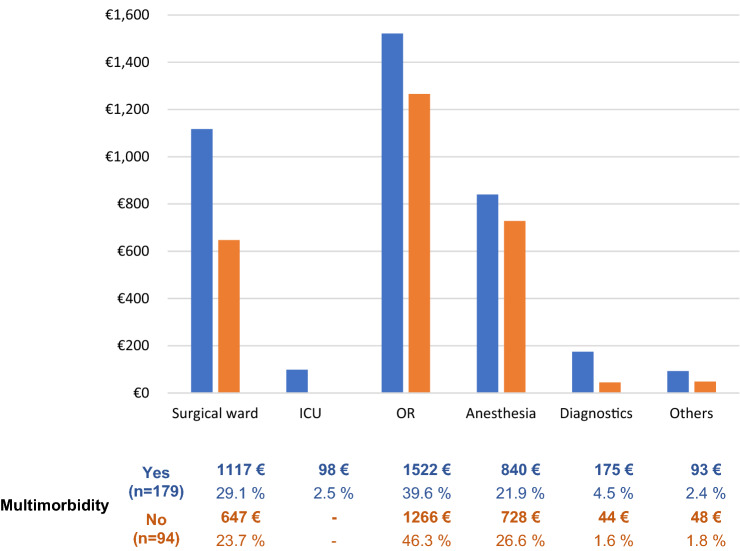
A majority of patients were male (90.7%), with a mean age of 55 years. The surgical methods utilized were mainly the TAPP (57.2%) and Lichtenstein (41.7%) procedures, with an average duration of surgery of 85 min and an average duration of anesthesia of 155 min. The mean cost of all procedures was 3338.3 € (± 1608.1 €). Older age, multimorbidity, emergency operations with signs of incarceration, longer hospital stays and postoperative complications were significant cost-driving factors. On the other hand, sex, the side of the hernia (left vs. right) and the presence of recurrent hernias had no influence on the overall direct costs.
From a purely economic point of view, older age and multimorbidity are demographic cost-driving factors that cannot be influenced. The national hospital reimbursement system needs to consider and compensate for these factors. Emergency operations need to be prevented by early elective treatment. Long postoperative stays and postoperative complications need to be prevented by proper preoperative check-ups and accurate treatment.
与世界其他地区一样,在德国,腹股沟疝手术是最常见的手术之一。从经济角度来看,人们对人口统计学、临床或疝相关参数对腹股沟疝修补术成本的影响知之甚少。因此,我们评估了与更高成本相关的个体患者参数,特别关注多病共存。
2014 年至 2017 年期间,共有 916 名患者在一家大学中心接受了原发性或复发性腹股沟疝的疝修补术,并纳入了分析。对这些患者的临床和财务数据进行了分析,以确定增加成本的参数。
大多数患者为男性(90.7%),平均年龄为 55 岁。使用的手术方法主要是 TAPP(57.2%)和 Lichtenstein(41.7%)手术,手术平均持续时间为 85 分钟,麻醉平均持续时间为 155 分钟。所有手术的平均费用为 3338.3 欧元(±1608.1 欧元)。年龄较大、多病共存、有嵌顿迹象的急诊手术、住院时间延长和术后并发症是显著的成本驱动因素。另一方面,性别、疝的侧别(左侧与右侧)和复发性疝的存在对总直接费用没有影响。
从纯粹的经济角度来看,年龄较大和多病共存是不可影响的人口统计学成本驱动因素。国家医院报销系统需要考虑并补偿这些因素。通过早期择期治疗预防急诊手术。通过适当的术前检查和准确的治疗预防术后住院时间延长和术后并发症。