Aix Marseille University, National Institute of Health and Medical Research (INSERM), Institute of Research for Development (IRD), Economic and Social Sciences for Health and Medical Information Processing (SESSTIM), UMR1252, Marseille, France; Public Assistance Marseille Hospitals (APHM), Biostatistics and Information and Communication Technologies Service (BioSTIC), Marseille, France.
Aix Marseille University, National Institute of Health and Medical Research (INSERM), Institute of Research for Development (IRD), Economic and Social Sciences for Health and Medical Information Processing (SESSTIM), UMR1252, Marseille, France.
Lancet Public Health. 2021 Apr;6(4):e222-e231. doi: 10.1016/S2468-2667(21)00006-2. Epub 2021 Feb 6.
The objective of this study was to better understand the factors associated with the heterogeneity of in-hospital COVID-19 morbidity and mortality across France, one of the countries most affected by COVID-19 in the early months of the pandemic.
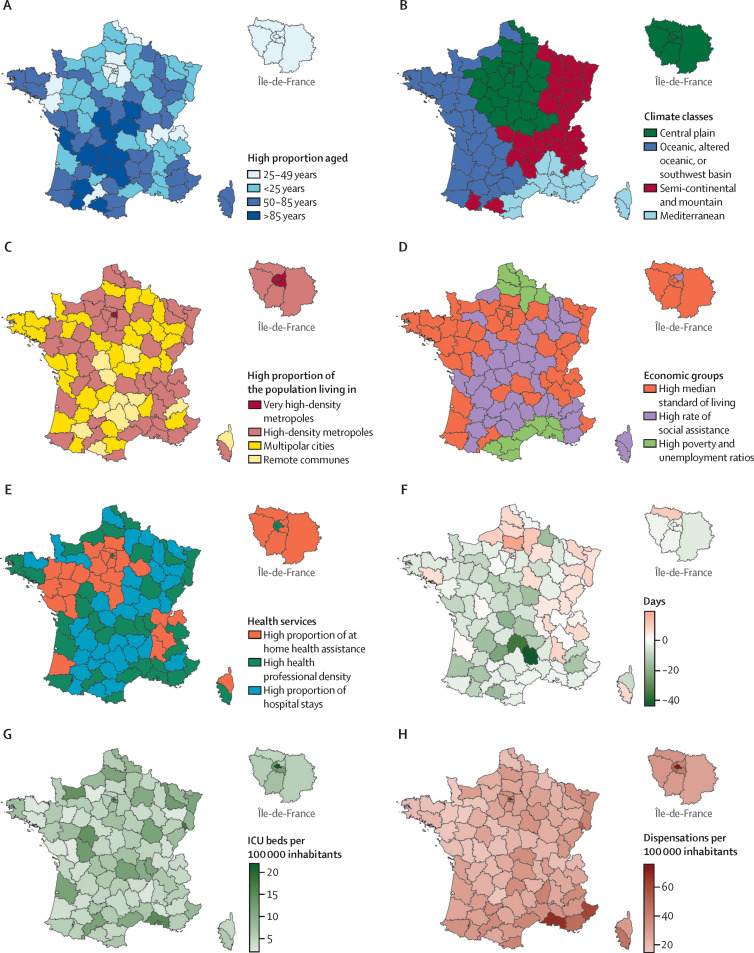
This geo-epidemiological analysis was based on data publicly available on government and administration websites for the 96 administrative departments of metropolitan France between March 19 and May 11, 2020, including Public Health France, the Regional Health Agencies, the French national statistics institute, and the Ministry of Health. Using hierarchical ascendant classification on principal component analysis of multidimensional variables, and multivariate analyses with generalised additive models, we assessed the associations between several factors (spatiotemporal spread of the epidemic between Feb 7 and March 17, 2020, the national lockdown, demographic population structure, baseline intensive care capacities, baseline population health and health-care services, new chloroquine and hydroxychloroquine dispensations, economic indicators, degree of urbanisation, and climate profile) and in-hospital COVID-19 incidence, mortality, and case fatality rates. Incidence rate was defined as the cumulative number of in-hospital COVID-19 cases per 100 000 inhabitants, mortality rate as the cumulative number of in-hospital COVID-19 deaths per 100 000, and case fatality rate as the cumulative number of in-hospital COVID-19 deaths per cumulative number of in-hospital COVID-19 cases.
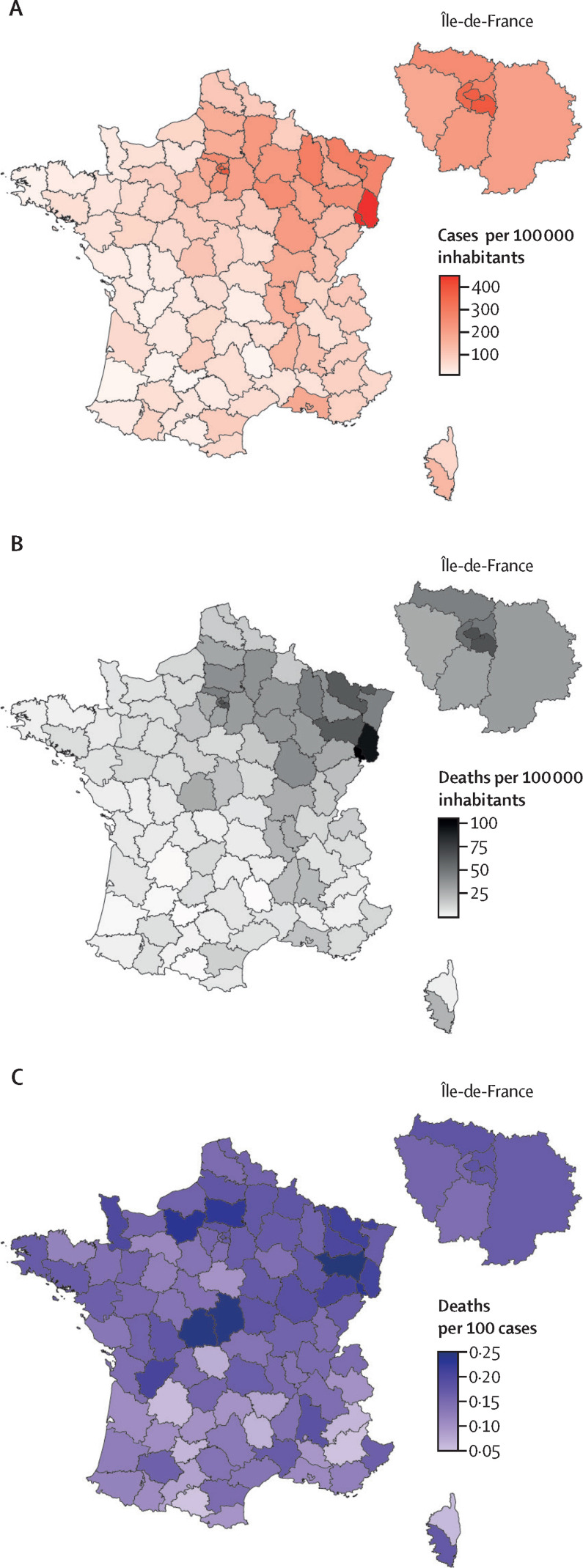
From March 19 to May 11, 2020, hospitals in metropolitan France notified a total of 100 988 COVID-19 cases, including 16 597 people who were admitted to intensive care and 17 062 deaths. There was an overall cumulative in-hospital incidence rate of 155·6 cases per 100 000 inhabitants (range 19·4-489·5), in-hospital mortality rate of 26·3 deaths per 100 000 (1·1-119·2), and in-hospital case fatality rate of 16·9% (4·8-26·2). We found clear spatial heterogeneity of in-hospital COVID-19 incidence and mortality rates, following the spread of the epidemic. After multivariate adjustment, the delay between the first COVID-19-associated death and the onset of the national lockdown was positively associated with in-hospital incidence (adjusted standardised incidence ratio 1·02, 95% CI 1·01-1·04), mortality (adjusted standardised mortality ratio 1·04, 1·02-1·06), and case fatality rates (adjusted standardised fatality ratio 1·01, 1·01-1·02). Mortality and case fatality rates were higher in departments with older populations (adjusted standardised ratio for populations with a high proportion older than aged >85 years 2·17 [95% CI 1·20-3·90] for mortality and 1·43 [1·08-1·88] for case fatality rate). Mortality rate was also associated with incidence rate (1·0004, 1·0002-1·001), but mortality and case fatality rates did not appear to be associated with baseline intensive care capacities. We found no association between climate and in-hospital COVID-19 incidence, or between economic indicators and in-hospital COVID-19 incidence or mortality rates.
This ecological study highlights the impact of the epidemic spread, national lockdown, and reactive adaptation of intensive care capacities on the spatial distribution of COVID-19 morbidity and mortality. It provides information for future geo-epidemiological analyses and has implications for preparedness and response policies to current and future epidemic waves in France and elsewhere.
None.
本研究的目的是更好地了解法国 COVID-19 发病率和死亡率的异质性相关因素,法国是 COVID-19 大流行早期受影响最严重的国家之一。
本地理流行病学分析基于 2020 年 3 月 19 日至 5 月 11 日法国大都市 96 个行政部门的政府和管理网站上公布的数据,包括法国公共卫生署、地区卫生机构、法国国家统计研究所和卫生部。我们使用多维变量主成分分析的层次递升分类法和广义加性模型的多变量分析,评估了几种因素(2020 年 2 月 7 日至 3 月 17 日之间的疫情时空传播、国家封锁、人口结构、基线重症监护能力、基线人口健康和卫生保健服务、新的氯喹和羟氯喹配给、经济指标、城市化程度和气候特征)与住院 COVID-19 发病率、死亡率和病死率之间的关联。发病率定义为每 10 万人中累计住院 COVID-19 病例数,死亡率定义为每 10 万人中累计住院 COVID-19 死亡人数,病死率定义为每 10 万例住院 COVID-19 死亡人数中累计住院 COVID-19 死亡人数。
从 2020 年 3 月 19 日至 5 月 11 日,法国大都市的医院共报告了 100988 例 COVID-19 病例,其中 16597 人入住重症监护病房,17062 人死亡。累计住院 COVID-19 发病率为 155.6 例/10 万人(范围 19.4-489.5),住院 COVID-19 死亡率为 26.3 例/10 万人(1.1-119.2),住院 COVID-19 病死率为 16.9%(4.8-26.2)。我们发现,随着疫情的传播,住院 COVID-19 发病率和死亡率存在明显的空间异质性。在多变量调整后,首例 COVID-19 相关死亡与国家封锁开始之间的延迟与住院 COVID-19 发病率(调整后的标准化发病率比 1.02,95%CI 1.01-1.04)、死亡率(调整后的标准化死亡率比 1.04,1.02-1.06)和病死率(调整后的标准化病死率比 1.01,1.01-1.02)呈正相关。老年人口比例较高的部门死亡率和病死率较高(年龄大于 85 岁的人口比例较高的部门的标准化比值为 2.17 [95%CI 1.20-3.90] 死亡率和 1.43 [1.08-1.88] 病死率)。死亡率还与发病率相关(1.0004,1.0002-1.001),但死亡率和病死率似乎与基线重症监护能力无关。我们没有发现气候与住院 COVID-19 发病率之间的关联,也没有发现经济指标与住院 COVID-19 发病率或死亡率之间的关联。
这项生态研究强调了疫情传播、国家封锁和重症监护能力的反应性适应对 COVID-19 发病率和死亡率空间分布的影响。它为未来的地理流行病学分析提供了信息,并对法国和其他地区当前和未来疫情波次的备灾和应对政策具有启示意义。
无。