Mathematical Modelling of Infectious Diseases Unit, Institut Pasteur, UMR2000, CNRS, Paris, France.
Department of Genetics, University of Cambridge, Cambridge, UK.
Science. 2020 Jul 10;369(6500):208-211. doi: 10.1126/science.abc3517. Epub 2020 May 13.
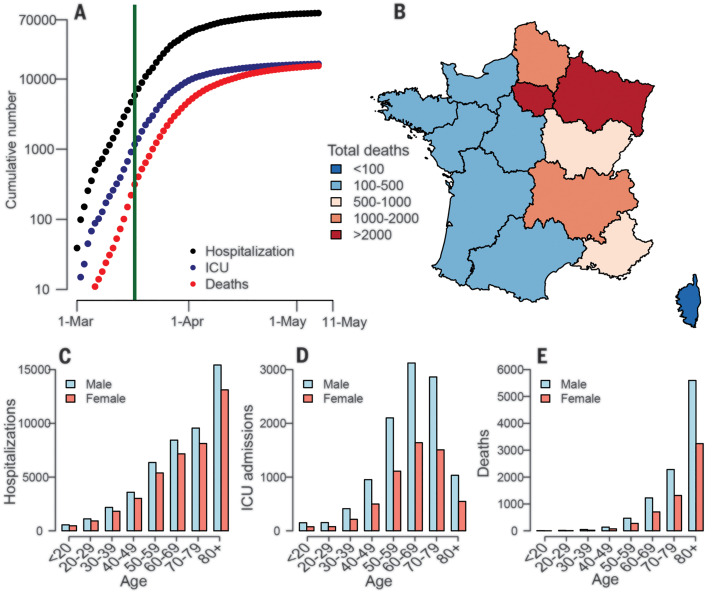
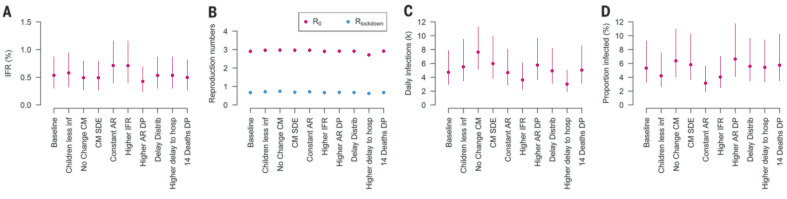
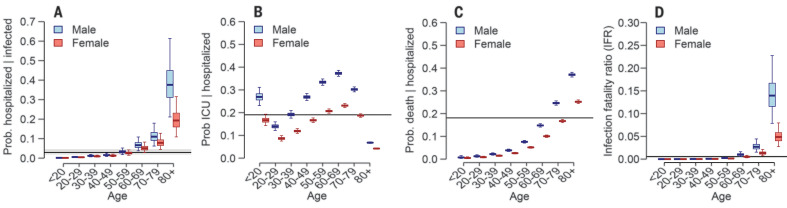
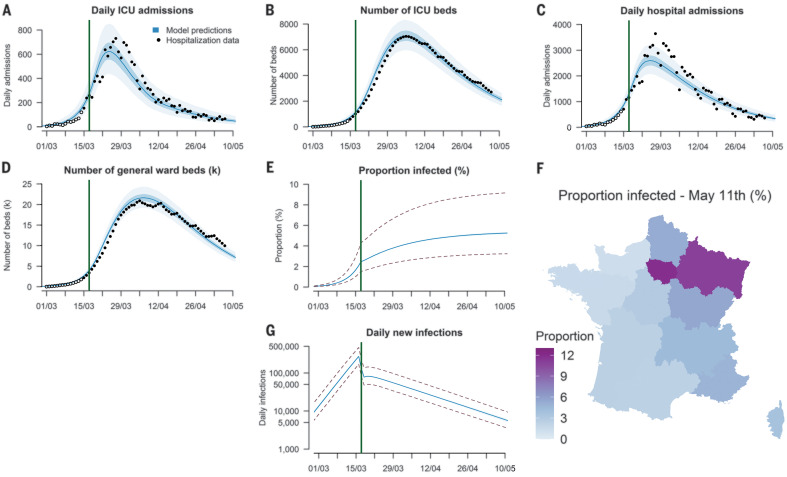
France has been heavily affected by the severe acute respiratory syndrome coronavirus 2 (SARS-CoV-2) pandemic and went into lockdown on 17 March 2020. Using models applied to hospital and death data, we estimate the impact of the lockdown and current population immunity. We find that 2.9% of infected individuals are hospitalized and 0.5% of those infected die (95% credible interval: 0.3 to 0.9%), ranging from 0.001% in those under 20 years of age to 8.3% in those 80 years of age or older. Across all ages, men are more likely to be hospitalized, enter intensive care, and die than women. The lockdown reduced the reproductive number from 2.90 to 0.67 (77% reduction). By 11 May 2020, when interventions are scheduled to be eased, we project that 3.5 million people (range: 2.1 million to 6.0 million), or 5.3% of the population (range: 3.3 to 9.3%), will have been infected. Population immunity appears to be insufficient to avoid a second wave if all control measures are released at the end of the lockdown.
法国深受严重急性呼吸系统综合症冠状病毒 2 型(SARS-CoV-2)疫情的影响,并于 2020 年 3 月 17 日进入封锁状态。我们利用应用于医院和死亡数据的模型,估计了封锁和当前人群免疫力的影响。我们发现,2.9%的感染者住院,0.5%的感染者死亡(95%可信区间:0.3 至 0.9%),从 20 岁以下人群的 0.001%到 80 岁以上人群的 8.3%不等。在所有年龄段中,男性住院、进入重症监护病房和死亡的可能性均高于女性。封锁将繁殖数从 2.90 减少到 0.67(减少 77%)。到 2020 年 5 月 11 日,即干预措施计划放宽之时,我们预计将有 350 万人(范围:210 万至 600 万),或 5.3%的人口(范围:3.3 至 9.3%)感染。如果在封锁结束时解除所有控制措施,人群免疫力似乎不足以避免第二波疫情。