Division of Oncology, IRCCS Azienda Ospedaliero-Universitaria di Bologna, 40138 Bologna, Italy.
Oncology Unit, Macerata Hospital, 62100 Macerata, Italy.
Int J Mol Sci. 2021 Feb 4;22(4):1551. doi: 10.3390/ijms22041551.
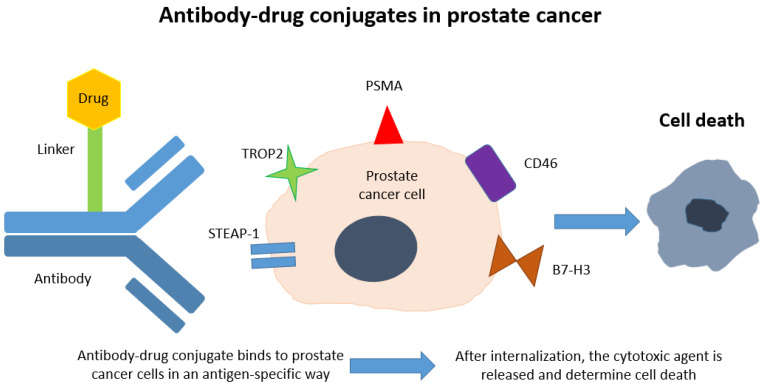
Prostate cancer is the most frequent malignancy in the worldwide male population; it is also one of the most common among all the leading cancer-related death causes. In the last two decades, the therapeutic scenario of metastatic castration-resistant prostate cancer has been enriched by the use of chemotherapy and androgen receptor signaling inhibitors (ARSI) and, more recently, by immunotherapy and poly(ADP-ribose) polymerase (PARP) inhibitors. At the same time, several trials have shown the survival benefits related to the administration of novel ARSIs among patients with non-castration-resistant metastatic disease along with nonmetastatic castration-resistant cancer too. Consequently, the therapeutic course of this malignancy has been radically expanded, ensuring survival benefits never seen before. Among the more recently emerging agents, the so-called "antibody-drug conjugates" (ADCs) are noteworthy because of their clinical practice changing outcomes obtained in the management of other malignancies (including breast cancer). The ADCs are novel compounds consisting of cytotoxic agents (also known as the payload) linked to specific antibodies able to recognize antigens expressed over cancer cells' surfaces. As for prostate cancer, researchers are focusing on STEAP1, TROP2, PSMA, CD46 and B7-H3 as optimal antigens which may be targeted by ADCs. In this paper, we review the pivotal trials that have currently changed the therapeutic approach to prostate cancer, both in the nonmetastatic castration-resistant and metastatic settings. Therefore, we focus on recently published and ongoing trials designed to investigate the clinical activity of ADCs against prostate malignancy, characterizing these agents. Lastly, we briefly discuss some ADCs-related issues with corresponding strategies to overwhelm them, along with future perspectives for these promising novel compounds.
前列腺癌是全球男性人群中最常见的恶性肿瘤;也是所有主要癌症相关死亡原因中最常见的癌症之一。在过去的二十年中,转移性去势抵抗性前列腺癌的治疗方案因使用化疗和雄激素受体信号抑制剂(ARSI)而得到丰富,最近,免疫疗法和聚(ADP-核糖)聚合酶(PARP)抑制剂也得到了丰富。与此同时,几项试验表明,在非去势抵抗性转移性疾病和非转移性去势抵抗性癌症患者中,新型 ARSI 的使用与生存获益相关。因此,这种恶性肿瘤的治疗方案得到了彻底扩展,确保了以前从未见过的生存获益。在最近出现的药物中,所谓的“抗体药物偶联物”(ADC)值得注意,因为它们在管理其他恶性肿瘤(包括乳腺癌)方面取得了改变临床实践的结果。ADC 是由细胞毒性剂(也称为有效载荷)与能够识别癌细胞表面表达的抗原的特定抗体连接而成的新型化合物。就前列腺癌而言,研究人员正在关注 STEAP1、TROP2、PSMA、CD46 和 B7-H3 作为可能被 ADC 靶向的最佳抗原。在本文中,我们回顾了目前改变了非转移性去势抵抗性和转移性前列腺癌治疗方法的关键试验。因此,我们专注于最近发表和正在进行的旨在研究 ADC 对前列腺恶性肿瘤的临床活性的试验,对这些药物进行了特征描述。最后,我们简要讨论了一些与 ADC 相关的问题及其克服策略,并对这些有前途的新型化合物的未来前景进行了展望。