Ishii Yasutaka, Serikawa Masahiro, Tsuboi Tomofumi, Kawamura Ryota, Tsushima Ken, Nakamura Shinya, Hirano Tetsuro, Fukiage Ayami, Mori Takeshi, Ikemoto Juri, Kiyoshita Yusuke, Saeki Sho, Tamura Yosuke, Miyamoto Sayaka, Chayama Kazuaki
Department of Gastroenterology and Metabolism, Graduate School of Biomedical & Health Sciences, Hiroshima University, 1-2-3 Kasumi, Minami-ku, Hiroshima 734-8551, Japan.
Research Center for Hepatology and Gastroenterology, Hiroshima University, 1-2-3 Kasumi, Minami-ku, Hiroshima 734-8551, Japan.
Diagnostics (Basel). 2021 Feb 4;11(2):238. doi: 10.3390/diagnostics11020238.
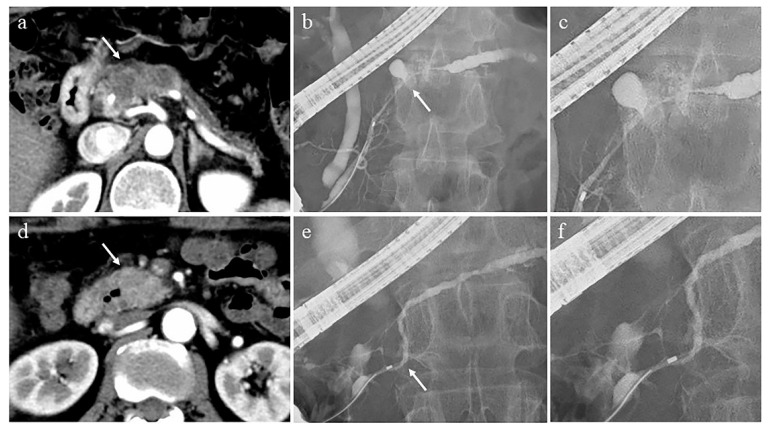
Pancreatic cancer has the poorest prognosis among all cancers, and early diagnosis is essential for improving the prognosis. Along with radiologic modalities, such as computed tomography (CT) and magnetic resonance imaging (MRI), endoscopic modalities play an important role in the diagnosis of pancreatic cancer. This review evaluates the roles of two of those modalities, endoscopic ultrasonography (EUS) and endoscopic retrograde cholangiopancreatography (ERCP), in the diagnosis of pancreatic cancer. EUS can detect pancreatic cancer with higher sensitivity and has excellent sensitivity for the diagnosis of small pancreatic cancer that cannot be detected by other imaging modalities. EUS may be useful for the surveillance of pancreatic cancer in high-risk individuals. Contrast-enhanced EUS and EUS elastography are also useful for differentiating solid pancreatic tumors. In addition, EUS-guided fine needle aspiration shows excellent sensitivity and specificity, even for small pancreatic cancer, and is an essential examination method for the definitive pathological diagnosis and treatment decision strategy. On the other hand, ERCP is invasive and performed less frequently for the purpose of diagnosing pancreatic cancer. However, ERCP is essential in cases that require evaluation of pancreatic duct stricture that may be early pancreatic cancer or those that require differentiation from focal autoimmune pancreatitis.
在所有癌症中,胰腺癌的预后最差,早期诊断对于改善预后至关重要。除了诸如计算机断层扫描(CT)和磁共振成像(MRI)等放射学检查方法外,内镜检查方法在胰腺癌的诊断中也发挥着重要作用。本综述评估了其中两种方法,即内镜超声检查(EUS)和内镜逆行胰胆管造影(ERCP)在胰腺癌诊断中的作用。EUS能够以更高的灵敏度检测胰腺癌,对于其他成像方法无法检测到的小胰腺癌的诊断具有出色的灵敏度。EUS可能有助于对高危个体进行胰腺癌监测。对比增强EUS和EUS弹性成像对于鉴别实性胰腺肿瘤也很有用。此外,EUS引导下的细针穿刺即使对于小胰腺癌也显示出出色的灵敏度和特异性,是明确病理诊断和制定治疗决策策略的重要检查方法。另一方面,ERCP具有侵入性,用于诊断胰腺癌的频率较低。然而,在需要评估可能为早期胰腺癌的胰管狭窄情况或需要与局灶性自身免疫性胰腺炎进行鉴别的病例中,ERCP是必不可少的。