Sarkeala Tytti, Färkkilä Martti, Anttila Ahti, Hyöty Marja, Kairaluoma Matti, Rautio Tero, Voutilainen Markku, Helander Sanni, Jäntti Maija, Lehtinen Milla, Patrikka Lotta, Malila Nea, Heinävaara Sirpa
Finnish Cancer Registry, Cancer Society of Finland, Helsinki, Finland
Clinic of Gastroenterology, Helsinki University Central Hospital, Helsinki, Finland.
BMJ Open. 2021 Feb 8;11(2):e046667. doi: 10.1136/bmjopen-2020-046667.
To assess the feasibility and evaluate the performance of a relaunched colorectal cancer (CRC) screening programme with different cut-offs for men and women.
Population-based registry study.
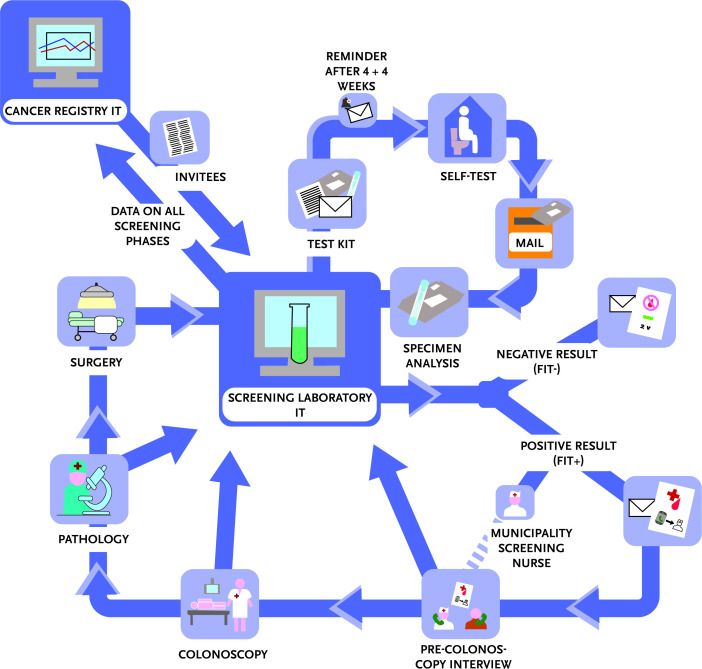
Nine municipalities in Finland which started CRC screening with faecal immunochemical test (FIT) in April 2019 with cut-off levels 70 µg Hg/g faeces for men and 25 µg Hg/g faeces for women.
Men (n=13 059) and women (n=14 669) aged 60-66 years invited to screening during the first programme year.
Participation rates, positivity rates, detection rates of CRC and advanced adenoma (AA), and positive predictive values (PPV) of FIT for CRC and AA.
Altogether 21 993 invitees returned stool samples. The participation rate of women (83.4%; 95% CI 82.8 to 84.0) was significantly higher than that of men (74.7%; 95% CI 73.9 to 75.4). The positivity rates were 2.4% (2.2 to 2.7) and 2.8% (2.5 to 3.1), respectively. In total, 37 CRCs and 116 AAs were detected. The detection rates of CRC and AA per 1000 participants were 1.8 (1.1 to 2.9) and 7.2 (5.6 to 9.1) for men and 1.6 (0.9 to 2.4) and 3.8 (2.8 to 5.0) for women. The PPVs per 100 positive tests were 6.6 (4.0 to 10.3) and 25.7 (20.6 to 31.4) for men and 6.4 (3.9 to 9.8) and 15.5 (11.6 to 20.2) for women.
The chosen FIT strategy narrowed the gap in the diagnostic performance between men and women especially in the detection of CRC. The participation rates were excellent. The levels of positivity and detection rates were moderate and need further action. The results indicate that gender-specific protocols can be introduced to organised CRC screening. It is yet to be seen whether they are more effective than a uniform screening protocol.
评估重新启动的针对男性和女性采用不同临界值的结直肠癌(CRC)筛查项目的可行性,并评价其性能。
基于人群的登记研究。
芬兰的9个直辖市于2019年4月开始采用粪便免疫化学检测(FIT)进行CRC筛查,男性的临界值为70μg Hg/g粪便,女性为25μg Hg/g粪便。
在项目第一年被邀请参加筛查的60 - 66岁男性(n = 13059)和女性(n = 14669)。
参与率、阳性率、CRC和高级别腺瘤(AA)的检出率,以及FIT对CRC和AA的阳性预测值(PPV)。
共有21993名受邀者返回了粪便样本。女性的参与率(83.4%;95%置信区间82.8至84.0)显著高于男性(74.7%;95%置信区间73.9至75.4)。阳性率分别为2.4%(2.2至2.7)和2.8%(2.5至3.1)。总共检测到37例CRC和116例AA。每1000名参与者中CRC和AA的检出率,男性分别为1.8(1.1至2.9)和7.2(5.6至9.1),女性分别为1.6(0.9至2.4)和3.8(2.8至5.0)。每100次阳性检测的PPV,男性为6.6(4.0至10.3)和25.7(20.6至31.4),女性为6.4(3.9至9.8)和15.5(11.6至20.2)。
所选择的FIT策略缩小了男性和女性在诊断性能上的差距,尤其是在CRC检测方面。参与率很高。阳性率和检出率处于中等水平,需要进一步采取行动。结果表明,可以在有组织的CRC筛查中引入针对性别的方案。它们是否比统一的筛查方案更有效还有待观察。