Department of Chemistry, University of Reading, Whiteknights, Reading, RG6 6DX, UK.
Department of Health Sciences, "Magna Græcia University" of Catanzaro, Campus Universitario "Salvatore Venuta" Viale Europa, 88100, Catanzaro, Italy.
Sci Rep. 2021 Feb 8;11(1):3305. doi: 10.1038/s41598-021-82846-5.
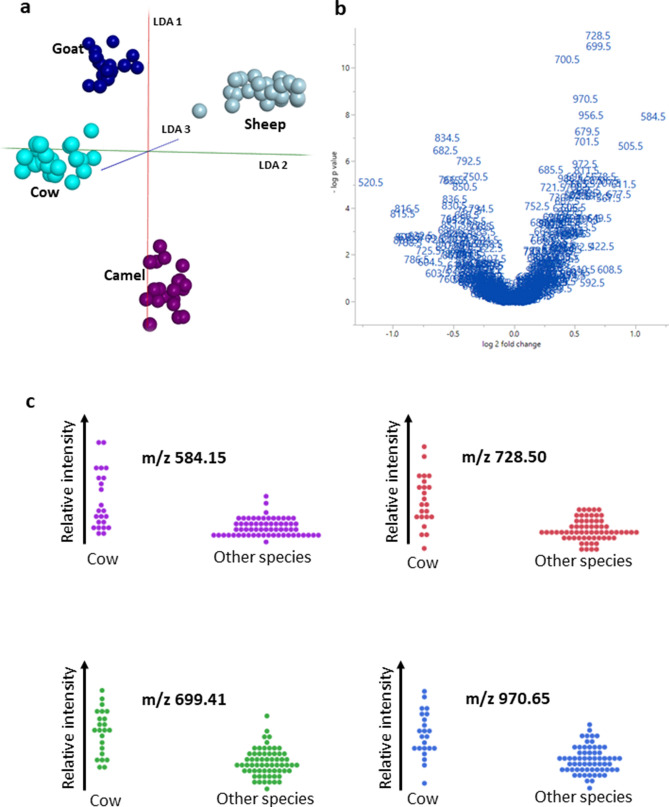
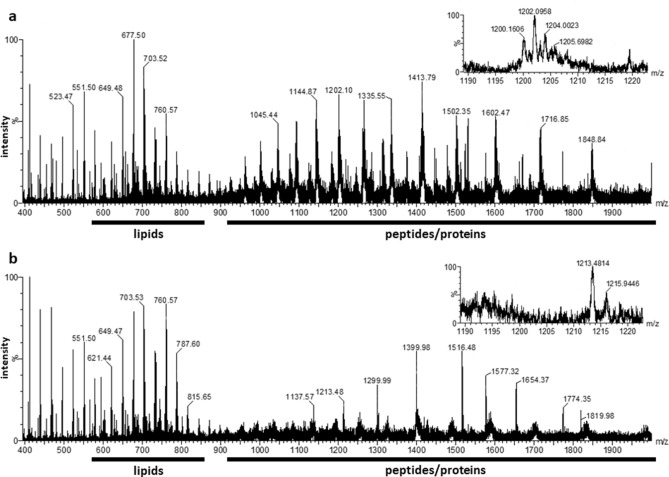
Growing interest in food quality and traceability by regulators as well as consumers demands advances in more rapid, versatile and cost-effective analytical methods. Milk, as most food matrices, is a heterogeneous mixture composed of metabolites, lipids and proteins. One of the major challenges is to have simultaneous, quantitative detection (profiling) of this panel of biomolecules to gather valuable information for assessing food quality, traceability and safety. Here, for milk analysis, atmospheric pressure matrix-assisted laser desorption/ionization employing homogenous liquid sample droplets was used on a Q-TOF mass analyzer. This method has the capability to produce multiply charged proteinaceous ions as well as highly informative profiles of singly charged lipids/metabolites. In two examples, this method is coupled with user-friendly machine-learning software. First, rapid speciation of milk (cow, goat, sheep and camel) is demonstrated with 100% classification accuracy. Second, the detection of cow milk as adulterant in goat milk is shown at concentrations as low as 5% with 92.5% sensitivity and 94.5% specificity.
监管机构和消费者对食品质量和可追溯性的兴趣日益浓厚,这就要求开发更快速、多功能和具有成本效益的分析方法。牛奶作为大多数食品基质,是一种由代谢物、脂质和蛋白质组成的不均匀混合物。其中一个主要挑战是能够同时对这组生物分子进行定量检测(分析),以收集有价值的信息,用于评估食品质量、可追溯性和安全性。在这里,我们在 Q-TOF 质谱仪上使用均匀液体样品液滴的常压基质辅助激光解吸/电离方法来分析牛奶。该方法能够产生多电荷蛋白离子,以及单电荷脂质/代谢物的高信息量图谱。在两个实例中,该方法与用户友好的机器学习软件相结合。首先,以 100%的分类准确率快速鉴定牛奶(牛、山羊、绵羊和骆驼)的种类。其次,以 92.5%的灵敏度和 94.5%的特异性,在低至 5%的山羊奶掺假牛奶的浓度下,该方法也能被检测到。