Jung Susanne, Bosch Agnes, Kolwelter Julie, Striepe Kristina, Kannenkeril Dennis, Schuster Tizia, Ott Christian, Achenbach Stephan, Schmieder Roland E
Department of Nephrology and Hypertension, University Hospital Erlangen, Friedrich-Alexander-University, Ulmenweg 18, Erlangen-Nuremberg, 91054, Germany.
Department of Cardiology and Angiology, University Hospital Erlangen, Friedrich-Alexander-University, Erlangen-Nuremberg, Germany.
ESC Heart Fail. 2021 Apr;8(2):1562-1570. doi: 10.1002/ehf2.13257. Epub 2021 Feb 9.
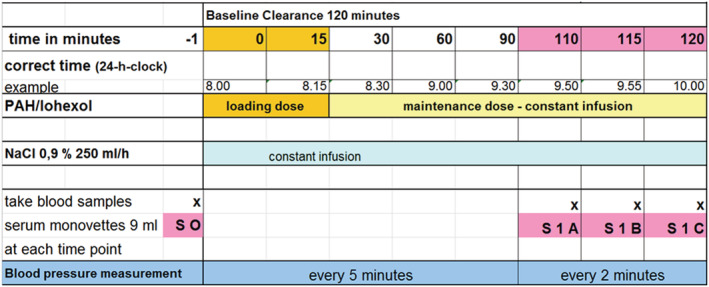
Congestive heart failure (CHF) and impaired renal function are two often co-existing medical conditions and associated with adverse cardiovascular outcome. The aim of the current study was to assess renal and intraglomerular haemodynamics by constant infusion input clearance technique in subjects with CHF.
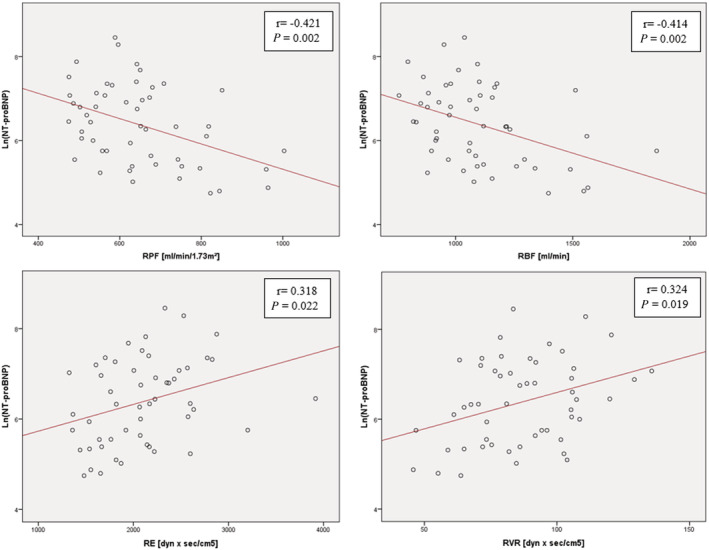
The group of subjects with CHF consisted of 27 individuals with HFpEF and 27 individuals with HFrEF and were compared with 31 healthy controls. Subjects underwent renal clearance examination to measure glomerular filtration rate (GFR) and renal blood and plasma flow (RBF and RPF) and to calculate intraglomerular haemodynamics such as resistances of the afferent (R ) and efferent arterioles (R ) as well as intraglomerular pressure (P ). Measured GFR was lower in CHF subjects (68.1 ± 10.1 mL/min/1.73 m ) compared with controls (83.6 ± 13.4 mL/min/1.73 m , P < 0.001) as was P (P < 0.001). Total renal vascular resistance (RVR) was higher in CHF subjects (87.3 ± 20.1 vs. 73.8 ± 17.1 dyn × s/cm , P < 0.001) mediated by an increased resistance at the afferent site (3201 ± 1084 vs. 2181 ± 796 dyn × s/cm , P < 0.001). Comparing HFpEF and HFrEF subjects, R was higher in HFrEF subjects. The severity of CHF assessed by NT-proBNP revealed an inverse association with renal perfusion (RPF r = -0.421, P = 0.002, RBF r = -0.414, P = 0.002) and a positive relation with RVR (r = 0.346, P = 0.012) at the post-glomerular site (R : r = 0.318, P = 0.022).
Renal function assessed by measured GFR is reduced and renal vascular resistance at the preglomerular, afferent site is increased in HFpEF and, to greater extent, in HFrEF. Our data indicate a close cardiorenal interaction in CHF.
充血性心力衰竭(CHF)和肾功能受损是两种常并存的病症,且与不良心血管结局相关。本研究的目的是通过持续输注输入清除技术评估CHF患者的肾和肾小球内血流动力学。
CHF患者组由27例射血分数保留的心力衰竭(HFpEF)患者和27例射血分数降低的心力衰竭(HFrEF)患者组成,并与31名健康对照者进行比较。受试者接受肾脏清除检查以测量肾小球滤过率(GFR)、肾血流量和血浆流量(RBF和RPF),并计算肾小球内血流动力学指标,如入球小动脉(R )和出球小动脉(R )的阻力以及肾小球内压力(P )。与对照组(83.6±13.4 mL/min/1.73 m ,P <0.001)相比,CHF患者的测量GFR较低(68.1±10.1 mL/min/1.73 m ),P 也较低(P <0.001)。CHF患者的总肾血管阻力(RVR)较高(87.3±20.1对73.8±17.1 dyn×s/cm ,P <0.001),这是由入球部位阻力增加介导的(3201±1084对2181±796 dyn×s/cm ,P <0.001)。比较HFpEF和HFrEF患者,HFrEF患者的R 较高。通过NT-proBNP评估的CHF严重程度显示与肾灌注呈负相关(RPF r=-0.421,P=0.002,RBF r=-0.414,P=0.002),与肾小球后部位的RVR呈正相关(r=0.346,P=0.012)(R :r=0.318,P=0.022)。
通过测量GFR评估的肾功能降低,在HFpEF患者中肾小球前入球部位的肾血管阻力增加,在HFrEF患者中增加程度更大。我们的数据表明CHF中存在密切的心肾相互作用。