Plath Michaela, Marienfeld Theresa, Sand Matthias, van de Weyer Philipp S, Praetorius Mark, Plinkert Peter K, Baumann Ingo, Zaoui Karim
Department of Otorhinolaryngology, Head and Neck Surgery, University Hospital Heidelberg, Ruprecht-Karls-University, Im Neuenheimer Feld 400, 69120, Heidelberg, Germany.
GESIS-Leibniz-Institute for the Social Sciences, Mannheim, Germany.
Eur Arch Otorhinolaryngol. 2022 Jan;279(1):115-125. doi: 10.1007/s00405-021-06631-w. Epub 2021 Feb 9.
Assessing cochlear implant (CI)-associated patient outcomes is a focus of implant research. Most studies have analyzed outcomes retrospectively with low patient numbers and few measurement time points. In addition, standardized CI-specific health-related quality of life (HRQoL) instruments have not been used. To address this, we prospectively assessed HRQoL in patients before and after implantation.
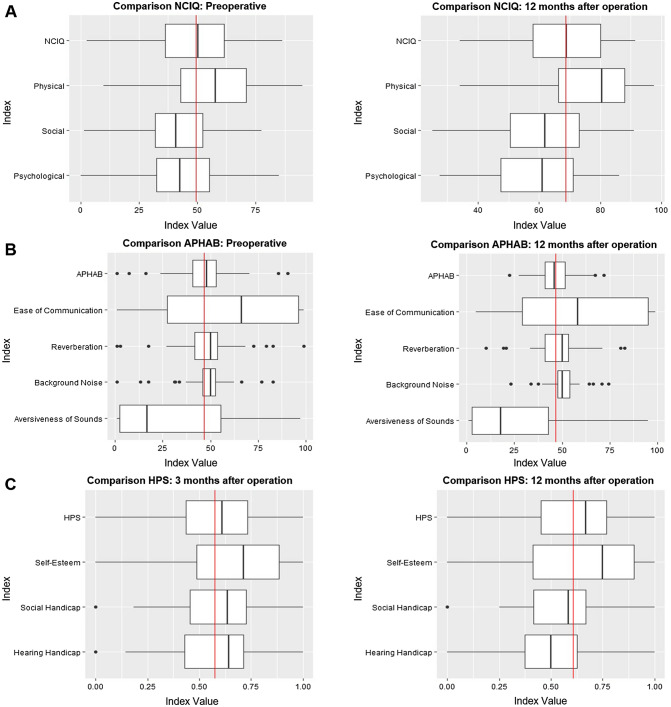
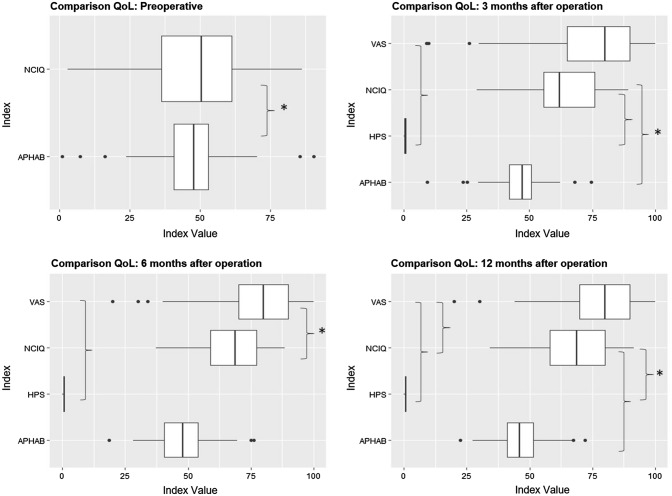
We assessed HRQoL using the Nijmegen Cochlear Implant Questionnaire (NCIQ), Abbreviated Profile of Hearing Aid Benefit (APHAB), Hearing Participation Scale (HPS), and the Visual Analogue Scale (VAS) in 100 deaf or severely hearing-impaired patients (57 unilaterally deaf and 43 bilaterally deaf) before and 3, 6, and 12 months after cochlear implantation. We compared the results of unilaterally and bilaterally hearing-impaired patients and patients with or without a hearing aid. Principal component (PCA) and exploratory factor analyses (EFA) were also conducted.
The NCIQ measured improvements in all 6 domains after CI and correlated well with other QoL instruments. The PCA revealed that the NCIQ can be better explained by physical, physical advanced, and socio-psychological components. The APHAB score ameliorated over time, except for the background noise domain. The overall HPS score improved over time, but the hearing handicap subscore significantly decreased. Sociodemographic influences on the questionnaire scores were relatively weak.
Assessing HRQoL is essential for quantifying the patient outcome after CI. NCIQ scores in our patient cohort showed improved HRQoL in all domains and we recommend that the NCIQ be used as a first-line questionnaire for assessing QoL in hearing-impaired patients after CI.
评估人工耳蜗(CI)相关的患者预后是植入研究的重点。大多数研究对预后进行回顾性分析,样本量小且测量时间点少。此外,尚未使用标准化的CI特定健康相关生活质量(HRQoL)工具。为解决这一问题,我们对患者植入前后的HRQoL进行了前瞻性评估。
我们使用奈梅亨人工耳蜗问卷(NCIQ)、助听器益处简明量表(APHAB)、听力参与量表(HPS)和视觉模拟量表(VAS)对100名聋人或重度听力障碍患者(57名单侧聋人和43名双侧聋人)在人工耳蜗植入前以及植入后3、6和12个月进行了HRQoL评估。我们比较了单侧和双侧听力障碍患者以及佩戴或未佩戴助听器患者的结果。还进行了主成分分析(PCA)和探索性因素分析(EFA)。
NCIQ测量显示CI后所有6个领域均有改善,且与其他生活质量工具相关性良好。PCA显示,NCIQ可以通过身体、身体进阶和社会心理成分得到更好的解释。除背景噪声领域外,APHAB评分随时间改善。HPS总分随时间提高,但听力障碍子评分显著降低。社会人口统计学对问卷评分的影响相对较弱。
评估HRQoL对于量化CI后的患者预后至关重要。我们患者队列中的NCIQ评分显示所有领域的HRQoL均有改善,我们建议将NCIQ用作评估CI后听力障碍患者生活质量的一线问卷。