Vial Jean Philippe, Lechevalier Nicolas, Lacombe Francis, Dumas Pierre-Yves, Bidet Audrey, Leguay Thibaut, Vergez François, Pigneux Arnaud, Béné Marie C
Hematology Biology, Flow Cytometry, Bordeaux University Hospital, 33600 Pessac, France.
Service d'Hématologie Clinique et de Thérapie Cellulaire, Bordeaux University Hospital, 33600 Pessac, France.
Cancers (Basel). 2021 Feb 5;13(4):629. doi: 10.3390/cancers13040629.
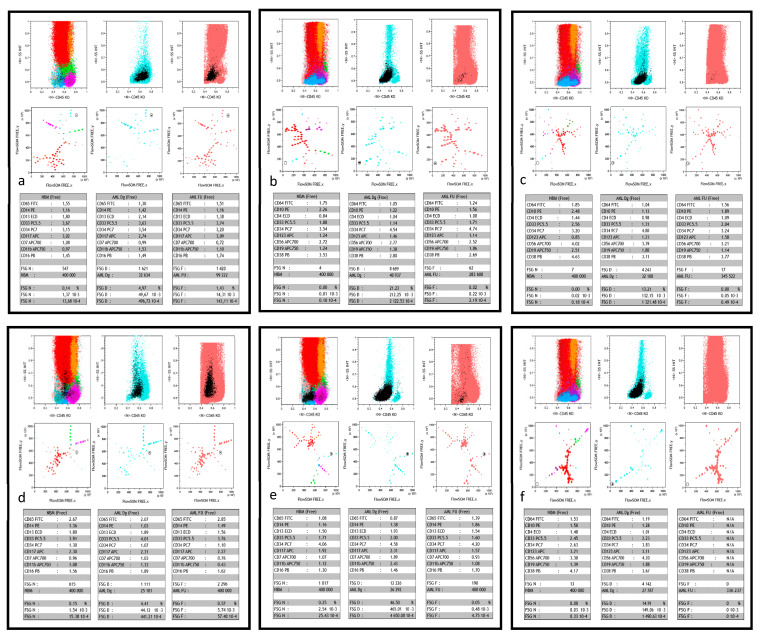
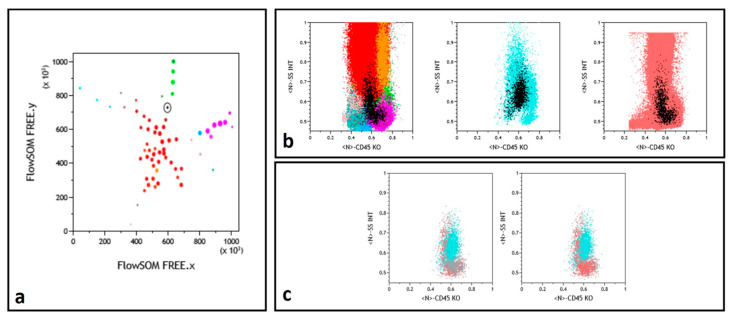
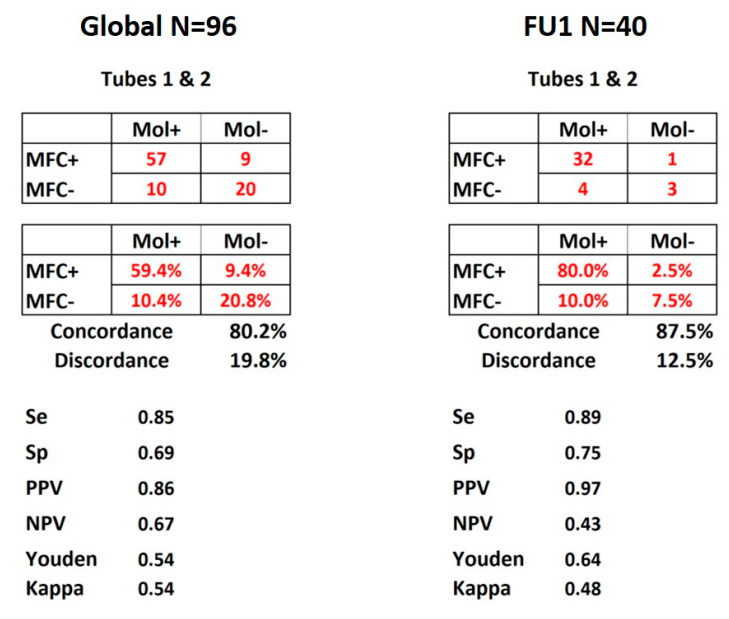
The assessment of minimal residual disease (MRD) is increasingly considered to monitor response to therapy in hematological malignancies. In acute myeloblastic leukemia (AML), molecular MRD (mMRD) is possible for about half the patients while multiparameter flow cytometry (MFC) is more broadly available. However, MFC analysis strategies are highly operator-dependent. Recently, new tools have been designed for unsupervised MFC analysis, segregating cell-clusters with the same immunophenotypic characteristics. Here, the Flow-Self-Organizing-Maps (FlowSOM) tool was applied to assess MFC-MRD in 96 bone marrow (BM) follow-up (FU) time-points from 40 AML patients with available mMRD. A reference FlowSOM display was built from 19 healthy/normal BM samples (NBM), then simultaneously compared to the patient's diagnosis and FU samples at each time-point. MRD clusters were characterized individually in terms of cell numbers and immunophenotype. This strategy disclosed subclones with varying immunophenotype within single diagnosis and FU samples including populations absent from NBM. Detectable MRD was as low as 0.09% in MFC and 0.051% for mMRD. The concordance between mMRD and MFC-MRD was 80.2%. MFC yielded 85% specificity and 69% sensitivity compared to mMRD. Unsupervised MFC is shown here to allow for an easy and robust assessment of MRD, applicable also to AML patients without molecular markers.
微小残留病(MRD)评估越来越被认为是监测血液系统恶性肿瘤治疗反应的手段。在急性髓细胞白血病(AML)中,约半数患者可行分子MRD(mMRD)检测,而多参数流式细胞术(MFC)应用更为广泛。然而,MFC分析策略高度依赖操作人员。最近,已设计出用于无监督MFC分析的新工具,可分离具有相同免疫表型特征的细胞簇。在此,将流式自组织映射(FlowSOM)工具应用于评估40例有可用mMRD的AML患者96个骨髓(BM)随访(FU)时间点的MFC-MRD。从19份健康/正常BM样本(NBM)构建参考FlowSOM显示,然后在每个时间点与患者的诊断样本和FU样本同时进行比较。根据细胞数量和免疫表型对MRD簇进行个体特征分析。该策略揭示了在单一诊断样本和FU样本中具有不同免疫表型的亚克隆,包括NBM中不存在的细胞群体。MFC中可检测到的MRD低至0.09%,mMRD为0.051%。mMRD与MFC-MRD的一致性为80.2%。与mMRD相比,MFC的特异性为85%,敏感性为69%。本文显示,无监督MFC可轻松、可靠地评估MRD,也适用于无分子标志物的AML患者。