Guedes-Alonso Rayco, Sosa-Ferrera Zoraida, Santana-Rodríguez José J, Kabir Abuzar, Furton Kenneth G
Instituto Universitario de Estudios Ambientales y Recursos Naturales (i-UNAT), Universidad de Las Palmas de Gran Canaria, 35017 Las Palmas de Gran Canaria, Spain.
Department of Chemistry and Biochemistry, International Forensic Research Institute, Florida International University, Miami, FL 33199, USA.
Foods. 2021 Feb 5;10(2):343. doi: 10.3390/foods10020343.
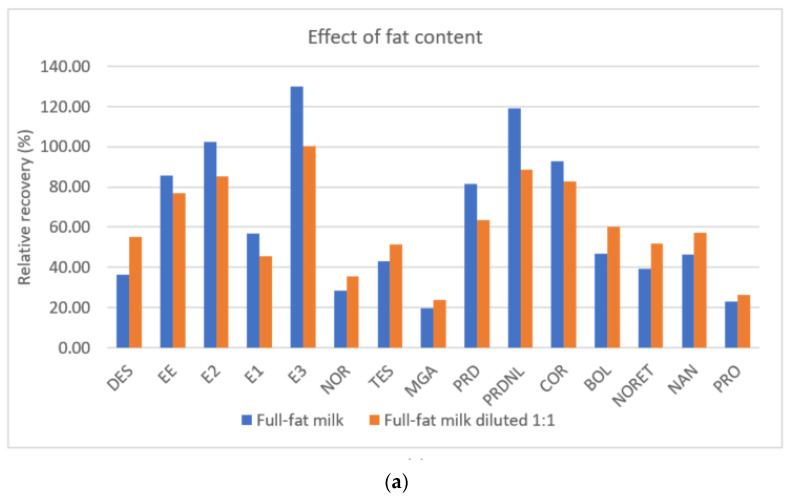
Hormones in edible matrices, such as milk, are a subject of concern because of their adverse effects on the endocrine system and cell signaling and the consequent disruption of homeostasis in human consumers. Therefore, the assessment of the presence of hormones in milk as potential endocrine-disrupting compounds is warranted. However, the complexity of milk as a sample matrix and the ultra-low concentration of hormones pose significant analytical challenges. Fabric phase sorptive extraction (FPSE) has emerged as a powerful analytical technique for the extraction of emerging pollutants from complex aqueous matrices. FPSE allows for substantially simplified sample handling and short extraction and desorption times, as well as the decreased use of organic solvents. It is considered a green alternative to traditional extraction methodologies. In this work, the FPSE technique was evaluated to perform the simultaneous extraction of 15 steroid hormones from raw milk without employing any sample pretreatment steps. Clean and preconcentrated hormone solutions obtained from FPSE of raw milk were analyzed using ultra-high-performance liquid chromatography-tandem mass spectrometry to achieve low detection limits, which ranged from 0.047 to 1.242 ng·mL. Because of the presence of many interferents in milk, such as proteins, lipids, and sugar, the effect of fat content on the extraction procedure was also thoroughly studied. Additionally, for the first time, the effect of lactose on the extraction of steroid hormones was evaluated, and the results showed that the extraction efficiencies were enhanced in lactose-free samples. Finally, the optimized methodology was applied to commercial samples of cow and goat milk, and no measurable concentrations of the studied hormones were detected in these samples.
可食用基质中的激素,如牛奶中的激素,因其对内分泌系统和细胞信号传导的不利影响以及随之而来的人类消费者体内稳态的破坏而备受关注。因此,有必要评估牛奶中作为潜在内分泌干扰化合物的激素的存在情况。然而,牛奶作为样品基质的复杂性以及激素的超低浓度带来了重大的分析挑战。织物相吸附萃取(FPSE)已成为一种从复杂水性基质中萃取新兴污染物的强大分析技术。FPSE能够显著简化样品处理过程,缩短萃取和解吸时间,同时减少有机溶剂的使用。它被认为是传统萃取方法的绿色替代方案。在这项工作中,对FPSE技术进行了评估,以在不采用任何样品预处理步骤的情况下从生牛奶中同时萃取15种甾体激素。使用超高效液相色谱-串联质谱对从生牛奶的FPSE中获得的纯净且预浓缩的激素溶液进行分析,以实现低检测限,检测限范围为0.047至1.242 ng·mL。由于牛奶中存在许多干扰物,如蛋白质、脂质和糖,因此还深入研究了脂肪含量对萃取过程的影响。此外,首次评估了乳糖对甾体激素萃取的影响,结果表明在无乳糖样品中萃取效率有所提高。最后,将优化后的方法应用于牛奶和羊奶的商业样品,在这些样品中未检测到可测量浓度的所研究激素。