Department of Anesthesia and Intensive Care, St. Luke's International Hospital, 9-1 Akashicho, Chuo-ku, Tokyo, 104-8560, Japan.
Department of Emergency and Critical Care Medicine, St. Luke's International Hospital, Tokyo, Japan.
BMC Infect Dis. 2021 Feb 9;21(1):163. doi: 10.1186/s12879-021-05840-2.
Many studies have been published about critically ill coronavirus disease 2019 (COVID-19) during the early phases of the pandemic but the characteristic or survival of critically ill Japanese patients have not yet been investigated. We sought to investigate the characteristics, inflammatory laboratory finding trends, and outcomes among critically ill Japanese patients who were admitted to the intensive care unit (ICU) with the first wave of COVID-19.
A retrospective observational study was performed in a single institution in the center of Tokyo. Laboratory-confirmed COVID-19 patients admitted to the ICU from March 19 to April 30, 2020 were included. Trends for significant inflammatory laboratory findings were analyzed. In-hospital death, days of mechanical ventilation or oxygen supplementation, days of ICU or hospital stay were followed until May 26, 2020.
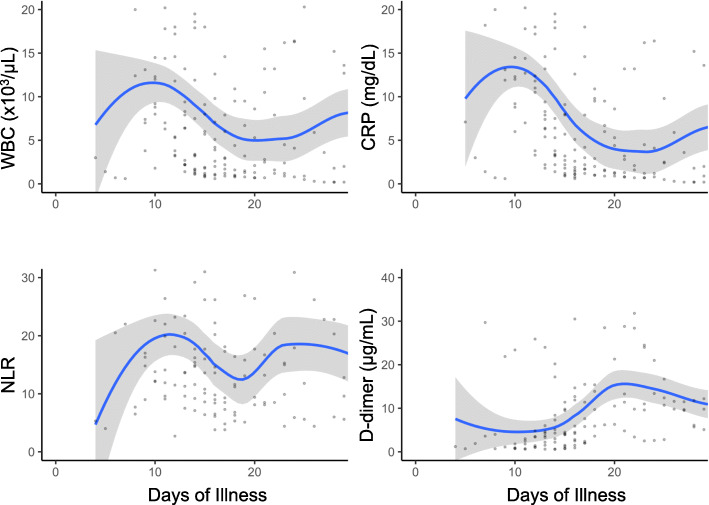
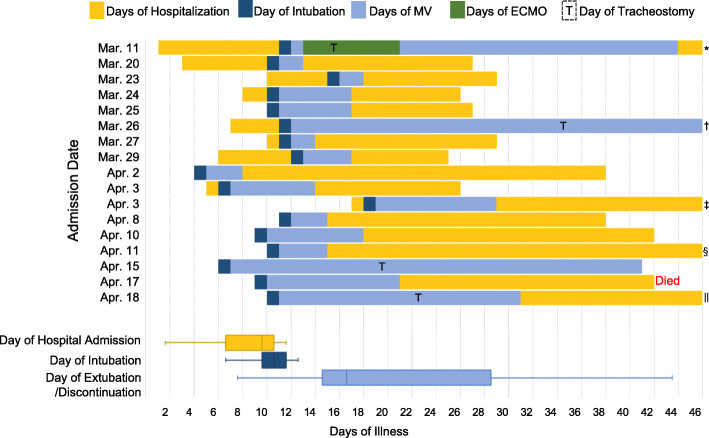
Twenty-four patients were included. Median age was 57.5 years, and 79% were male. The neutrophil-to-lymphocyte ratio was elevated to a median of 10.1 on admission and peaked on Day 10 of illness. Seventeen patients were intubated on Day 11 of illness and received mechanical ventilation. One patient underwent extracorporeal membrane oxygenation. The majority (88%) received systemic steroids, including 16 patients who received high dose methylprednisolone (500-1000 mg). Favipiravir was used in 38% of patients. Two patients, including 1 who refused intensive care, died. Eighteen patients were discharged. Median length of ICU and hospital stay for all patients was 6 and 22 days, respectively. Median length of ventilator dependency was 7 days. Four patients underwent a tracheostomy and received prolonged ventilation for more than 21 days. One patient receiving mechanical ventilation died. All survivors discontinued ventilator use.
Mortality was remarkably low in our single institutional study. Three survivors received mechanical ventilation for more than 3 weeks. Trends of clinically significant laboratory markers reflected the clinical course of COVID-19.
许多研究已经发表了关于在大流行早期的重症 2019 年冠状病毒病(COVID-19),但重症日本患者的特征或生存情况尚未得到调查。我们试图调查在 COVID-19 第一波期间入住重症监护病房(ICU)的重症日本患者的特征、炎症实验室发现趋势和结局。
在东京市中心的一家单机构进行了回顾性观察研究。纳入 2020 年 3 月 19 日至 4 月 30 日入住 ICU 的实验室确诊 COVID-19 患者。分析了显著炎症实验室发现的趋势。截至 2020 年 5 月 26 日,记录院内死亡、机械通气或氧疗天数、ICU 或住院天数。
共纳入 24 例患者。中位年龄为 57.5 岁,79%为男性。入院时中性粒细胞与淋巴细胞比值升高至中位数 10.1,发病第 10 天达到峰值。17 例患者于发病第 11 天气管插管并接受机械通气。1 例患者接受体外膜氧合。大多数(88%)患者接受全身类固醇治疗,包括 16 例患者接受高剂量甲泼尼龙(500-1000mg)。38%的患者使用了法匹拉韦。2 例患者死亡,其中 1 例拒绝重症监护。18 例患者出院。所有患者的 ICU 和住院中位时间分别为 6 天和 22 天。机械通气依赖的中位时间为 7 天。4 例患者接受了气管切开术并接受了超过 21 天的长时间通气。1 例接受机械通气的患者死亡。所有幸存者均停止使用呼吸机。
在我们的单机构研究中,死亡率显著较低。3 例幸存者接受机械通气超过 3 周。临床显著实验室标志物的趋势反映了 COVID-19 的临床过程。