Alebel Mekonnen, Mekonnen Feleke, Mulu Wondemagegn
Department of Clinical Laboratory Science, Chagni Hospital, Chagni, Ethiopia.
Department of Medical Laboratory Science, College of Medicine and Health Sciences, Bahir Dar University, Bahir Dar, Ethiopia.
Infect Drug Resist. 2021 Feb 2;14:391-405. doi: 10.2147/IDR.S292246. eCollection 2021.
Owing to the specific risk profile of its residents, intensive care units (ICUs) are the best place for selection pressure and the epicenter for resistance development and dissemination. Infections with β-lactamase releasing Gram-negative bacilli (GNB) at ICUs are an emerging global threat. This study dogged the magnitude of extended-spectrum β-lactamase (ESBL) and carbapenemase releasing Gram-negative bacilli infections and associated factors among patients in the ICUs of Felegehiwot Referral Hospital, Ethiopia.
A cross-sectional study was done through February to June 2020. Wound swabs, urine, blood and sputum samples were collected from patients in the ICUs symptomatic for infections while excluding those under coma and shock. Bacterial species were verified using standard microbiological methods. Carbapenemase and ESBL production were identified using modified carbapenem inactivation and combined disk diffusion methods, respectively. Multivariable analysis was calculated for factors associated with ESBL production. P-value < 0.05 was taken as cut-off for statistical significance.
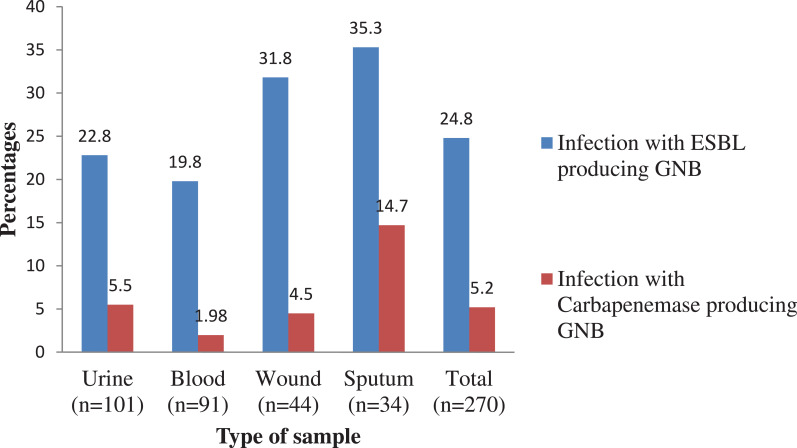
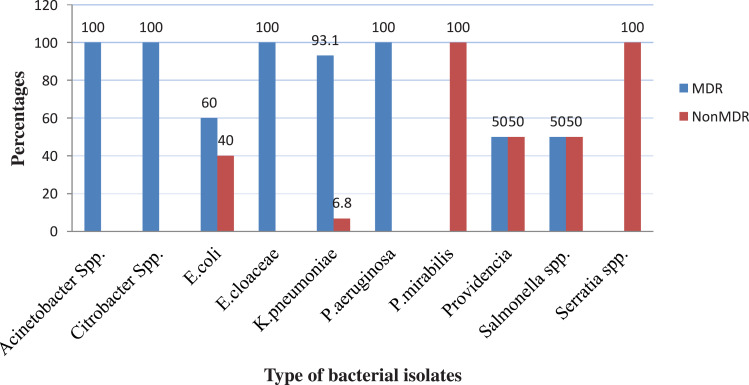
Out of 270 patients in the ICU, 67 (24.8%) and 14 (5.2%) had infections with ESBL and carbapenemase releasing GNB, respectively. The most frequent ESBL producing isolates were (100%), (100%), (82.8%) and (64%). The predominant carbapenemase producer isolates were (27.6%) and (33.3%). Overall, 77 (81.1%) of species were multi-drug resistant. All GNB species were 100% resistant to tetracycline and ampicillin. They are also resistant to cefuroxime, ceftazidime, sulfamethoxazole-trimethoprim and cefotaxime. Prior hospitalization (AOR = 5.5, CI = 2.63-11.46), support with medical care devices (AOR = 23.7, CI = 4.6-12) and arterial intravenous catheterization (AOR = 2.7, CI = 1.3-5.3) had significant association with β-lactamase producing GNB infection.
Infection with ESBL and carbapenemase producing Gram-negative bacilli linked with an alarming degree of multi-drug resistant isolates is a major healthcare threat among patients in ICUs. Hence, strict adherence to infection prevention practices and wise use of antibiotics are recommended to slow the spread of antimicrobial resistance.
由于重症监护病房(ICU)患者具有特定的风险特征,该病房是产生选择压力的最佳场所,也是耐药性产生和传播的中心。ICU中由产β-内酰胺酶的革兰氏阴性杆菌(GNB)引起的感染是一种新出现的全球威胁。本研究追踪了埃塞俄比亚费莱格希沃特转诊医院ICU患者中产超广谱β-内酰胺酶(ESBL)和产碳青霉烯酶的革兰氏阴性杆菌感染的严重程度及相关因素。
于2020年2月至6月进行了一项横断面研究。从ICU中有感染症状的患者身上采集伤口拭子、尿液、血液和痰液样本,排除昏迷和休克患者。使用标准微生物学方法鉴定细菌种类。分别采用改良碳青霉烯灭活法和复合纸片扩散法鉴定碳青霉烯酶和ESBL的产生情况。对与ESBL产生相关的因素进行多变量分析。以P值<0.05作为具有统计学意义的临界值。
在ICU的270例患者中,分别有67例(24.8%)和14例(5.2%)感染了产ESBL和产碳青霉烯酶的GNB。最常见的产ESBL菌株为大肠埃希菌(100%)、肺炎克雷伯菌(100%)、阴沟肠杆菌(82.8%)和产气肠杆菌(64%)。主要的产碳青霉烯酶菌株为鲍曼不动杆菌(27.6%)和铜绿假单胞菌(33.3%)。总体而言,77种(81.1%)菌株对多种药物耐药。所有GNB菌株对四环素和氨苄西林的耐药率均为100%。它们对头孢呋辛、头孢他啶、复方磺胺甲恶唑和头孢噻肟也耐药。既往住院史(调整后比值比[AOR]=5.5,可信区间[CI]=2.63 - 11.46)、使用医疗护理设备(AOR = 23.7,CI = 4.6 - 12)和动静脉置管(AOR = 2.7,CI = 1.3 - 5.3)与产β-内酰胺酶的GNB感染显著相关。
产ESBL和产碳青霉烯酶的革兰氏阴性杆菌感染以及与之相关的令人担忧的多重耐药菌株程度,是ICU患者面临的主要医疗威胁。因此,建议严格遵守感染预防措施并合理使用抗生素,以减缓抗菌药物耐药性的传播。