Kohyama Jun
Tokyo Bay Urayasu Ichikawa Medical Centre, Sleep medicine - Urayasu - Chiba - Japan.
Sleep Sci. 2020 Oct-Dec;13(4):286-292. doi: 10.5935/1984-0063.20190151.
To assess associations of adolescents' lifestyle habits with their daytime functioning in Japan.
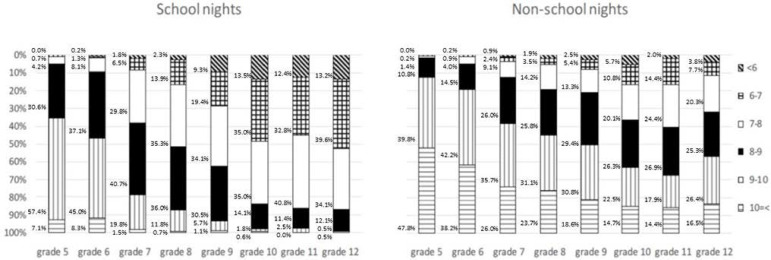
A total of 2,722 questionnaires obtained from pupils in grades 5 to 12 in Japan were assessed by the multiple comparison test to determine significant differences in the lifestyle habits among the self-reported academic performance categories (AP1: very good; AP2: good; AP3: not good; AP4: poor).
The average non-school-day screen time of AP4 pupils was significantly longer than that of AP1 pupils in elementary and junior high schools. In junior and senior high schools, AP4 pupils showed more sleepiness and higher occurrence of breakfast skipping than AP2 pupils. In all school types, sleep duration showed no significant differences among the self-reported academic performance categories.
Avoiding sleepiness, breakfast skipping, and heavy media usage is expected to ensure adolescents' daytime functioning. Although not studied here, napping might improve adolescents' daytime functioning.
评估日本青少年的生活习惯与其日间功能之间的关联。
通过多重比较检验对从日本5至12年级学生那里获得的总共2722份问卷进行评估,以确定自我报告的学业成绩类别(AP1:非常好;AP2:好;AP3:不好;AP4:差)之间生活习惯的显著差异。
在小学和初中,AP4学生的非上学日屏幕使用时间平均显著长于AP1学生。在初中和高中,AP4学生比AP2学生表现出更多困倦,且不吃早餐的情况更频繁。在所有学校类型中,自我报告的学业成绩类别之间的睡眠时间没有显著差异。
避免困倦、不吃早餐和大量使用媒体有望确保青少年的日间功能。尽管此处未作研究,但午睡可能会改善青少年的日间功能。