Uil Melissa, Hau Chi M, Ahdi Mohamed, Mills James D, Kers Jesper, Saleem Moin A, Florquin Sandrine, Gerdes Victor E A, Nieuwland Rienk, Roelofs Joris J T H
Department of Pathology, Amsterdam Infection & Immunity Institute, Amsterdam Cardiovascular Sciences, Amsterdam UMC, University of Amsterdam, Amsterdam, The Netherlands.
Laboratory of Experimental Clinical Chemistry, Amsterdam UMC, University of Amsterdam, Amsterdam, The Netherlands.
Clin Kidney J. 2019 Oct 23;14(1):358-365. doi: 10.1093/ckj/sfz145. eCollection 2021 Jan.
Diabetic nephropathy (DN) is a major complication of diabetes and the main cause of end-stage renal disease. Extracellular vesicles (EVs) are small cell-derived vesicles that can alter disease progression by microRNA (miRNA) transfer.
In this study, we aimed to characterize the cellular origin and miRNA content of EVs in plasma samples of type 2 diabetes patients at various stages of DN. Type 2 diabetes patients were classified in three groups: normoalbuminuria, microalbuminuria and macroalbuminuria. The concentration and cellular origin of plasma EVs were measured by flow cytometry. A total of 752 EV miRNAs were profiled in 18 subjects and differentially expressed miRNAs were validated.
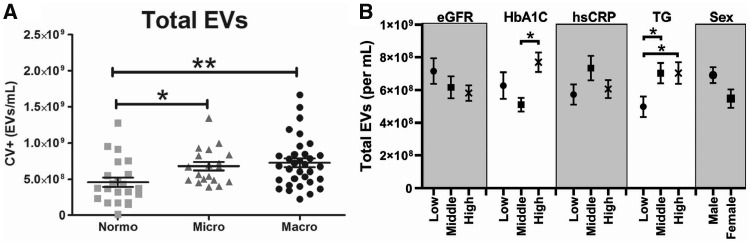
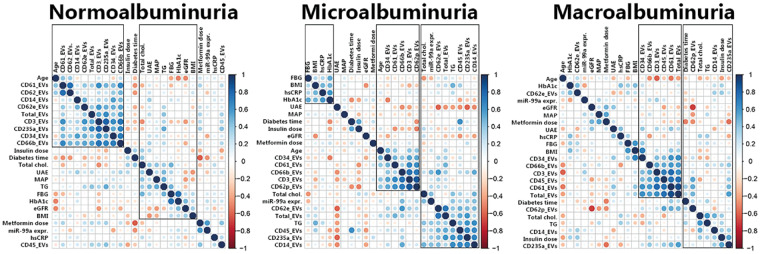
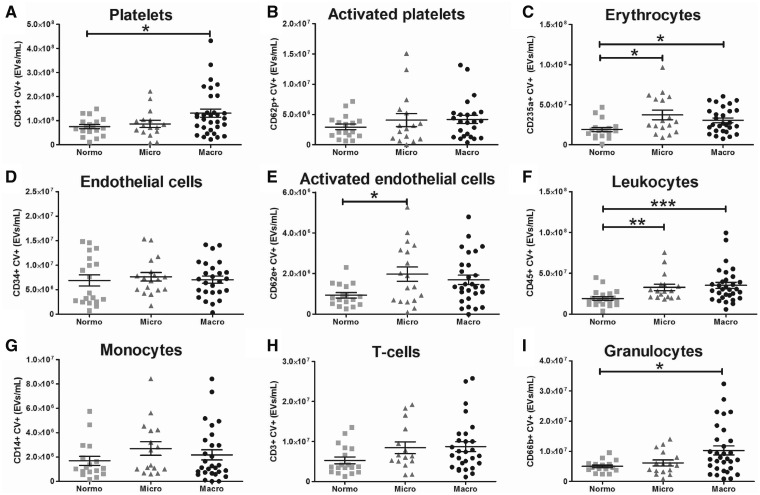
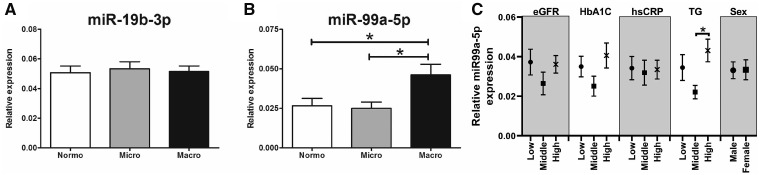
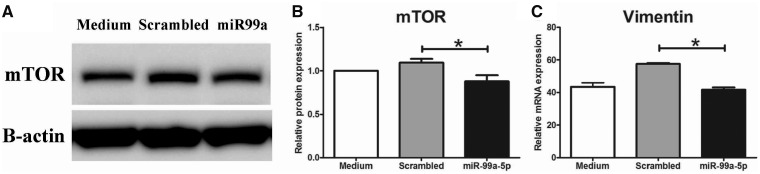
Diabetic patients with microalbuminuria and/or macroalbuminuria showed elevated concentrations of total EVs and EVs from endothelial cells, platelets, leucocytes and erythrocytes compared with diabetic controls. miR-99a-5p was upregulated in macroalbuminuric patients compared with normoalbuminuric and microalbuminuric patients. Transfection of miR-99a-5p in cultured human podocytes downregulated mammalian target of rapamycin (mTOR) protein expression and downregulated the podocyte injury marker vimentin.
Type 2 diabetes patients with microalbuminuria and macroalbuminuria display differential EV profiles. miR-99a-5p expression is elevated in EVs from macroalbuminuria and mTOR is its validated mRNA target.
糖尿病肾病(DN)是糖尿病的主要并发症,也是终末期肾病的主要病因。细胞外囊泡(EVs)是源自细胞的小囊泡,可通过微小RNA(miRNA)传递改变疾病进展。
在本研究中,我们旨在表征2型糖尿病患者在DN不同阶段血浆样本中EVs的细胞来源和miRNA含量。2型糖尿病患者分为三组:正常白蛋白尿组、微量白蛋白尿组和大量白蛋白尿组。通过流式细胞术测量血浆EVs的浓度和细胞来源。对18名受试者的总共752种EV miRNA进行了分析,并对差异表达的miRNA进行了验证。
与糖尿病对照组相比,微量白蛋白尿和/或大量白蛋白尿的糖尿病患者显示总EVs以及来自内皮细胞、血小板、白细胞和红细胞的EVs浓度升高。与正常白蛋白尿和微量白蛋白尿患者相比,大量白蛋白尿患者中miR-99a-5p上调。在培养的人足细胞中转染miR-99a-5p可下调雷帕霉素哺乳动物靶点(mTOR)蛋白表达,并下调足细胞损伤标志物波形蛋白。
微量白蛋白尿和大量白蛋白尿的2型糖尿病患者表现出不同的EV谱。大量白蛋白尿患者的EVs中miR-99a-5p表达升高,mTOR是其经验证的mRNA靶点。