Moon Su Young, Chung Ho Seok, Lee Jae Hyuck, Park So Young, Lee Hun, Kim Jae Young, Tchah Hungwon
Department of Ophthalmology, Asan Medical Center, University of Ulsan College of Medicine, Seoul 05505, Republic of Korea.
Department of Ophthalmology, Dankook University Hospital, Dankook University College of Medicine, Cheonan 31116, Republic of Korea.
J Ophthalmol. 2021 Jan 29;2021:2860840. doi: 10.1155/2021/2860840. eCollection 2021.
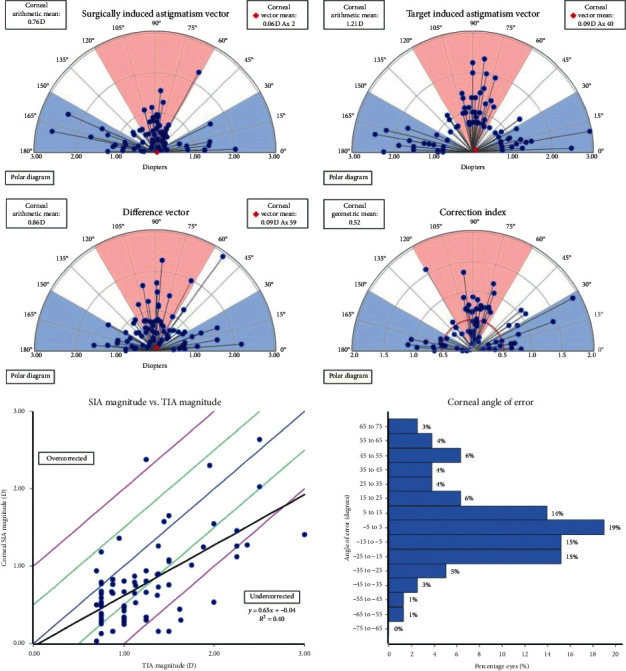
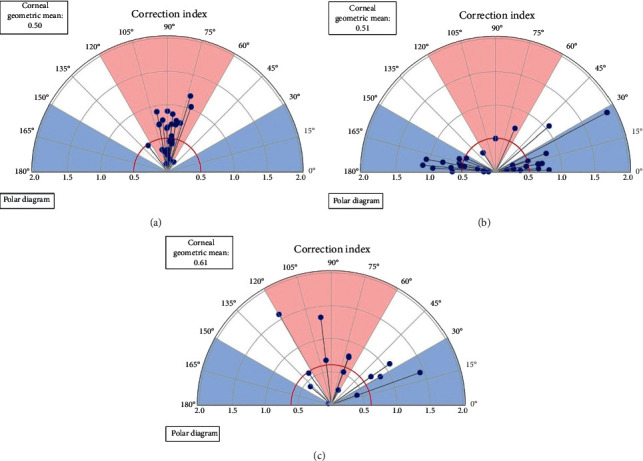
The aim of this study was to evaluate astigmatic correction in patients with mild to moderate astigmatism after combined femtosecond laser-assisted cataract surgery (FLACS) and intrastromal arcuate keratotomy (ISAK), using vector analysis. This retrospective study included patients with corneal astigmatism of 0.5-3.0 diopters (D) who underwent FLACS and ISAK. Vector analyses of astigmatism were performed using the Alpins method, considering three vectors: target-induced astigmatism (TIA), surgically induced astigmatism (SIA), and difference vector (DV). Magnitude of error (ME), angle of error (AE), correction index (CI), and coefficient of adjustment (CA) were calculated. Subgroup analysis according to the axis of astigmatism, patient age, and white to white (WTW) diameter was conducted. In total, for the 79 eyes of 79 patients, the TIA was 1.21 ± 0.52 , the SIA was 0.76 ± 0.53 D, and the DV was 0.86 ± 0.50 D. The ME (difference between SIA and TIA) was -0.46 ± 0.45 D, and the CI (ratio of SIA and TIA) was 0.62 ± 0.34; both these parameters demonstrated slight undercorrection. The CA (inverse of the CI) was 2.48 ± 2.61. The AE was 4.02° ± 28.7°, and the absolute AE was 21.7° ± 19.0°. In the univariate regression analyses to identify factors that affected the CI, there was a negative correlation between age and the CI (=0.022). In conclusion, vector analysis after the combined FLACS and ISAK revealed slight undercorrection, regardless of the astigmatism meridian. The precision of the nomogram should be improved through long-term vector analysis for the results of arcuate keratotomy and through further research on the relationship between patient demographics and CI. Overall, this study has shown that FLACS and ISAK could reduce postoperative corneal astigmatism effectively and safely.
本研究的目的是使用矢量分析评估飞秒激光辅助白内障手术(FLACS)联合基质内弧形角膜切开术(ISAK)后轻至中度散光患者的散光矫正情况。这项回顾性研究纳入了接受FLACS和ISAK的角膜散光为0.5-3.0屈光度(D)的患者。使用Alpins方法进行散光的矢量分析,考虑三个矢量:目标诱导散光(TIA)、手术诱导散光(SIA)和差异矢量(DV)。计算误差幅度(ME)、误差角度(AE)、矫正指数(CI)和调整系数(CA)。根据散光轴、患者年龄和白对白(WTW)直径进行亚组分析。总共,对于79例患者的79只眼,TIA为1.21±0.52,SIA为0.76±0.53 D,DV为0.86±0.50 D。ME(SIA与TIA之间的差异)为-0.46±0.45 D,CI(SIA与TIA的比值)为0.62±0.34;这两个参数均显示轻度矫正不足。CA(CI的倒数)为2.48±2.61。AE为4.02°±28.7°,绝对AE为21.7°±19.0°。在单因素回归分析中确定影响CI的因素时,年龄与CI之间存在负相关(=0.022)。总之,FLACS联合ISAK后的矢量分析显示,无论散光子午线如何,均存在轻度矫正不足。应通过对弧形角膜切开术结果进行长期矢量分析以及对患者人口统计学与CI之间的关系进行进一步研究来提高列线图的精度。总体而言,本研究表明FLACS和ISAK可以有效且安全地降低术后角膜散光。