Am J Epidemiol. 2021 Jul 1;190(7):1406-1413. doi: 10.1093/aje/kwab025.
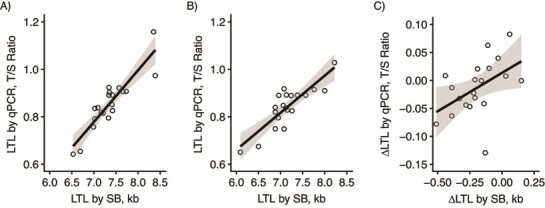
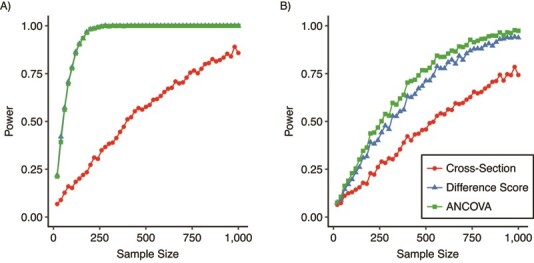
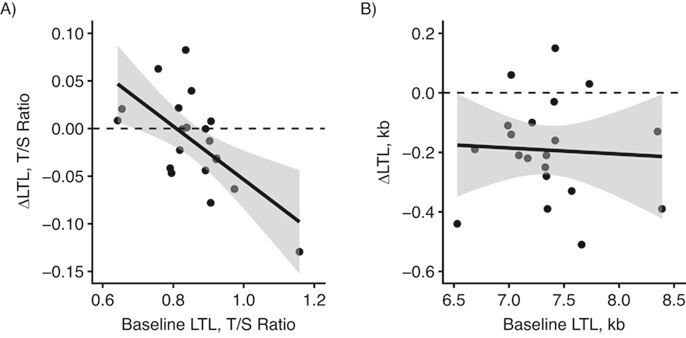
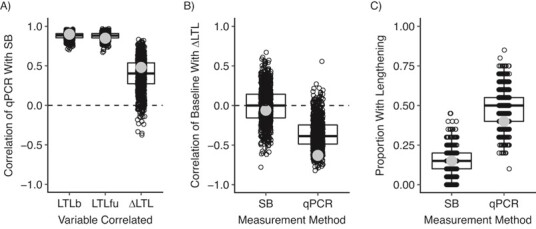
Researchers increasingly wish to test hypotheses concerning the impact of environmental or disease exposures on telomere length (TL), and they use longitudinal study designs to do so. In population studies, TL is usually measured with a quantitative polymerase chain reaction (qPCR)-based method. This method has been validated by calculating its correlation with a gold standard method such as Southern blotting (SB) in cross-sectional data sets. However, in a cross-section, the range of true variation in TL is large, and measurement error is introduced only once. In a longitudinal study, the target variation of interest is small, and measurement error is introduced at both baseline and follow-up. In this paper, we present results from a small data set (n = 20) in which leukocyte TL was measured twice 6.6 years apart by means of both qPCR and SB. The cross-sectional correlations between qPCR and SB were high at both baseline (r = 0.90) and follow-up (r = 0.85), yet their correlation for TL change was poor (r = 0.48). Moreover, the qPCR data but not the SB data showed strong signatures of measurement error. Through simulation, we show that the statistical power gain from performing a longitudinal analysis is much greater for SB than for qPCR. We discuss implications for optimal study design and analysis.
研究人员越来越希望检验关于环境或疾病暴露对端粒长度 (TL) 影响的假设,为此他们使用纵向研究设计。在人群研究中,TL 通常通过基于定量聚合酶链反应 (qPCR) 的方法进行测量。该方法已通过在横断面数据集上计算其与金标准方法(如 Southern 印迹法 (SB))的相关性进行验证。然而,在横截面上,TL 的真实变异范围较大,且仅引入一次测量误差。在纵向研究中,目标感兴趣的变异较小,且在基线和随访时都引入了测量误差。在本文中,我们展示了一个小数据集(n=20)的结果,该数据集通过 qPCR 和 SB 分别在相隔 6.6 年的时间内两次测量白细胞 TL。qPCR 和 SB 在基线(r=0.90)和随访时(r=0.85)的横断面相关性均较高,但 TL 变化的相关性较差(r=0.48)。此外,qPCR 数据而非 SB 数据显示出强烈的测量误差特征。通过模拟,我们表明,与 qPCR 相比,进行纵向分析可获得更大的统计功效增益。我们讨论了最佳研究设计和分析的影响。