Department of Cell and Molecular Biology, Manipal School of Life Sciences, Manipal Academy of Higher Education, Manipal, Karnataka, 576104, India.
Department of Obstetrics & Gynaecology, Kasturba Medical College, Manipal Academy of Higher Education, Manipal, Karnataka, 576104, India.
Cell Biol Toxicol. 2021 Oct;37(5):731-749. doi: 10.1007/s10565-021-09582-4. Epub 2021 Feb 10.
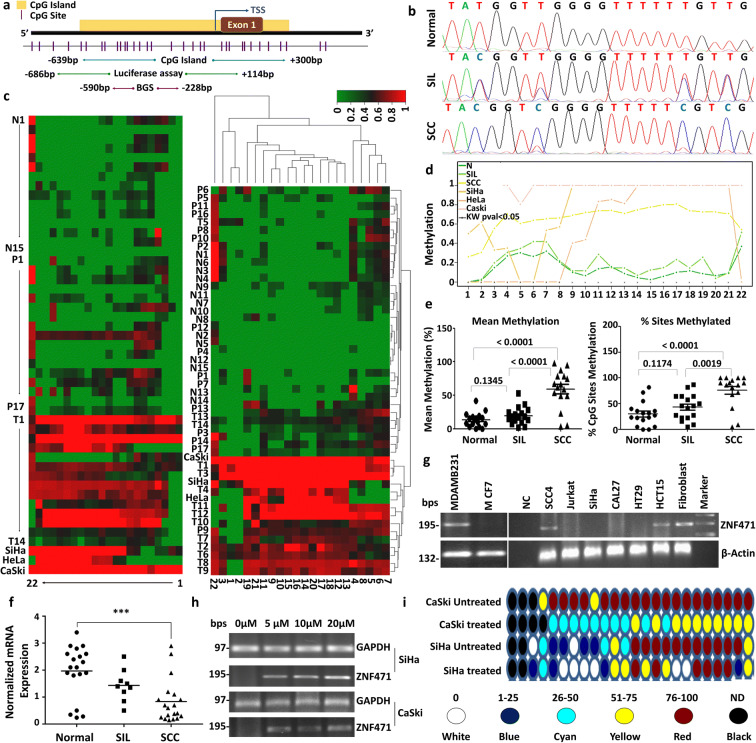
Cervical cancer (CC) is a leading cause of cancer-related death among women in developing countries. However, the underlying mechanisms and molecular targets for therapy remain to be fully understood. We investigated the epigenetic regulation, biological functions, and clinical utility of zinc-finger protein 471 (ZNF471) in CC. Analysis of cervical tissues and five independent public datasets of CC showed significant hypermethylation of the ZNF471 gene promoter. In CC cell lines, promoter DNA methylation was inversely correlated with ZNF471 expression. The sensitivity and specificity of the ZNF471 hypermethylation for squamous intraepithelial lesion (SIL) vs tumor and normal vs tumor was above 85% with AUC of 0.937. High methylation and low ZNF471 expression predicted poor overall and recurrence-free survival. We identified -686 to +114 bp as ZNF471 promoter, regulated by methylation using transient transfection and luciferase assays. The promoter CpG site methylation of ZNF471 was significantly different among cancer types and tumor grades. Gal4-based heterologous luciferase reporter gene assays revealed that ZNF471 acts as a transcriptional repressor. The retroviral mediated overexpression of ZNF471 in SiHa and CaSki cells inhibited growth, proliferation, cell migration, invasion; delayed cell cycle progression in vitro by increasing cell doubling time; and reduced tumor growth in vivo in nude mice. ZNF471 overexpression inhibited key members of epithelial-mesenchymal transition (EMT), Wnt, and PI3K-AKT signaling pathways. ZNF471 inhibited EMT by directly targeting vimentin as analyzed by bioinformatic analysis, ChIP-PCR, and western blotting. Thus, ZNF471 CpG specific promoter methylation may determine the prognosis of CC and could function as a potential tumor suppressor by targeting EMT signaling.
宫颈癌(CC)是发展中国家女性癌症相关死亡的主要原因。然而,治疗的潜在机制和分子靶点仍有待充分理解。我们研究了锌指蛋白 471(ZNF471)在 CC 中的表观遗传调控、生物学功能和临床应用。对宫颈组织和 5 个独立的 CC 公共数据集的分析显示,ZNF471 基因启动子的超甲基化显著。在 CC 细胞系中,启动子 DNA 甲基化与 ZNF471 表达呈负相关。ZNF471 高甲基化对鳞状上皮内病变(SIL)与肿瘤、正常与肿瘤的敏感性和特异性均高于 85%,AUC 为 0.937。高甲基化和低 ZNF471 表达预测总生存期和无复发生存期不良。我们确定了-686 到+114 bp 作为 ZNF471 启动子,使用瞬时转染和荧光素酶测定法对其进行甲基化调节。ZNF471 启动子 CpG 位点的甲基化在不同的癌症类型和肿瘤分级之间存在显著差异。Gal4 异源荧光素酶报告基因检测显示,ZNF471 作为转录抑制因子。在 SiHa 和 CaSki 细胞中转录病毒介导的 ZNF471 过表达抑制体外生长、增殖、细胞迁移、侵袭;通过增加细胞倍增时间,延迟细胞周期进程;并减少裸鼠体内肿瘤生长。ZNF471 过表达抑制 EMT、Wnt 和 PI3K-AKT 信号通路的关键成员。ZNF471 通过生物信息学分析、ChIP-PCR 和 Western blot 分析直接靶向波形蛋白抑制 EMT。因此,ZNF471 CpG 特异性启动子甲基化可能决定 CC 的预后,并通过靶向 EMT 信号发挥潜在的肿瘤抑制作用。