Department of Emergency Medicine, Soonchunhyang University Cheonan Hospital, Cheonan, Republic of Korea.
Department of Emergency Medicine, Hanyang University Hospital, Seoul, Republic of Korea.
PLoS One. 2021 Feb 10;16(2):e0246898. doi: 10.1371/journal.pone.0246898. eCollection 2021.
Neuron-specific enolase (NSE) is frequently used to predict neurological outcomes in patients with hypoxic brain injury. Hanging can cause hypoxic brain damage, and survivors can suffer from neurological deficits that may impair daily activities. Here, we investigated the utility of the initial serum NSE level as a predictor of neurological outcomes in near-hanging patients with decreased consciousness.
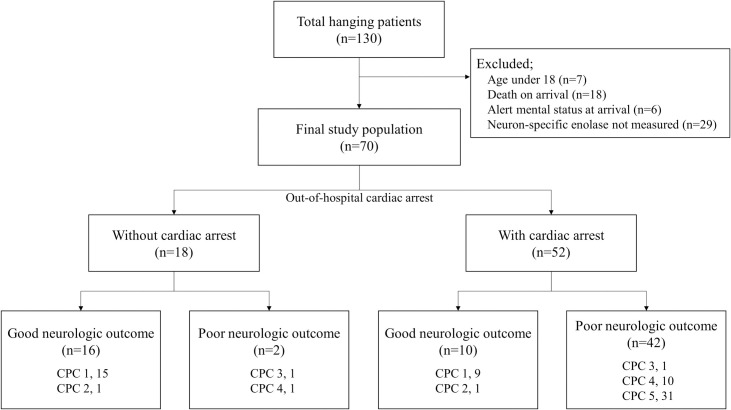
This retrospective multicenter study was conducted in patients who visited the emergency department due to near-hanging injury from October 2013 to February 2019 at three university hospitals in Korea. They were divided into two groups according to the presence of out-of-hospital cardiac arrest. The neurological outcome was determined using the Cerebral Performance Category (CPC) measured at the time of discharge. Multivariate analysis was performed to determine whether initial serum NSE is an independent predictor of neurological outcome.
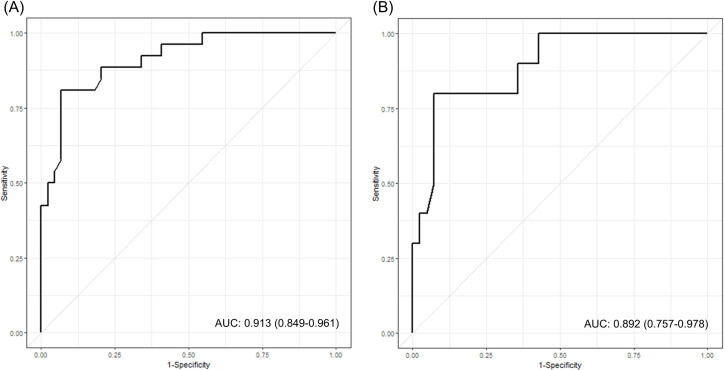
Of the 70 patients included in the study, 44 showed a poor neurological outcome (CPC score = 3-5). Among the 52 patients with cardiac arrest, only 10 (19.2%) were discharged with good neurological outcome (CPC score = 1-2). In the whole cohort, a high serum NSE level was a significant predictor of poor neurological outcome (odds ratio [OR], 1.343; 95% confidence interval [CI], 1.003-1.800, p = 0.048). Among the patients with cardiac arrest, a high serum NSE level was a significant predictor of poor neurological outcome (OR, 1.138; 95% CI, 1.009-1.284, p = 0.036).
In near-hanging patients, a high initial serum NSE level is an independent predictor of poor neurological outcome.
神经元特异性烯醇化酶(NSE)常用于预测缺氧性脑损伤患者的神经预后。上吊可导致缺氧性脑损伤,幸存者可能会出现神经功能缺损,从而影响日常活动。在此,我们研究了初始血清 NSE 水平作为预测意识下降的近上吊患者神经预后的指标的作用。
本回顾性多中心研究纳入了 2013 年 10 月至 2019 年 2 月期间,韩国三所大学医院因近上吊损伤就诊的患者。根据是否存在院外心脏骤停,将患者分为两组。出院时使用脑功能预后分类(Cerebral Performance Category,CPC)评估神经结局。进行多变量分析以确定初始血清 NSE 是否为神经结局的独立预测因子。
本研究共纳入 70 例患者,其中 44 例患者的神经预后不良(CPC 评分=3-5)。在 52 例发生心脏骤停的患者中,仅有 10 例(19.2%)出院时神经预后良好(CPC 评分=1-2)。在整个队列中,高血清 NSE 水平是神经预后不良的显著预测因子(优势比 [OR],1.343;95%置信区间 [CI],1.003-1.800,p=0.048)。在发生心脏骤停的患者中,高血清 NSE 水平是神经预后不良的显著预测因子(OR,1.138;95% CI,1.009-1.284,p=0.036)。
在近上吊患者中,初始血清 NSE 水平升高是神经预后不良的独立预测因子。