Department of Internal Medicine, Kalmar, Region of Kalmar County, Kalmar, Sweden.
Department of Biomedical and Clinical Sciences, Linköping University, Linköping, Sweden.
J Clin Endocrinol Metab. 2021 May 13;106(6):1750-1760. doi: 10.1210/clinem/dgab079.
Psychiatric symptoms are common in Cushing's disease (CD) and seem only partly reversible following treatment.
To investigate drug dispenses associated to psychiatric morbidity in CD patients before treatment and during long-term follow-up.
Nationwide longitudinal register-based study.
University Hospitals in Sweden.
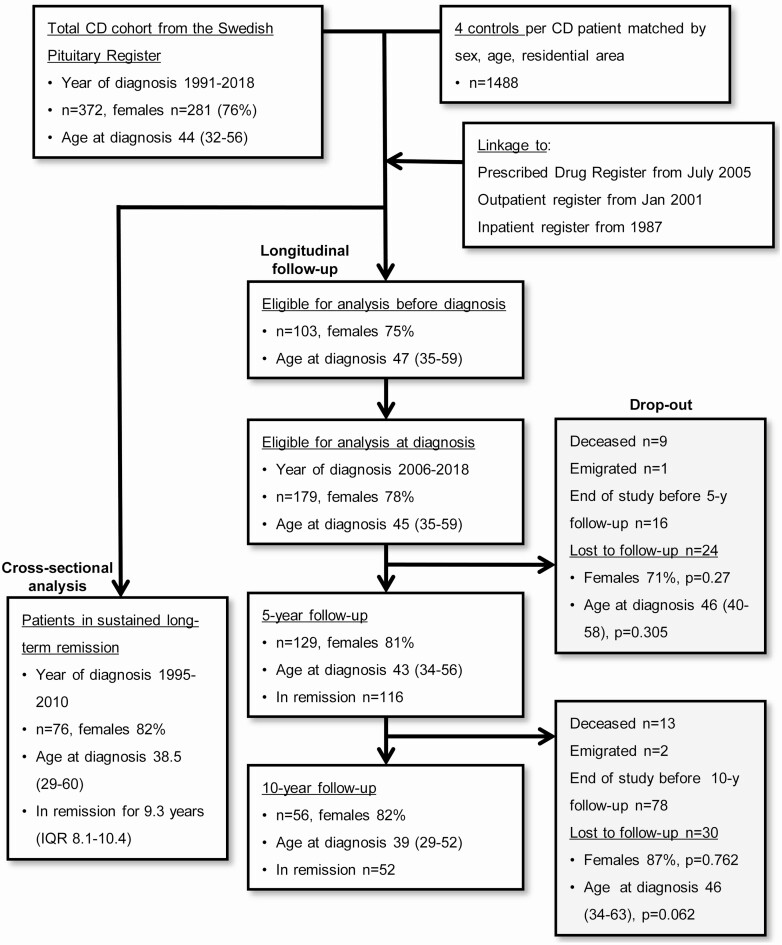
CD patients diagnosed between 1990 and 2018 (N = 372) were identified in the Swedish Pituitary Register. Longitudinal data was collected from 5 years before, at diagnosis, and during follow-up. Four matched controls per patient were included. Cross-sectional subgroup analysis of 76 patients in sustained remission was also performed.
Data from the Swedish Prescribed Drug Register and the Patient Register.
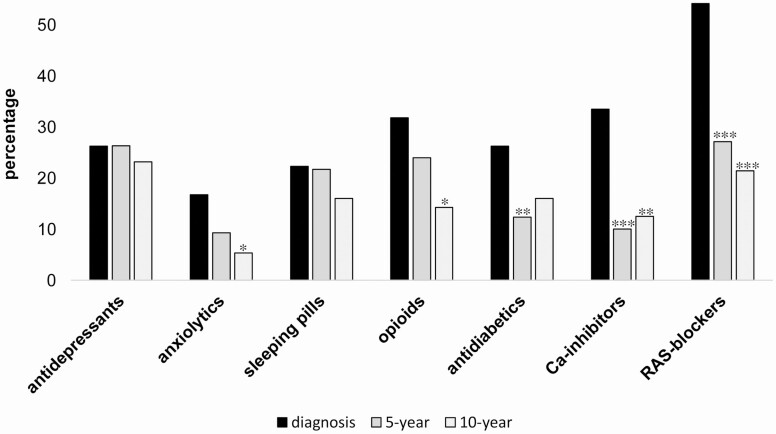
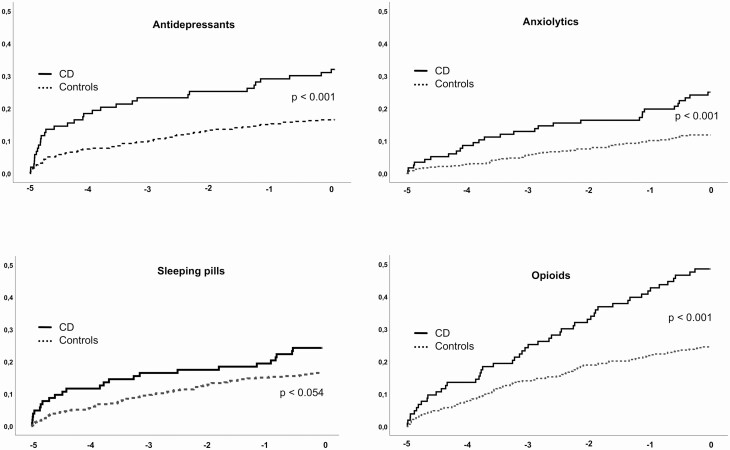
In the 5-year period before and at diagnosis, use of antidepressants (odds ratio [OR] 2.2 [95% confidence interval (CI) 1.3-3.7]) and 2.3 [1.6-3.5]), anxiolytics [2.9 (1.6-5.3) and 3.9 (2.3-6.6)], and sleeping pills [2.1 (1.2-3.7) and 3.8 (2.4-5.9)] was more common in CD than controls. ORs remained elevated at 5-year follow-up for antidepressants [2.4 (1.5-3.9)] and sleeping pills [3.1 (1.9-5.3)]. Proportions of CD patients using antidepressants (26%) and sleeping pills (22%) were unchanged at diagnosis and 5-year follow-up, whereas drugs for hypertension and diabetes decreased. Patients in sustained remission for median 9.3 years (interquartile range 8.1-10.4) had higher use of antidepressants [OR 2.0 (1.1-3.8)] and sleeping pills [2.4 (1.3-4.7)], but not of drugs for hypertension.
Increased use of psychotropic drugs in CD was observed before diagnosis and remained elevated regardless of remission status, suggesting persisting negative effects on mental health. The study highlights the importance of early diagnosis of CD, and the need for long-term monitoring of mental health.
在库欣病(CD)中,精神症状很常见,且似乎仅部分可在治疗后逆转。
研究 CD 患者在治疗前和长期随访期间与精神疾病相关的药物配给情况。
全国性纵向基于登记的研究。
瑞典大学医院。
于 1990 年至 2018 年期间在瑞典垂体登记处确诊为 CD 的患者(n=372)。从 5 年前、诊断时和随访期间收集纵向数据。为每位患者纳入 4 名匹配对照。还对 76 例持续缓解的患者进行了横断面亚组分析。
来自瑞典处方药物登记处和患者登记处的数据。
在诊断前的 5 年期间和诊断时,CD 患者使用抗抑郁药(比值比[OR]2.2[95%置信区间(CI)1.3-3.7])和 2.3[1.6-3.5])、抗焦虑药(2.9[1.6-5.3]和 3.9[2.3-6.6])和安眠药(2.1[1.2-3.7]和 3.8[2.4-5.9])的频率更高。在 5 年随访时,抗抑郁药(OR 2.4[1.5-3.9])和安眠药(OR 3.1[1.9-5.3])的 OR 仍升高。在诊断时和 5 年随访时,CD 患者使用抗抑郁药(26%)和安眠药(22%)的比例未发生变化,而高血压和糖尿病药物的使用则减少。中位随访时间为 9.3 年(四分位间距 8.1-10.4)的持续缓解患者,使用抗抑郁药(OR 2.0[1.1-3.8])和安眠药(OR 2.4[1.3-4.7])的频率更高,但使用高血压药物的频率不高。
在诊断前观察到 CD 患者使用精神药物的频率增加,且无论缓解状态如何,该频率仍居高不下,这表明精神健康仍持续受到负面影响。该研究强调了早期诊断 CD 的重要性,以及需要长期监测心理健康的必要性。