Department of Rural Health, The University of Newcastle, Taree, NSW, Australia.
Monash Rural Health, Warragul, Vic., Australia.
Aust J Rural Health. 2021 Feb;29(1):21-33. doi: 10.1111/ajr.12689. Epub 2021 Feb 10.
Linking enrolment and professional placement data for students' from 2 universities, this study compares characteristics across universities and health disciplines. The study explores associations between students' location of origin and frequency, duration and type of placements.
Retrospective cohort data linkage.
Two Australian universities, Monash University and the University of Newcastle.
Students who completed medical radiation science, nursing, occupational therapy, pharmacy or physiotherapy at either university between 2 February 2017 and 28 February 2018.
Location of origin, university and discipline of enrolment.
MAIN OUTCOME MEASURE(S): Main measures were whether graduates had multiple rural placements, number of rural placements and cumulative rural placement days. Location of origin, discipline and university of enrolment were the main explanatory variables. Secondary dependent variables were age, sex, socio-economic indices for location of origin, and available placements.
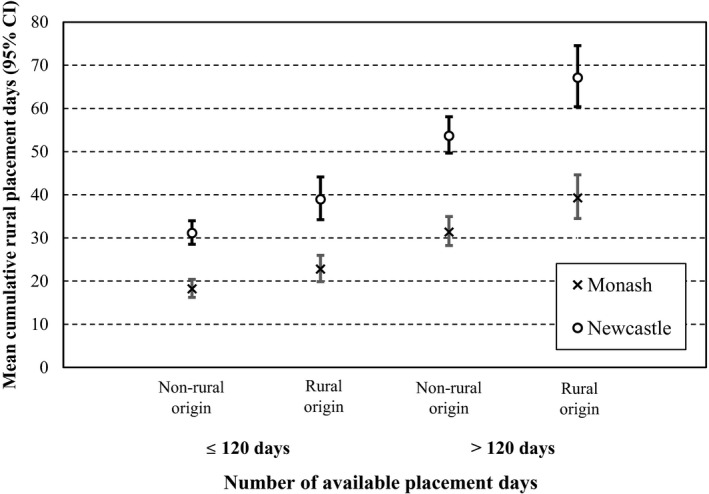
A total of 1,315 students were included, of which 22.1% were of rural origin. The odds of rural origin students undertaking a rural placement was more than 4.5 times greater than for urban origin students. A higher proportion of rural origin students had multiple rural placement (56.0% vs 14.9%), with a higher mean number of rural placement days. Public hospitals were the most common placement type, with fewer in primary care, mental health or aged care.
There is a positive association between rural origin and rural placements in nursing and allied health. To help strengthen recruitment and retention of graduates this association could be further exploited, while being inclusive of non-rural students.
通过链接两所大学学生的入学和专业安置数据,本研究比较了大学和卫生学科之间的特征。该研究探讨了学生原籍地和所在地之间的位置、频率、持续时间和安置类型之间的关联。
回顾性队列数据链接。
澳大利亚的两所大学,莫纳什大学和纽卡斯尔大学。
2017 年 2 月 2 日至 2018 年 2 月 28 日期间在这两所大学完成医学放射科学、护理、职业治疗、药学或物理治疗专业学习的学生。
原籍地、大学和入学专业。
主要衡量标准是毕业生是否有多次农村安置、农村安置次数和农村安置天数的累积。原籍地、专业和入学大学是主要的解释变量。次要因变量是年龄、性别、原籍地的社会经济指数以及可用的安置机会。
共纳入 1315 名学生,其中 22.1%来自农村。农村出身的学生从事农村安置的可能性是城市出身学生的 4.5 倍以上。农村出身的学生有更多的多次农村安置(56.0%比 14.9%),且农村安置天数的平均值更高。公立医院是最常见的安置类型,在初级保健、心理健康或老年护理方面则较少。
在护理和相关健康领域,农村出身与农村安置之间存在正相关关系。为了帮助加强毕业生的招聘和留用,可以进一步利用这种关联,同时包容非农村学生。