González Maldonado Sandra, Johnson Theron, Motsch Erna, Delorme Stefan, Kaaks Rudolf
Division of Cancer Epidemiology (C020), German Cancer Research Center (DKFZ), Im Neuenheimer Feld 581, 69120 Heidelberg, Germany.
Translational Lung Research Center Heidelberg (TLRC-H), Member of the German Center for Lung Research, Heidelberg, Germany.
Transl Lung Cancer Res. 2021 Jan;10(1):233-242. doi: 10.21037/tlcr-20-727.
Tumor-associated autoantibodies are considered promising markers for early lung cancer detection; so far, however, their capacity to detect cancer has been tested mostly in a clinical context, but not in population screening settings. This study evaluates the early detection accuracy, in terms of sensitivity and specificity, of EarlyCDT-Lung-a test panel of seven tumor-associated autoantibodies optimized for lung cancer detection-using blood samples originally collected as part of the German Lung Cancer Screening Intervention Trial.
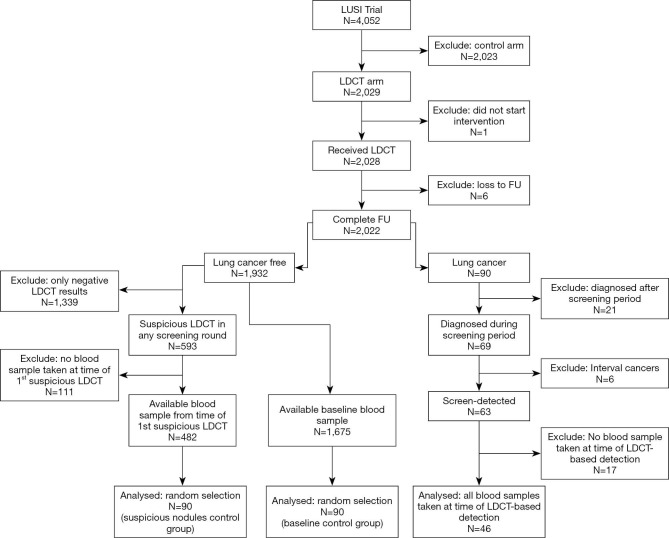
The EarlyCDT-Lung test was performed for all participants with lung cancer detected via low-dose computed tomography and with available blood samples taken at detection, and for 180 retrospectively selected cancer-free participants at the end of follow-up: 90 randomly selected from among all cancer-free participants (baseline controls) and 90 randomly selected from among cancer-free participants with suspicious imaging findings (suspicious nodules controls). Sensitivity and specificity of lung cancer detection were estimated in the case group and the two control groups, respectively.
In the case group, the test panel showed a sensitivity of only 13.0% (95% CI: 4.9-26.3%). Specificity was estimated at 88.9% (95% CI: 80.5-94.5%) in the baseline control group, and 91.1% (95% CI: 83.2-96.1%) among controls presenting CT-detected nodules.
The test panel showed insufficient sensitivity for detecting lung cancer at an equally early stage as with low-dose computed tomography screening.
肿瘤相关自身抗体被认为是早期肺癌检测的有前景的标志物;然而,到目前为止,它们检测癌症的能力大多在临床环境中进行了测试,而未在人群筛查环境中进行测试。本研究使用最初作为德国肺癌筛查干预试验一部分收集的血样,评估了EarlyCDT-Lung(一种针对肺癌检测优化的七种肿瘤相关自身抗体的检测组合)在早期检测准确性方面的灵敏度和特异性。
对所有通过低剂量计算机断层扫描检测出肺癌且在检测时采集了可用血样的参与者,以及在随访结束时回顾性选择的180名无癌参与者进行EarlyCDT-Lung检测:90名从所有无癌参与者中随机选择(基线对照组),90名从有可疑影像学表现的无癌参与者中随机选择(可疑结节对照组)。分别在病例组和两个对照组中估计肺癌检测的灵敏度和特异性。
在病例组中,检测组合的灵敏度仅为13.0%(95%置信区间:4.9 - 26.3%)。基线对照组的特异性估计为88.9%(95%置信区间:80.5 - 94.5%),CT检测出结节的对照组中的特异性为91.1%(95%置信区间:83.2 - 96.1%)。
该检测组合在检测与低剂量计算机断层扫描筛查同样早期阶段的肺癌时,灵敏度不足。