Genomic Epidemiology Branch, International Agency for Research on Cancer, Lyon, France.
Department of Radiation Sciences, Oncology, Umea University, Umea, Sweden.
J Natl Cancer Inst. 2023 Sep 7;115(9):1050-1059. doi: 10.1093/jnci/djad071.
We sought to develop a proteomics-based risk model for lung cancer and evaluate its risk-discriminatory performance in comparison with a smoking-based risk model (PLCOm2012) and a commercially available autoantibody biomarker test.
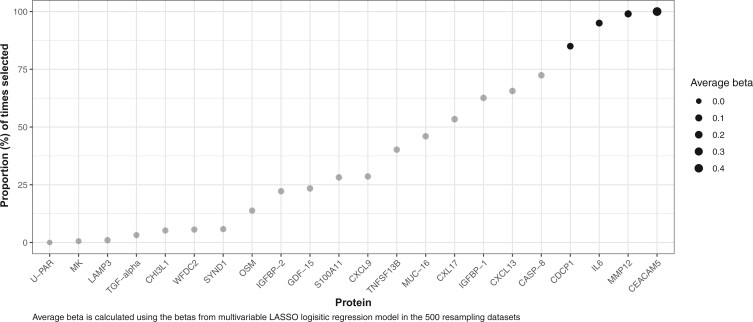
We designed a case-control study nested in 6 prospective cohorts, including 624 lung cancer participants who donated blood samples at most 3 years prior to lung cancer diagnosis and 624 smoking-matched cancer free participants who were assayed for 302 proteins. We used 470 case-control pairs from 4 cohorts to select proteins and train a protein-based risk model. We subsequently used 154 case-control pairs from 2 cohorts to compare the risk-discriminatory performance of the protein-based model with that of the Early Cancer Detection Test (EarlyCDT)-Lung and the PLCOm2012 model using receiver operating characteristics analysis and by estimating models' sensitivity. All tests were 2-sided.
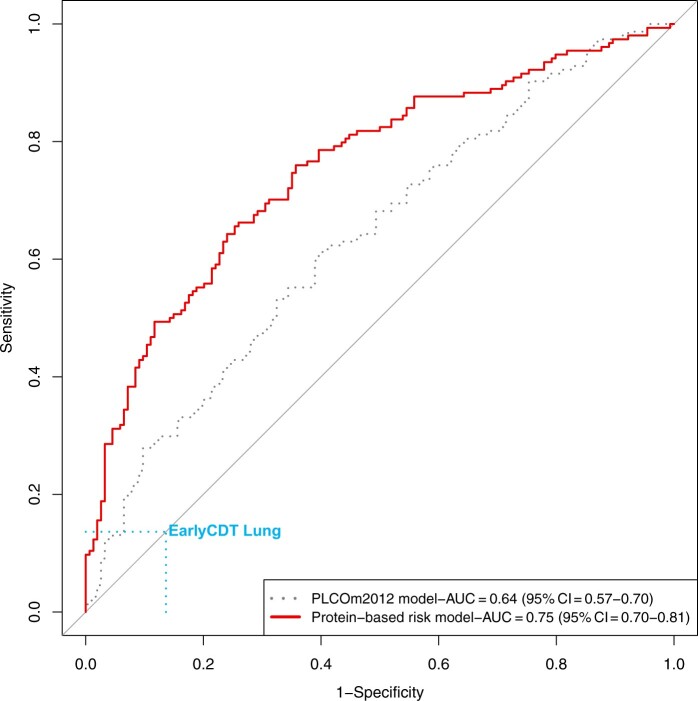
The area under the curve for the protein-based risk model in the validation sample was 0.75 (95% confidence interval [CI] = 0.70 to 0.81) compared with 0.64 (95% CI = 0.57 to 0.70) for the PLCOm2012 model (Pdifference = .001). The EarlyCDT-Lung had a sensitivity of 14% (95% CI = 8.2% to 19%) and a specificity of 86% (95% CI = 81% to 92%) for incident lung cancer. At the same specificity of 86%, the sensitivity for the protein-based risk model was estimated at 49% (95% CI = 41% to 57%) and 30% (95% CI = 23% to 37%) for the PLCOm2012 model.
Circulating proteins showed promise in predicting incident lung cancer and outperformed a standard risk prediction model and the commercialized EarlyCDT-Lung.
我们旨在开发一种基于蛋白质组学的肺癌风险模型,并将其风险区分性能与基于吸烟的风险模型(PLCOm2012)和商业化的自身抗体生物标志物检测进行比较。
我们设计了一项病例对照研究,嵌套在 6 个前瞻性队列中,包括 624 名在肺癌诊断前最多 3 年内捐献血液样本的肺癌患者和 624 名接受 302 种蛋白质检测的吸烟匹配无癌症患者。我们使用来自 4 个队列的 470 个病例对照对来选择蛋白质并训练基于蛋白质的风险模型。随后,我们使用来自 2 个队列的 154 个病例对照对来比较基于蛋白质的模型与早期癌症检测测试(EarlyCDT-Lung)和 PLCOm2012 模型的风险区分性能,使用接受者操作特征分析和估计模型的敏感性。所有测试均为双侧。
验证样本中基于蛋白质的风险模型的曲线下面积为 0.75(95%置信区间[CI] = 0.70 至 0.81),而 PLCOm2012 模型为 0.64(95% CI = 0.57 至 0.70)(P 差异= 0.001)。EarlyCDT-Lung 对新发肺癌的敏感性为 14%(95% CI = 8.2%至 19%),特异性为 86%(95% CI = 81%至 92%)。在相同的特异性为 86%时,基于蛋白质的风险模型的敏感性估计为 49%(95% CI = 41%至 57%)和 30%(95% CI = 23%至 37%)为 PLCOm2012 模型。
循环蛋白在预测新发肺癌方面具有潜力,优于标准风险预测模型和商业化的 EarlyCDT-Lung。