Yang Zhenyu, Yuan Lijuan, Yang Lin, Peng Shujia, Yang Ping, He Xianli, Bao Guoqiang
Department of General Surgery, Tangdu Hospital, The Air Force Military Medical University, Xi'an, China.
Ann Transl Med. 2021 Jan;9(2):156. doi: 10.21037/atm-20-8052.
The present study analyzed gene polymorphisms in the potassium voltage-gated channel KQT-like subfamily member 1 () and the long noncoding RNA, and their impacts on genetic susceptibility and survival in a Chinese Han population with gastric cancer (GC).
We designed a case-control study that included 681 patients with GC and 756 healthy controls. Three single-nucleotide polymorphisms (SNPs) in the gene region and eight SNPs in the gene region were selected for further research.
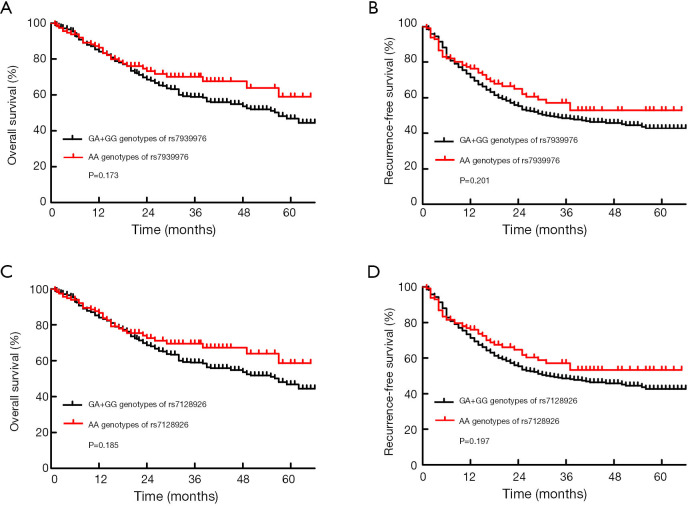
Among the 11 SNPs, we found no significant differences in the genotype and allele frequencies between GC patients and the healthy population. Hierarchical analysis by the log-additive model indicated that the rs231348 CT genotype was significantly associated with an increased GC risk in individuals aged ≥55 years, regardless of gender. The rs231352 CC and rs7128926 AA genotypes increased the risk of GC in individuals with stage III/IV tumors larger than 5 cm in diameter. On evaluating the genotype polymorphism and survival analysis, we detected that the AA genotypes of the rs7128926 and rs7939976 polymorphisms presented a significant survival advantage over the GA/GG genotypes, especially in patients with the following characteristics: age >55, infection, BMI >24, tumor in the non-cardia region with a diameter greater than 5 cm, clinical stage II, and postoperative adjuvant chemotherapy.
Our results suggest that the KCNQ1 rs231348 and KCNQ1OT1 rs231352 polymorphisms might be independent predictors of the risk of GC susceptibility depending on certain factors, such as the age of the individual and the tumor stage and diameter. Simultaneously, genotype polymorphism of the rs7128926 and rs7939976 loci of the KCNQ1OT1 gene independently predicted the recurrence-free survival (RFS) and overall survival (OS) of GC patients.
本研究分析了钾离子电压门控通道KQT样亚家族成员1(KCNQ1)基因多态性以及长链非编码RNA KCNQ1重叠转录本1(KCNQ1OT1),及其对中国汉族胃癌(GC)人群遗传易感性和生存的影响。
我们设计了一项病例对照研究,纳入681例GC患者和756例健康对照。选择KCNQ1基因区域的3个单核苷酸多态性(SNP)和KCNQ1OT1基因区域的8个SNP进行进一步研究。
在这11个SNP中,我们发现GC患者与健康人群在基因型和等位基因频率上无显著差异。对数相加模型的分层分析表明,KCNQ1 rs231348 CT基因型与年龄≥55岁个体的GC风险增加显著相关,无论性别如何。KCNQ1OT1 rs231352 CC和rs7128926 AA基因型增加了直径大于5 cm的III/IV期肿瘤个体的GC风险。在评估基因型多态性和生存分析时,我们检测到KCNQ1OT1 rs7128926和rs7939976多态性的AA基因型比GA/GG基因型具有显著的生存优势特征:年龄>55岁、幽门螺杆菌感染、BMI>24、非贲门区域直径大于5 cm的肿瘤、临床II期和术后辅助化疗。
我们的结果表明,KCNQ1 rs231348和KCNQ1OT1 rs231352多态性可能是GC易感性风险的独立预测因子,这取决于某些因素,如个体年龄、肿瘤分期和直径。同时,KCNQ1OT1基因rs7128926和rs7939976位点的基因型多态性独立预测了GC患者的无复发生存期(RFS)和总生存期(OS)。