Hamulyák Eva N, Daams Joost G, Leebeek Frank W G, Biemond Bart J, Te Boekhorst Peter A W, Middeldorp Saskia, Lauw Mandy N
Department of Vascular Medicine and.
Medical Library, Amsterdam University Medical Center (UMC), University of Amsterdam, Amsterdam, The Netherlands.
Blood Adv. 2021 Jan 12;5(1):113-121. doi: 10.1182/bloodadvances.2020003628.
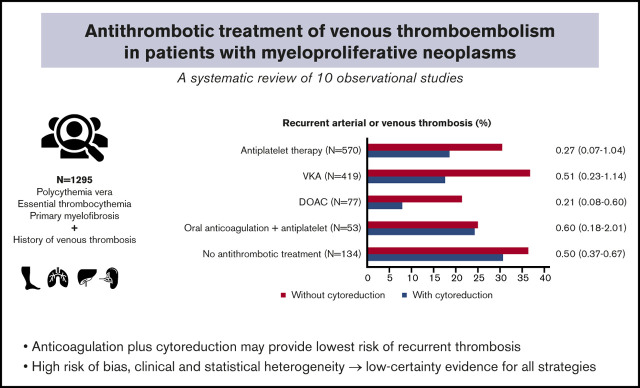
Patients with myeloproliferative neoplasms (MPNs), polycythemia vera, essential thrombocythemia, and primary myelofibrosis, have an increased risk of thrombosis. Risk of recurrent thrombosis can be reduced with antithrombotic therapy and/or cytoreduction, but the optimal long-term management in patients with MPN with a history of venous thromboembolism (VTE) is unknown, and clinical practice is heterogeneous. We performed a systematic review and meta-analysis of randomized trials and observational studies evaluating anticoagulant and/or antiplatelet therapy, with or without cytoreduction, in MPN patients with a history of VTE. A total of 5675 unique citations were screened for eligibility. No randomized trials were identified. Ten observational studies involving 1295 patients with MPN were included in the analysis. Overall, 23% had an arterial or recurrent venous thrombotic event on follow-up. The recurrence risk was lowest for patients on oral anticoagulation plus cytoreduction (16%); 55 of 313 (18%) with vitamin K antagonists (VKA) and 5 of 63 (8%) with direct oral anticoagulants (DOACs). In 746 analyzed patients, the risk of recurrent VTE ranged up to 33% (median 13%) and was low in 63 DOAC plus cytoreduction-treated patients (3.2%). All types of antithrombotic treatments were associated with a lower risk of recurrent VTE when combined with cytoreduction. Most studies had a high risk of bias, whereas clinical and statistical heterogeneity led to inconsistent and imprecise findings. In summary, evidence on the optimal antithrombotic treatment of VTE in patients with MPN is based on observational studies only with low certainty for all strategies. Our data suggest that a combination of anticoagulation and cytoreduction may provide the lowest recurrence risk.
骨髓增殖性肿瘤(MPN)患者,包括真性红细胞增多症、原发性血小板增多症和原发性骨髓纤维化患者,发生血栓形成的风险增加。抗血栓治疗和/或细胞减灭可降低复发性血栓形成的风险,但对于有静脉血栓栓塞(VTE)病史的MPN患者,最佳的长期管理方案尚不清楚,临床实践也存在差异。我们对评估抗凝和/或抗血小板治疗(无论是否联合细胞减灭)在有VTE病史的MPN患者中的随机试验和观察性研究进行了系统评价和荟萃分析。共筛选了5675篇独特的文献以确定其是否符合纳入标准。未发现随机试验。分析纳入了10项涉及1295例MPN患者的观察性研究。总体而言,23%的患者在随访期间发生了动脉或复发性静脉血栓事件。口服抗凝药联合细胞减灭治疗的患者复发风险最低(16%);313例使用维生素K拮抗剂(VKA)的患者中有55例(18%),63例使用直接口服抗凝剂(DOAC)的患者中有5例(8%)。在746例分析患者中,复发性VTE的风险高达33%(中位数为13%),而在63例接受DOAC联合细胞减灭治疗的患者中风险较低(3.2%)。所有类型的抗血栓治疗与细胞减灭联合使用时,复发性VTE的风险均较低。大多数研究存在高偏倚风险,而临床和统计异质性导致结果不一致且不精确。总之,关于MPN患者VTE最佳抗血栓治疗的证据仅基于观察性研究,所有策略的确定性都很低。我们的数据表明,抗凝和细胞减灭联合使用可能提供最低的复发风险。