Department of Gastrointestinal Surgery, Zhongnan Hospital of Wuhan University, Wuhan, China; Hubei Key Laboratory of Tumor Biological Behaviors, Wuhan 430071, China; Hubei Cancer Clinical Study Center, Wuhan 430071, China; The Clinical Medical Research Center of Peritoneal Cancer of Wuhan, Wuhan 430071, China.
Department of Gastrointestinal Surgery, Zhongnan Hospital of Wuhan University, Wuhan, China; Hubei Key Laboratory of Tumor Biological Behaviors, Wuhan 430071, China; Hubei Cancer Clinical Study Center, Wuhan 430071, China.
Mol Ther. 2021 Jun 2;29(6):2088-2107. doi: 10.1016/j.ymthe.2021.02.006. Epub 2021 Feb 9.
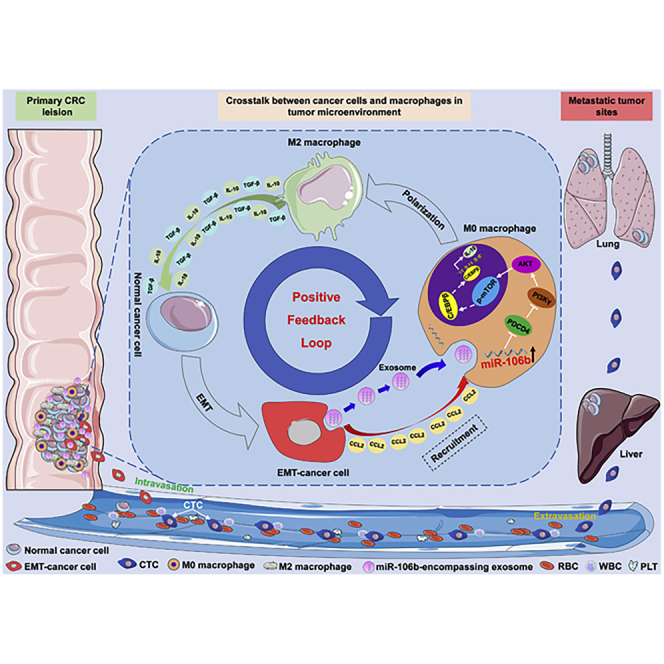
Epithelial-mesenchymal transition (EMT) is reported to involve in the crosstalk between tumor cells and tumor-associated macrophages (TAMs). Exosomes are considered as important mediators of orchestrating intercellular communication. However, the underlying mechanisms by which EMT-colorectal cancer (CRC) cells promote the M2 polarization of TAMs remain less understood. In this study, we found that EMT-CRC cells promoted the M2-like polarization of macrophages by directly transferring exosomes to macrophages, leading to a significant increase of the microRNA-106b-5p (miR-106b) level in macrophages. Mechanically, an increased level of miR-106b activated the phosphatidylinositol 3-kinase (PI3K)γ/AKT/mammalian target of rapamycin (mTOR) signaling cascade by directly suppressing programmed cell death 4 (PDCD4) in a post-transcription level, contributing to the M2 polarization of macrophages. Activated M2 macrophages, in a positive-feedback manner, promote EMT-mediated migration, invasion, and metastasis of CRC cells. Clinically, miR-106b was significantly elevated in CRC tissues and negatively correlated with the levels of PDCD4 in CRC specimens, and high expression of exosomal miR-106b in plasma was significantly associated with the malignant progression of CRC. Taken together, our results indicate that exosomal miR-106b derived from EMT-CRC cells has an important role in intercellular communication for inducing M2 macrophage polarization, illuminating a novel mechanism underlying CRC progression and offering potential targets for prevention of CRC metastasis.
上皮-间充质转化(EMT)被报道涉及肿瘤细胞和肿瘤相关巨噬细胞(TAMs)之间的串扰。外泌体被认为是协调细胞间通讯的重要介质。然而,EMT-结直肠癌(CRC)细胞促进 TAMs 向 M2 极化的潜在机制仍知之甚少。在这项研究中,我们发现 EMT-CRC 细胞通过直接将外泌体转移到巨噬细胞中,促进巨噬细胞向 M2 样极化,导致巨噬细胞中 microRNA-106b-5p(miR-106b)水平显著增加。在机制上,miR-106b 的水平升高通过直接在转录后水平抑制程序性细胞死亡因子 4(PDCD4),激活磷脂酰肌醇 3-激酶(PI3K)γ/AKT/雷帕霉素靶蛋白(mTOR)信号级联,从而促进巨噬细胞向 M2 极化。激活的 M2 巨噬细胞以正反馈的方式促进 EMT 介导的 CRC 细胞迁移、侵袭和转移。临床上,CRC 组织中 miR-106b 显著升高,与 CRC 标本中 PDCD4 的水平呈负相关,血浆中外泌体 miR-106b 的高表达与 CRC 的恶性进展显著相关。总之,我们的研究结果表明,来自 EMT-CRC 细胞的外泌体 miR-106b 在诱导 M2 巨噬细胞极化的细胞间通讯中起重要作用,为 CRC 进展的潜在机制提供了新的见解,并为预防 CRC 转移提供了潜在的治疗靶点。