Rashid Saqib, Sebastiani Marco, Mughal Muhammad Zeeshan, Daniel Rostislav, Bemporad Edoardo
Engineering Department, University of Rome "Roma Tre", via della Vasca Navale 79, 00146 Rome, Italy.
School of Engineering & Innovation, The Open University, Walton Hall, Milton Keynes MK7 6AA, UK.
Nanomaterials (Basel). 2021 Feb 9;11(2):435. doi: 10.3390/nano11020435.
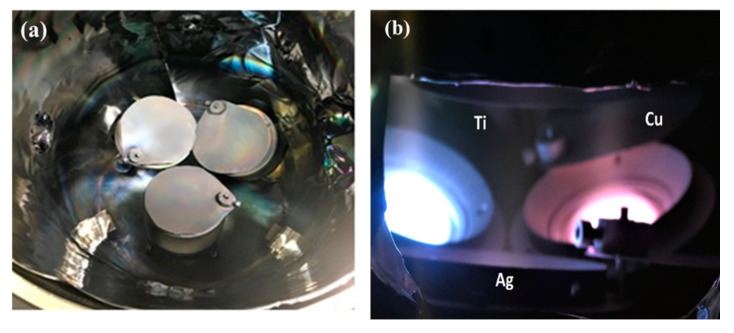
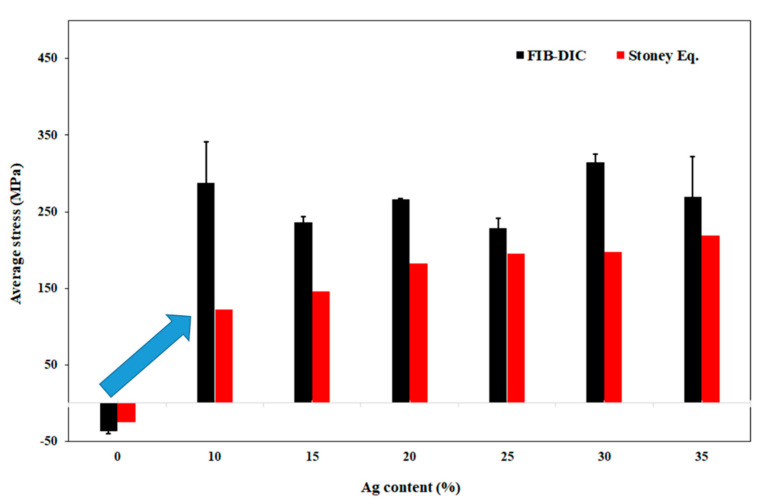
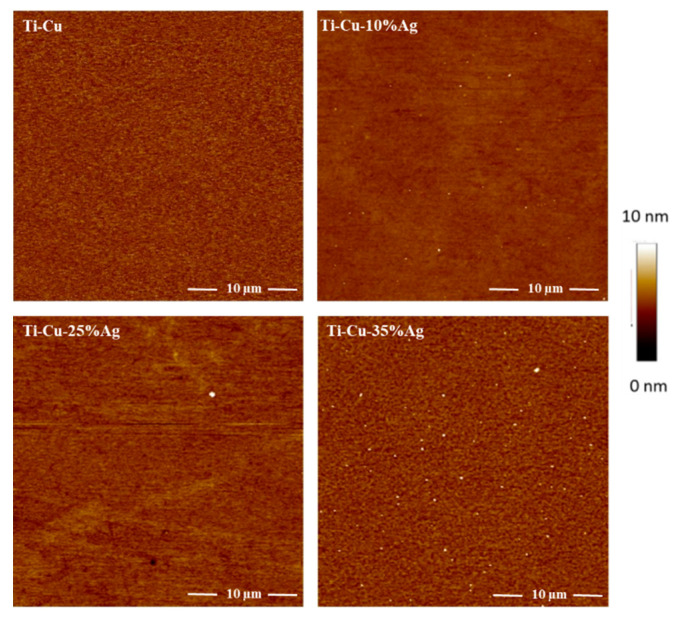
In this work, the ternary titanium, copper, and silver (Ti-Cu-Ag) system is investigated as a potential candidate for the production of mechanically robust biomedical thin films. The coatings are produced by physical vapor deposition-magnetron sputtering (MS-PVD). The composite thin films are deposited on a silicon (100) substrate. The ratio between Ti and Cu was approximately kept one, with the variation of the Ag content between 10 and 35 at.%, while the power on the targets is changed during each deposition to get the desired Ag content. Thin film characterization is performed by X-ray diffraction (XRD), nanoindentation (modulus and hardness), to quantitatively evaluate the scratch adhesion, and atomic force microscopy to determine the surface topography. The residual stresses are measured by focused ion beam and digital image correlation method (FIB-DIC). The produced Ti-Cu-Ag thin films appear to be smooth, uniformly thick, and exhibit amorphous structure for the Ag contents lower than 25 at.%, with a transition to partially crystalline structure for higher Ag concentrations. The Ti-Cu control film shows higher values of 124.5 GPa and 7.85 GPa for modulus and hardness, respectively. There is a clear trend of continuous decrease in the modulus and hardness with the increase of Ag content, as lowest value of 105.5 GPa and 6 GPa for 35 at.% Ag containing thin films. In particular, a transition from the compressive (-36.5 MPa) to tensile residual stresses between 229 MPa and 288 MPa are observed with an increasing Ag content. The obtained results suggest that the Ag concentration should not exceed 25 at.%, in order to avoid an excessive reduction of the modulus and hardness with maintaining (at the same time) the potential for an increase of the antibacterial properties. In summary, Ti-Cu-Ag thin films shows characteristic mechanical properties that can be used to improve the properties of biomedical implants such as Ti-alloys and stainless steel.
在本研究中,三元钛、铜和银(Ti-Cu-Ag)体系被作为制备机械性能稳健的生物医学薄膜的潜在候选体系进行研究。这些涂层通过物理气相沉积-磁控溅射(MS-PVD)制备。复合薄膜沉积在硅(100)衬底上。Ti与Cu的比例大致保持为1,Ag含量在10至35原子百分比之间变化,同时在每次沉积过程中改变靶材上的功率以获得所需的Ag含量。通过X射线衍射(XRD)、纳米压痕(模量和硬度)进行薄膜表征,以定量评估划痕附着力,并通过原子力显微镜确定表面形貌。残余应力通过聚焦离子束和数字图像相关方法(FIB-DIC)测量。所制备的Ti-Cu-Ag薄膜看起来光滑、厚度均匀,对于Ag含量低于25原子百分比的薄膜呈现非晶结构,而对于较高的Ag浓度则转变为部分结晶结构。Ti-Cu对照薄膜的模量和硬度分别显示出较高的值,即124.