Division of Thoracic Surgery, Department of Surgery, Kindai University Faculty of Medicine, Osaka-Sayama 589-8511, Japan.
Cells. 2021 Feb 9;10(2):354. doi: 10.3390/cells10020354.
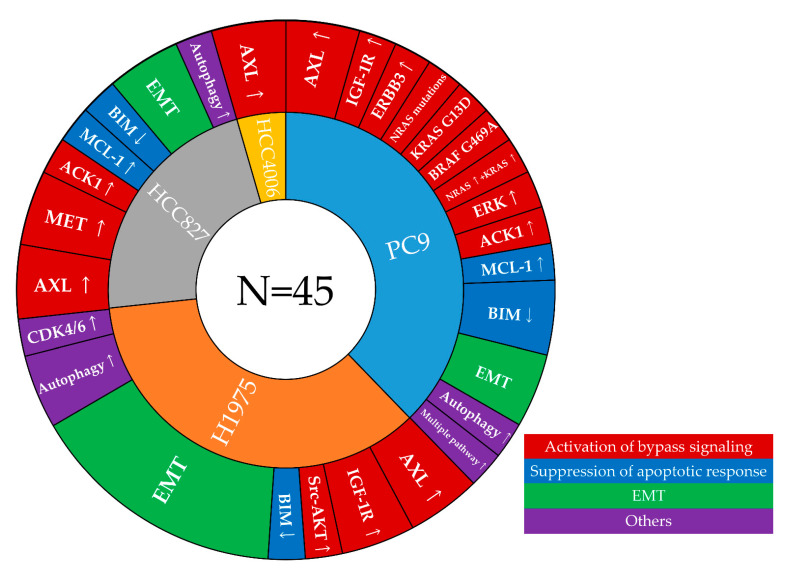
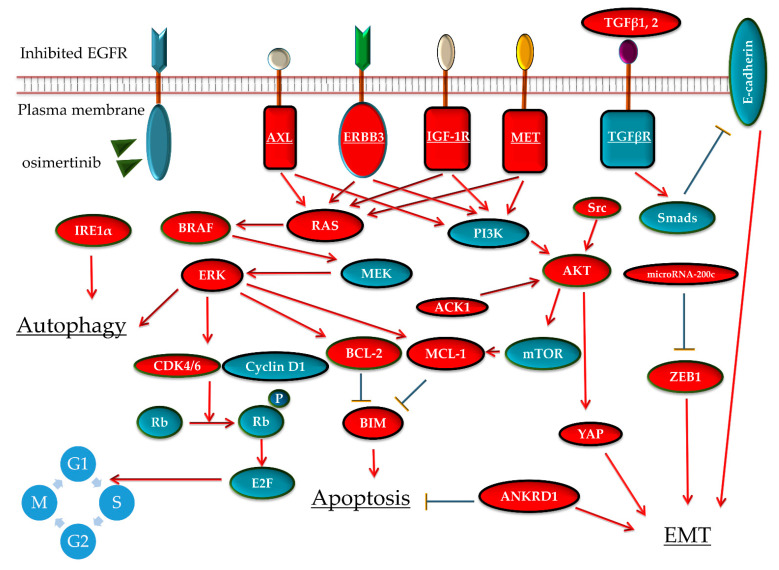
Epidermal growth factor receptor (EGFR) tyrosine kinase inhibitors (TKIs) are first-line drugs for lung cancers with activating mutations. Although first- and second-generation EGFR-TKIs were standard first-line treatments, acquired resistance (AR) to these drugs is almost inevitable. Cell line models have been widely used to explore the molecular mechanisms of AR to first- and second-generation EGFR-TKIs. Many research groups, including ours, have established AR cell lines that harbor the T790M secondary mutation, gene amplification, or epithelial-mesenchymal transition (EMT) features, which are all found in clinical specimens obtained from TKI-refractory lesions. Currently, many oncologists prescribe osimertinib, a third-generation EGFR-TKI that can overcome T790M-mediated resistance, as a first-line TKI. Although few clinical data are available about AR mechanisms that arise when osimertinib is used as a first-line therapy, many research groups have established cell lines with AR to osimertinib and have reported on their AR mechanisms. In this review, we summarize the findings on AR mechanisms against first-line osimertinib obtained from analyses of cell line models.
表皮生长因子受体(EGFR)酪氨酸激酶抑制剂(TKI)是具有激活突变的肺癌的一线药物。尽管第一代和第二代 EGFR-TKI 是标准的一线治疗药物,但对这些药物的获得性耐药(AR)几乎是不可避免的。细胞系模型已被广泛用于探索 AR 对第一代和第二代 EGFR-TKI 的分子机制。包括我们在内的许多研究小组已经建立了 AR 细胞系,这些细胞系具有 T790M 继发性突变、基因扩增或上皮-间充质转化(EMT)特征,这些特征都存在于从 TKI 耐药病变中获得的临床标本中。目前,许多肿瘤学家将奥希替尼(一种可克服 T790M 介导的耐药性的第三代 EGFR-TKI)作为一线 TKI 处方。尽管关于奥希替尼作为一线治疗药物时出现 AR 机制的临床数据很少,但许多研究小组已经建立了对奥希替尼产生 AR 的细胞系,并报告了它们的 AR 机制。在这篇综述中,我们总结了从细胞系模型分析中获得的针对一线奥希替尼的 AR 机制的研究结果。