Canadian Sport Institute, Calgary, AB T3B 6B7, Canada.
Helios Wellness Centres, Calgary, AB T2N 4Z6, Canada.
Nutrients. 2021 Jan 29;13(2):448. doi: 10.3390/nu13020448.
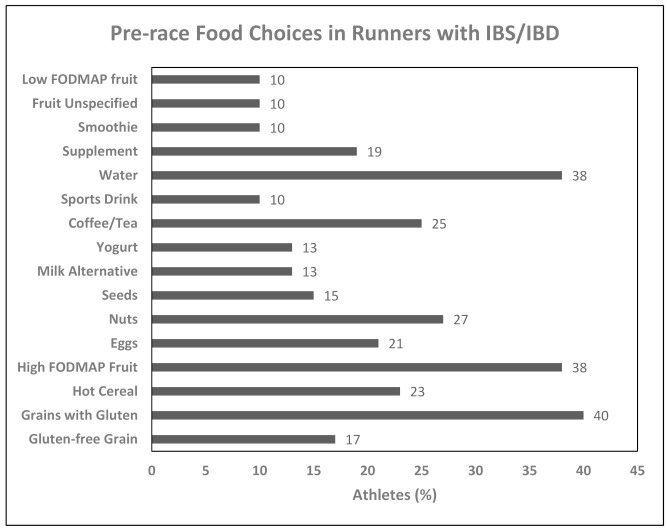
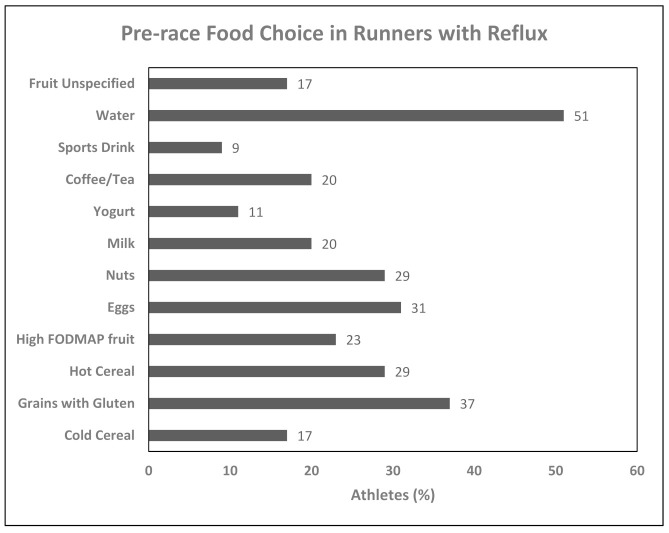
Individuals with inflammatory bowel disease (IBD), irritable bowel syndrome (IBS) and reflux frequently experience gastrointestinal symptoms (GIS), potentially enhanced by high-intensity running. Food avoidances, food choices, and GIS in runners with IBS/IBD ( = 53) and reflux ( = 37) were evaluated using a reliability and validity tested questionnaire. Comparisons to a control group of runners ( = 375) were made using a Fisher's Exact test. Runners with IBS/IBD experienced the greatest amount of exercise-induced GIS followed by those with reflux. Commonly reported GIS were stomach pain/cramps (77%; 53%), bloating (52%; 50%), intestinal pain/cramps (58%; 33%), and diarrhea (58%; 39%) in IBS/IBD and reflux groups respectively. In the pre-race meal, those with IBS/IBD frequently avoided milk products (53%), legumes (37%), and meat (31%); whereas, runners with reflux avoided milk (38%), meat (36%), and high-fibre foods (33%). When considering food choices pre-race, runners with IBS/IBD chose grains containing gluten (40%), high fermentable oligo-, di-, mono-saccharides and polyols (FODMAP) fruits (38%), and water (38%). Runners with reflux chose water (51%), grains containing gluten (37%), and eggs (31%). In conclusion, while many runners with IBS/IBD and reflux are avoiding trigger foods in their pre-race meals, they are also consuming potentially aggravating foods, suggesting nutrition advice may be warranted.
患有炎症性肠病 (IBD)、肠易激综合征 (IBS) 和反流的个体经常出现胃肠道症状 (GIS),高强度跑步可能会加重这些症状。使用经过可靠性和有效性测试的问卷评估了 IBS/IBD(=53)和反流(=37)跑步者的食物回避、食物选择和 GIS。使用 Fisher's 精确检验将与对照组跑步者(=375)进行比较。IBS/IBD 患者经历的运动引起的 GIS 最多,其次是反流患者。分别报告的常见 GIS 是腹痛/痉挛(77%;53%)、腹胀(52%;50%)、肠痛/痉挛(58%;33%)和腹泻(58%;39%)在 IBS/IBD 和反流组中。在赛前餐中,IBS/IBD 患者经常避免食用奶制品(53%)、豆类(37%)和肉类(31%);而反流患者则避免食用奶制品(38%)、肉类(36%)和高纤维食物(33%)。考虑到赛前的食物选择,IBS/IBD 患者选择含有麸质的谷物(40%)、高可发酵寡糖、二糖、单糖和多元醇(FODMAP)水果(38%)和水(38%)。反流患者选择水(51%)、含麸质的谷物(37%)和鸡蛋(31%)。总之,虽然许多患有 IBS/IBD 和反流的跑步者在赛前餐中避免食用触发食物,但他们也在食用潜在的刺激性食物,这表明可能需要营养建议。