Center for Prevention and Diagnosis of Celiac Disease, Gastroenterology and Endoscopy Unit, Fondazione IRCCS Ca' Granda, Ospedale Maggiore Policlinico, 20122 Milan, Italy.
Department of Biomedical, Surgical and Dental Sciences, University of Milan, 20131 Milan, Italy.
Nutrients. 2018 Nov 15;10(11):1769. doi: 10.3390/nu10111769.
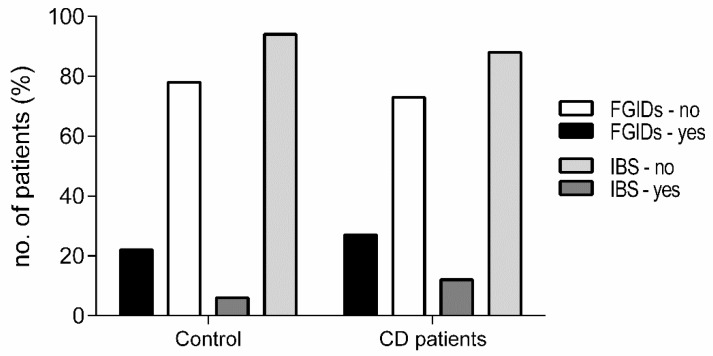
Our aim was to evaluate the intake of foods containing fermentable oligo/di/mono-saccharides and polyols (FODMAP) as a possible factor that induces gastrointestinal symptoms in treated celiac disease (CD) patients. We collected seven-day weighed food records for 104 CD patients and 91 healthy volunteers. All evaluated food items were from sources with high and low content of FODMAP, which were divided into cereals and sweets, sweeteners and soft drinks, fruits, dried fruits, and vegetables. Nutrient intake was calculated using the food database of the European Institute of Oncology. The symptoms reported were assessed by a Rome IV Irritable bowel syndrome (IBS) diagnostic questionnaire and by specific questions for the evaluation of functional gastrointestinal disorders (FGIDs). The 12% of CD patients met IBS symptoms criteria as opposed to 6% of controls ( = 0.09) and 27% of patients reported FGIDs symptoms vs. 22% of healthy controls ( = 0.42). The intake by CD patients was significantly higher than healthy volunteers for: sweeteners and sugars with low content of FODMAP ( = 0.0007), fruits, dried fruits, and vegetables high in FODMAP ( = 0.003) and low in FODMAP ( = 0.04) when compared to controls. CD patients had a lower intake of cereals and sweets with a high content of FODMAP ( = 0.00001). Healthy volunteers consumed significantly higher alcoholic beverages and fats high in FODMAP (both < 0.044). The mean daily intake of other food categories did not differ between both groups. Even though CD patients had a low intake of gluten-free cereals high in FODMAP, they still consumed a significant amount of fruits and vegetables high in FODMAP. The clinical effect of a concomitant gluten-free diet and low-FODMAP diet should be prospectively evaluated as a supportive therapy in CD patients.
我们旨在评估可发酵寡糖/二糖/单糖和多元醇(FODMAP)的食物摄入量是否为治疗后乳糜泻(CD)患者胃肠道症状的一个可能因素。我们收集了 104 例 CD 患者和 91 名健康志愿者的 7 天称重食物记录。所有评估的食物均来自 FODMAP 含量高和低的来源,分为谷物和甜食、甜味剂和软饮料、水果、干果和蔬菜。通过欧洲肿瘤研究所的食物数据库计算营养素摄入量。通过罗马 IV 肠易激综合征(IBS)诊断问卷和评估功能性胃肠道疾病(FGIDs)的特定问题来评估报告的症状。12%的 CD 患者符合 IBS 症状标准,而对照组为 6%(=0.09),27%的患者报告 FGIDs 症状,而健康对照组为 22%(=0.42)。与健康对照组相比,CD 患者的摄入量明显更高:低 FODMAP 含量的甜味剂和糖(=0.0007)、高 FODMAP 的水果、干果和蔬菜(=0.003)以及低 FODMAP(=0.04)。与对照组相比,CD 患者高 FODMAP 谷物和甜食的摄入量较低(=0.00001)。健康志愿者消耗的高 FODMAP 酒精饮料和脂肪明显更高(均 <0.044)。两组之间其他食物类别的平均每日摄入量没有差异。尽管 CD 患者低 FODMAP 的无麸质谷物摄入量较低,但他们仍消耗大量高 FODMAP 的水果和蔬菜。应前瞻性评估无麸质饮食和低 FODMAP 饮食的联合作为 CD 患者的辅助治疗的临床效果。