Axelsson Fisk Sten, Lindström Martin, Perez-Vicente Raquel, Merlo Juan
Unit for Social Epidemiology, Department of Clinical Sciences, Lund University, Malmö, Sweden
Unit for Social Medicine and Health Policy, Department of Clinical Sciences, Lund University, Malmö, Sweden.
BMJ Open. 2021 Feb 11;11(2):e042323. doi: 10.1136/bmjopen-2020-042323.
Socioeconomic disparities in smoking prevalence remain a challenge to public health. The objective of this study was to present a simple methodology that displays intersectional patterns of smoking and quantify heterogeneities within groups to avoid inappropriate and potentially stigmatising conclusions exclusively based on group averages.
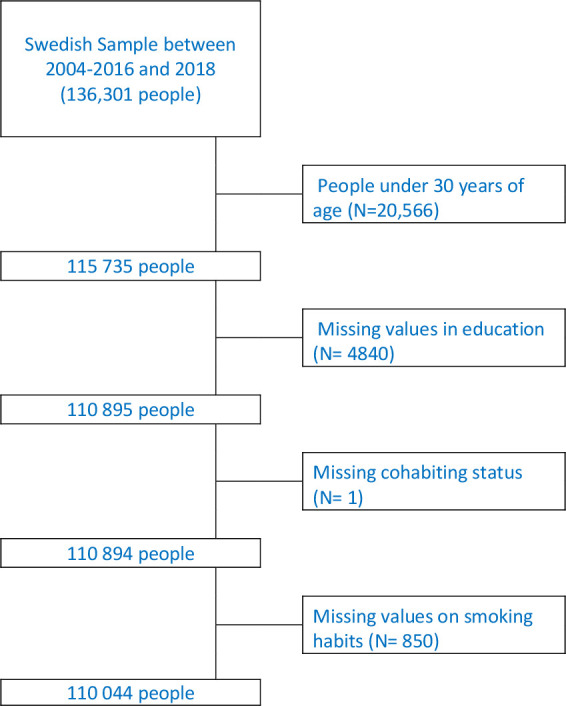
This is a cross-sectional observational study based on data from the National Health Surveys for Sweden (2004-2016 and 2018) including 136 301 individuals. We excluded people under 30 years of age, or missing information on education, household composition or smoking habits. The final sample consisted on 110 044 individuals or 80.7% of the original sample.
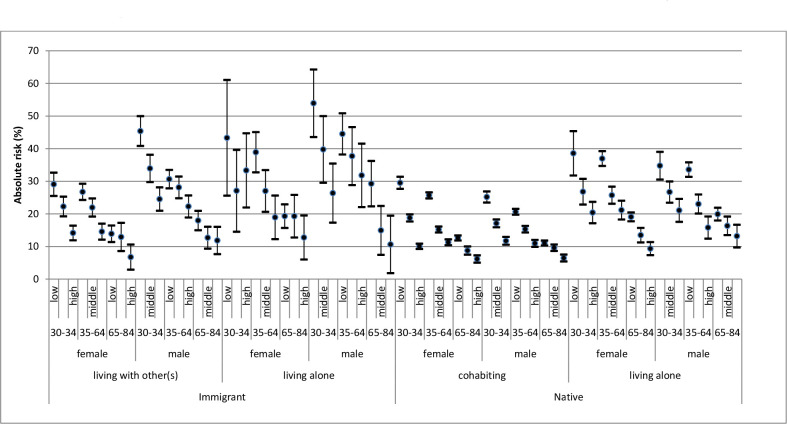
Applying intersectional analysis of individual heterogeneity and discriminatory accuracy (AIHDA), we investigated the risk of self-reported smoking across 72 intersectional strata defined by age, gender, educational achievement, migration status and household composition.
The distribution of smoking habit risk in the population was very heterogeneous. For instance, immigrant men aged 30-44 with low educational achievement that lived alone had a prevalence of smoking of 54% (95% CI 44% to 64%), around nine times higher than native women aged 65-84 with high educational achievement and living with other(s) that had a prevalence of 6% (95% CI 5% to 7%). The discriminatory accuracy of the information was moderate.
A more detailed, intersectional mapping of the socioeconomic and demographic disparities of smoking can assist in public health management aiming to eliminate this unhealthy habit from the community. Intersectionality theory together with AIHDA provides information that can guide resource allocation according to the concept proportionate universalism.
吸烟流行率方面的社会经济差异仍是公共卫生领域面临的一项挑战。本研究的目的是提出一种简单的方法,该方法能呈现吸烟的交叉模式,并对组内异质性进行量化,以避免仅基于组均值得出不恰当且可能带有污名化的结论。
这是一项横断面观察性研究,基于瑞典国家健康调查(2004 - 2016年及2018年)的数据,涵盖136301人。我们排除了30岁以下的人群,以及教育程度、家庭构成或吸烟习惯信息缺失的人群。最终样本包括110044人,占原始样本的80.7%。
应用个体异质性与判别准确性的交叉分析(AIHDA),我们调查了由年龄、性别、教育成就、移民身份和家庭构成所定义的72个交叉分层中自我报告吸烟的风险。
人群中吸烟习惯风险的分布非常不均一。例如,年龄在30 - 44岁、教育程度低且独居的移民男性吸烟率为54%(95%置信区间44%至64%),约为年龄在65 - 84岁、教育程度高且与他人同住的本国女性吸烟率6%(95%置信区间5%至7%)的9倍左右。信息的判别准确性中等。
对吸烟的社会经济和人口差异进行更详细的交叉映射,有助于公共卫生管理,旨在从社区消除这种不健康习惯。交叉性理论与AIHDA提供的信息可根据相称普遍主义概念指导资源分配。