Imperial College London Diabetes Centre, Abu Dhabi, United Arab Emirates.
Department of Epidemiology and Biostatistics, Imperial College London, London, UK.
Int J Obes (Lond). 2021 May;45(5):944-956. doi: 10.1038/s41366-021-00764-y. Epub 2021 Feb 11.
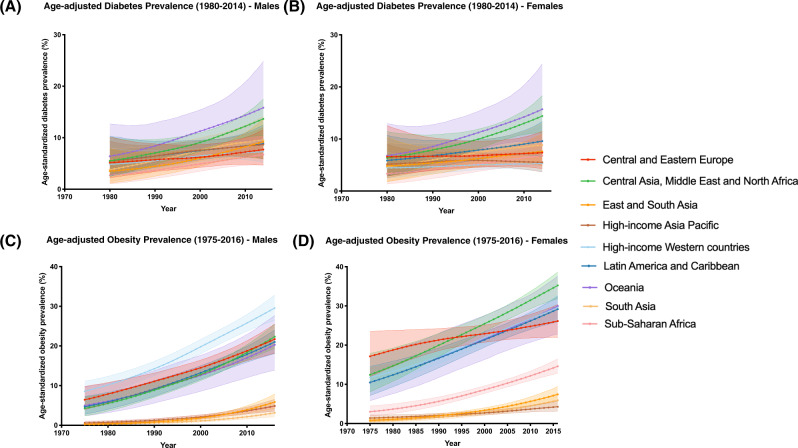
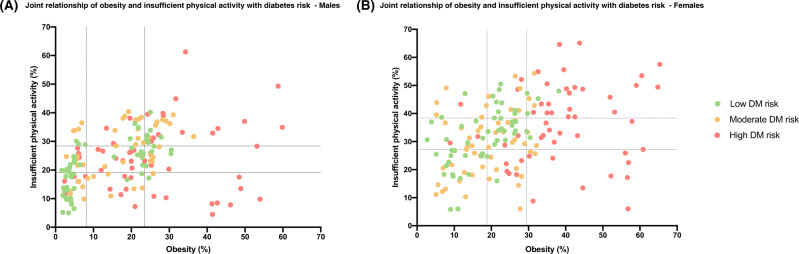
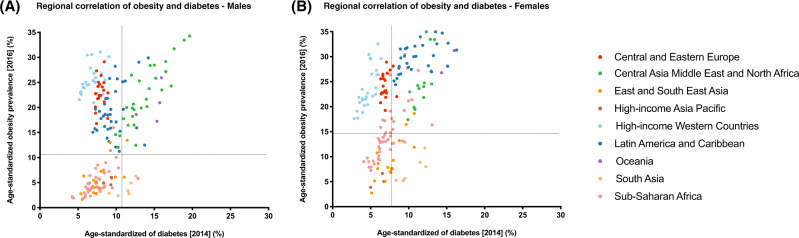
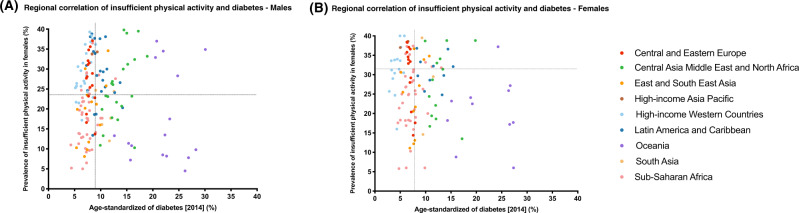
Type 2 diabetes rates vary significantly across geographic regions. These differences are sometimes assumed to be entirely driven by differential distribution of environmental triggers, including obesity and insufficient physical activity (IPA). In this review, we discuss data which conflicts with this supposition. We carried out a secondary analysis of publicly available data to unravel the relative contribution of obesity and IPA towards diabetes risk across different populations. We used sex-specific, age-standardized estimates from Non-Communicable Disease Risk Factor Collaboration (NCD-RisC) on diabetes (1980-2014) and obesity (1975-2016) rates, in 200 countries, and from WHO on IPA rates in 168 countries in the year 2016. NCD-RisC and WHO organized countries into nine super-regions. All analyses were region- and sex-specific. Although obesity has been increasing since 1975 in every part of the world, this was not reflected in a proportional increase in diabetes rates in several regions, including Central and Eastern Europe, and High-income western countries region. Similarly, the association of physical inactivity with diabetes is not homogeneous across regions. Countries from different regions across the world could have very similar rates of diabetes, despite falling on opposite ends of IPA rate spectrum. The combined effect of obesity and IPA on diabetes risk was analyzed at the worldwide and country level. The overall findings highlighted the larger impact of obesity on disease risk; low IPA rates do not seem to be protective of diabetes, when obesity rates are high. Despite that, some countries deviate from this overall observation. Sex differences were observed across all our analyses. Overall, data presented in this review indicate that different populations, while experiencing similar environmental shifts, are apparently differentially subject to diabetes risk. Sex-related differences observed suggest that males and females are either subject to different risk factor exposures or have different responses to them.
2 型糖尿病的发病率在地理区域上有显著差异。这些差异有时被认为完全是由环境触发因素(包括肥胖和体力活动不足)的差异分布所驱动的。在这篇综述中,我们讨论了与这一假设相矛盾的数据。我们对公开可用的数据进行了二次分析,以揭示肥胖和体力活动不足对不同人群糖尿病风险的相对贡献。我们使用了非传染性疾病风险因素合作组织(NCD-RisC)关于糖尿病(1980-2014 年)和肥胖(1975-2016 年)发病率的按性别和年龄标准化的估计值,以及世界卫生组织(WHO)关于 2016 年 168 个国家体力活动不足率的数据。NCD-RisC 和 WHO 将各国分为九个超级区域。所有分析均按区域和性别进行。尽管自 1975 年以来,世界上每个地区的肥胖率都在上升,但这并没有反映在一些地区的糖尿病发病率的相应增加上,包括中欧和东欧以及高收入西方国家地区。同样,体力活动不足与糖尿病的关联在各区域并不一致。尽管在体力活动不足率的分布上处于两个极端,但世界各地的不同区域的国家可能具有非常相似的糖尿病发病率。肥胖和体力活动不足对糖尿病风险的综合影响在全球和国家层面进行了分析。总体研究结果强调了肥胖对疾病风险的更大影响;当肥胖率较高时,低体力活动不足率似乎不能预防糖尿病。尽管如此,一些国家的情况仍不符合这一总体观察结果。在我们所有的分析中都观察到了性别差异。总体而言,本综述中呈现的数据表明,不同人群尽管经历了相似的环境变化,但显然易患糖尿病的风险不同。观察到的性别差异表明,男性和女性要么受到不同的风险因素暴露,要么对这些因素有不同的反应。