Xu Danping, Zhu Yiyang, Li Lanfang, Xu Yingping, Yan Weihua, Dai Meizhen, Gan Linghong
Reproductive Center, Taizhou Hospital of Zhejiang Province, Wezhou Medical University, Wenzhou, China.
Medical Research Center, Taizhou Hospital of Zhejiang Province, Wezhou Medical University, Wenzhou, China.
Front Genet. 2021 Jan 26;11:497264. doi: 10.3389/fgene.2020.497264. eCollection 2020.
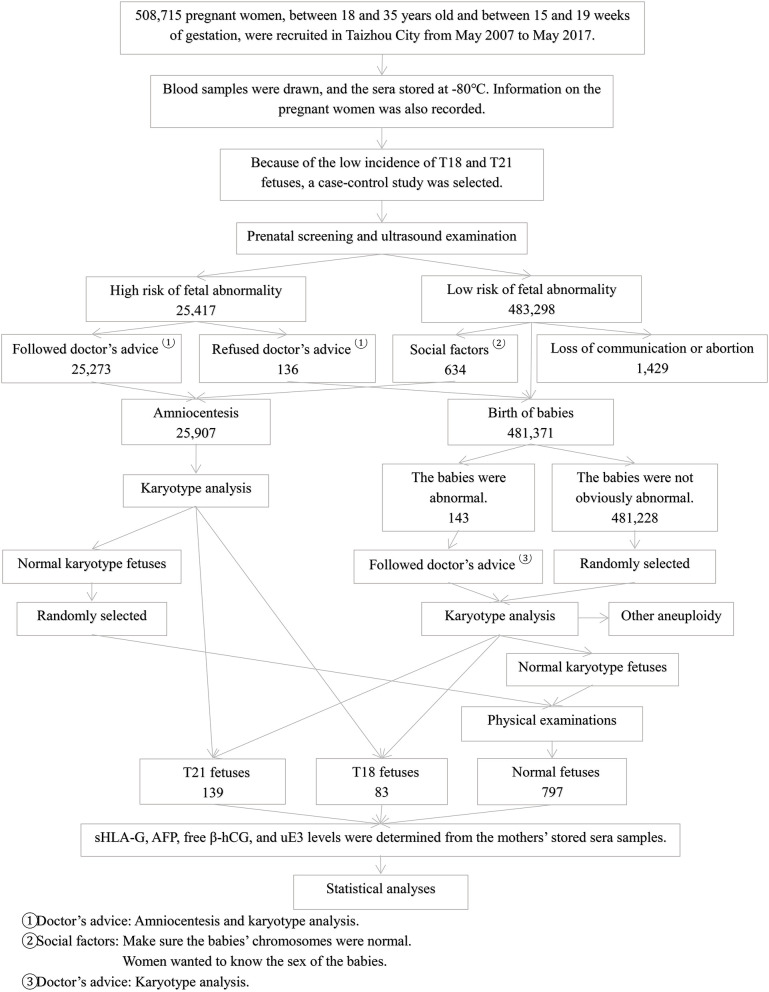
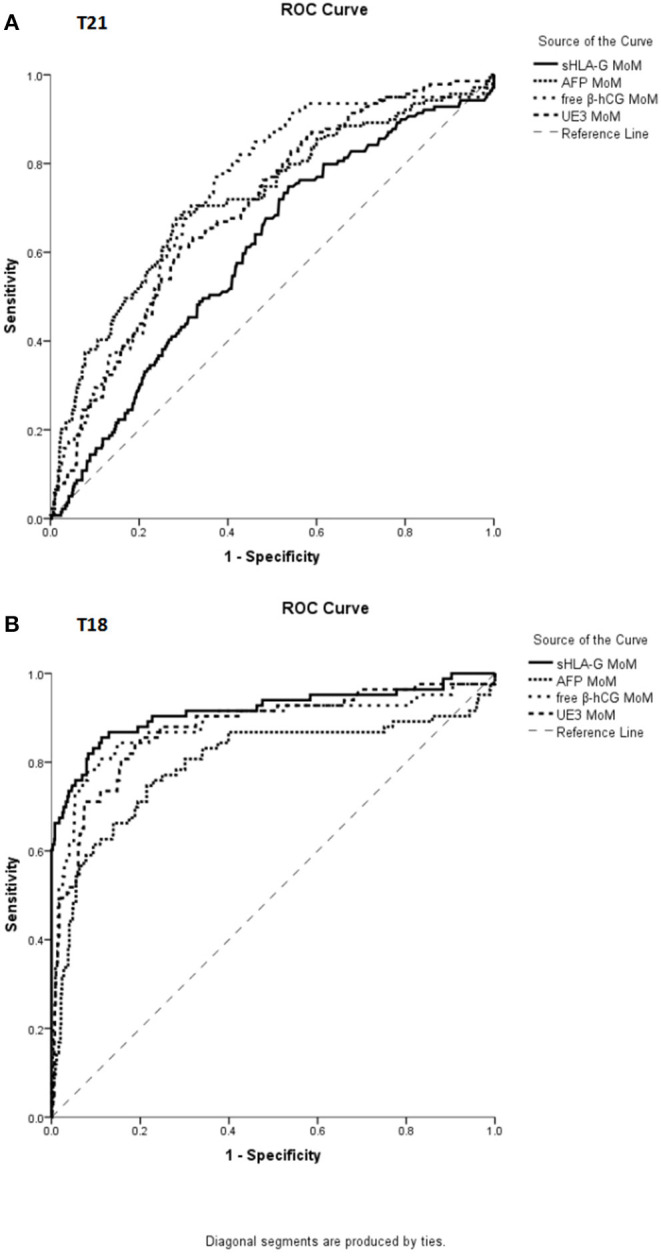
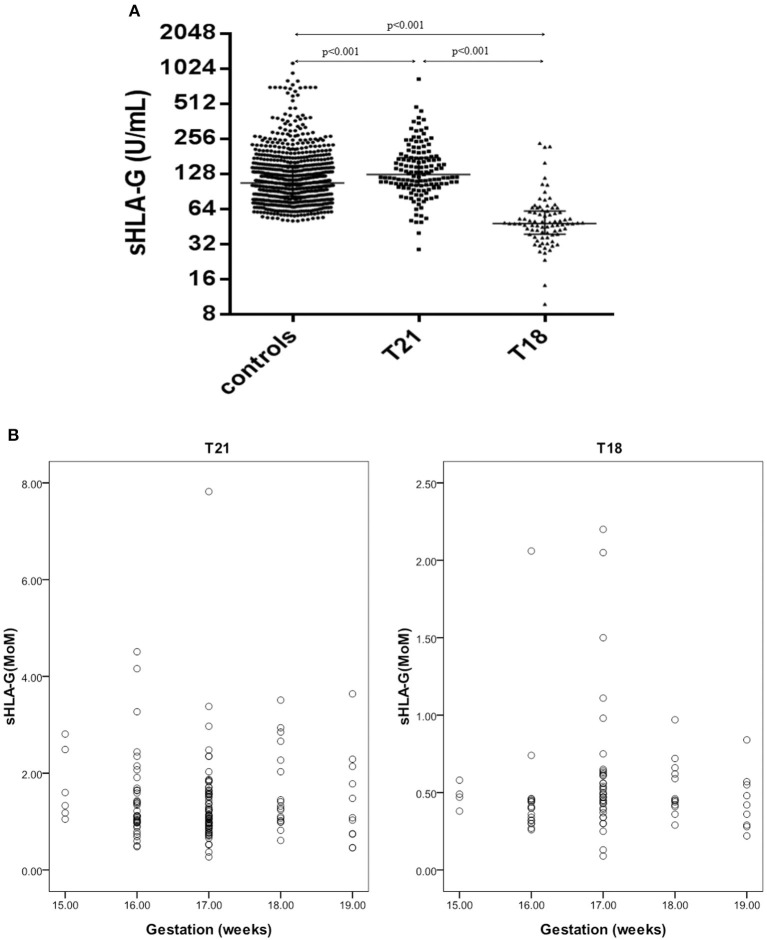
Human leukocyte antigen-G (HLA-G) has been widely acknowledged to play critical roles in fetal-maternal maintenance. However, the significance of using maternal serum sHLA-G to detect prenatal chromosomal abnormality has not been investigated. In China, prenatal screening using maternal α-fetoprotein (AFP), unconjugated estriol (uE3), and free β subunit human chorionic gonadotropin (β-hCG) in the second trimester has been widely applied. In this study, we evaluated the use of sHLA-G as a screening marker, compared with traditional second trimester prenatal screening. Serum samples from 1,019 singleton women in their second trimester were assessed. Among them, 139 infants were confirmed with trisomy 21 (T21) by karyotyping, 83 were confirmed with trisomy 18 (T18), and the remaining 797 infants had no abnormalities. The sHLA-G levels in maternal sera were significantly lower in pregnant women with T18 fetuses (median: 47.8 U/ml, range: 9.8-234.2 U/ml) and significantly higher in those with T21 fetuses (median: 125.7 U/ml, range: 28.7-831.7 U/ml), compared with the normal controls (median: 106.3 U/ml, range: 50.5-1136.4 U/ml) ( < 0.001). The risk values of the screening of T21 or T18 fetuses were assessed using mean and standard deviation log analyte multiples of median (MoM) which showed that the predictive values of sHLA-G were the same as free β-hCG, and superior to AFP and uE3 for T18 screening. Logistic regression analysis revealed that sHLA-G MoM was the highest risk factor associated with pregnant women carrying T18 fetuses [Exp(B): 171.26, 95% CI: 36.30-807.97, < 0.001]. Receiver operating characteristic (ROC) analysis revealed that the area under ROC curve for sHLA-G MoM was 0.915 (95% CI, 0.871-0.959, < 0.001), for AFP MoM was 0.796 (95% CI, 0.730-0.861, < 0.001), for free β-hCG MoM was 0.881 (95% CI, 0.829-0.934, < 0.001), and for uE3 MoM was 0.876 (95% CI, 0.828-0.923, < 0.001) in the T18 group. sHLA-G MoM demonstrated the best sensitivity and negative predictive value. For the first time, our findings reveal that sHLA-G is a better second trimester screening marker for the detection of T18 fetuses and the combined application of sHLA-G with AFP, free β-hCG, and uE3 could improve clinical screening for T18 fetuses.
人类白细胞抗原-G(HLA-G)在维持胎儿与母体关系中发挥关键作用,这一点已得到广泛认可。然而,利用母体血清可溶性HLA-G(sHLA-G)检测产前染色体异常的意义尚未得到研究。在中国,孕中期使用母体甲胎蛋白(AFP)、游离雌三醇(uE3)和游离β亚基人绒毛膜促性腺激素(β-hCG)进行产前筛查已被广泛应用。在本研究中,我们评估了sHLA-G作为一种筛查标志物的应用情况,并与传统的孕中期产前筛查进行了比较。我们对1019名单胎妊娠的孕中期女性的血清样本进行了评估。其中,139例婴儿经核型分析确诊为21三体(T21),83例确诊为18三体(T18),其余797例婴儿无异常。与正常对照组(中位数:106.3 U/ml,范围:50.5 - 1136.4 U/ml)相比,T18胎儿孕妇血清中的sHLA-G水平显著降低(中位数:47.8 U/ml,范围:9.8 - 234.2 U/ml),而T21胎儿孕妇血清中的sHLA-G水平显著升高(中位数:125.7 U/ml,范围:28.7 - 831.7 U/ml)(P < 0.001)。使用中位数的平均和标准差对数分析物倍数(MoM)评估T21或T18胎儿筛查的风险值,结果表明sHLA-G的预测价值与游离β-hCG相同,且在T18筛查中优于AFP和uE3。逻辑回归分析显示,sHLA-G MoM是与怀有T18胎儿的孕妇相关的最高风险因素[Exp(B):171.26,95%置信区间:36.30 - 807.97,P < 0.001]。受试者工作特征(ROC)分析显示,在T