Assistance Publique-Hôpitaux de Paris, Hôpital Saint-Louis, Centre National de Référence des Histiocytoses, Service de Pneumologie, Paris, France.
Division of Pulmonary, Critical Care and Sleep Medicine, University of Cincinnati, Cincinnati, Ohio, United States of America.
PLoS One. 2021 Feb 12;16(2):e0246604. doi: 10.1371/journal.pone.0246604. eCollection 2021.
The prevalence of psychological symptoms and the co-occurrence of substance abuse disorders in adult patients with Langerhans cell histiocytosis (LCH) has not been previously explored. We aimed to use validated scales to evaluate depression and anxiety symptoms experienced by adult LCH patients.
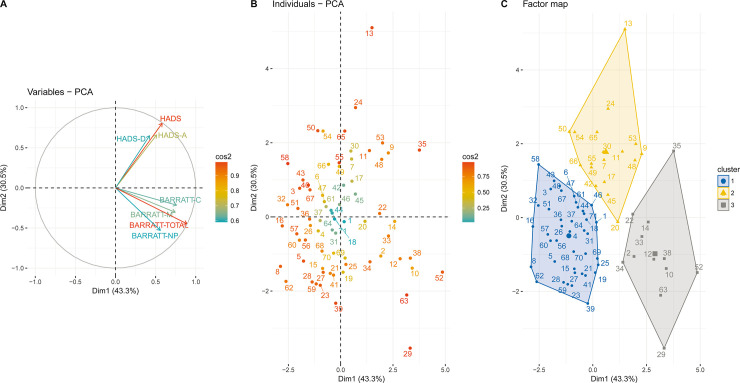
In this cross-sectional study, all consecutive adult LCH patients seen at our national reference center between January 2012 and January 2013 were asked to complete the following instruments: the Hospital Anxiety and Depression scale (HADS); Barratt Impulsiveness Scale, Version 10 (BIS-10); and Cannabis Use Disorders Identification Test (CUDIT). Self-reported scores on these scales were used to determine the point prevalence of clinically significant psychological symptoms and substance use disorders in LCH patients. Patient profiles in terms of psychological features were assessed by principal component analysis including the HADS and BIS-10 instruments values, followed by hierarchical clustering. Fisher exact tests and Wilcoxon tests were used to examine the associations between disease-related parameters and high levels of anxiety and impulsivity.
Seventy-one adult LCH patients, mainly with pulmonary LCH (PLCH), completed the evaluations. Clinically significant anxiety and depression symptoms were reported by 22 (31%) and 4 (6%) subjects, respectively. Impulsivity was detected in 14% (10/71) of the patients. Seventeen percent (12/71) of the patients used cannabis on a regular basis, with 50% of these individuals (6/12) exhibiting scores consistent with cannabis use disorder. Three derived clusters of patients were identified in the principal component analysis; these patient clusters differed in successful weaning from tobacco at the time of evaluation (p = 0.03). In univariate analyses, isolated PLCH and the use of psychotropic treatments were statistically associated with clinically significant anxiety symptoms.
High levels of anxiety and impulsivity are common in adult patients with LCH. The consequences of these symptoms for the management of LCH patients warrant further evaluation.
成人朗格汉斯细胞组织细胞增生症(LCH)患者的心理症状发生率和物质滥用障碍的共病情况尚未得到研究。我们旨在使用经过验证的量表评估成人 LCH 患者的抑郁和焦虑症状。
在这项横断面研究中,我们邀请了 2012 年 1 月至 2013 年 1 月在我们的国家参考中心就诊的所有成年 LCH 患者完成以下量表:医院焦虑和抑郁量表(HADS);Barratt 冲动量表第 10 版(BIS-10);和大麻使用障碍识别测试(CUDIT)。这些量表的自我报告评分用于确定 LCH 患者中临床显著的心理症状和物质使用障碍的患病率。通过包括 HADS 和 BIS-10 仪器值的主成分分析评估患者的心理特征谱,然后进行层次聚类。Fisher 确切检验和 Wilcoxon 检验用于检查疾病相关参数与焦虑和冲动水平升高之间的关联。
71 名成年 LCH 患者(主要为肺 LCH [PLCH])完成了评估。22 名(31%)和 4 名(6%)患者分别报告有临床显著的焦虑和抑郁症状。14%(10/71)的患者存在冲动。17%(12/71)的患者经常使用大麻,其中 50%(6/12)的人表现出与大麻使用障碍一致的分数。在主成分分析中确定了 3 个患者聚类;这些患者聚类在评估时成功戒烟的情况有所不同(p = 0.03)。在单变量分析中,孤立性 PLCH 和使用精神药物治疗与临床显著的焦虑症状具有统计学相关性。
高水平的焦虑和冲动在成人 LCH 患者中很常见。这些症状对 LCH 患者管理的影响需要进一步评估。