Oliveras Anna, Galceran Isabel, Goday Albert, Vázquez Susana, Sans Laia, Riera Marta, Benaiges David, Pascual Julio
Nephrology Department, Hospital Universitari del Mar, 08003 Barcelona, Spain.
IMIM (Hospital del Mar Medical Research Institute), 08003 Barcelona, Spain.
J Clin Med. 2021 Feb 10;10(4):691. doi: 10.3390/jcm10040691.
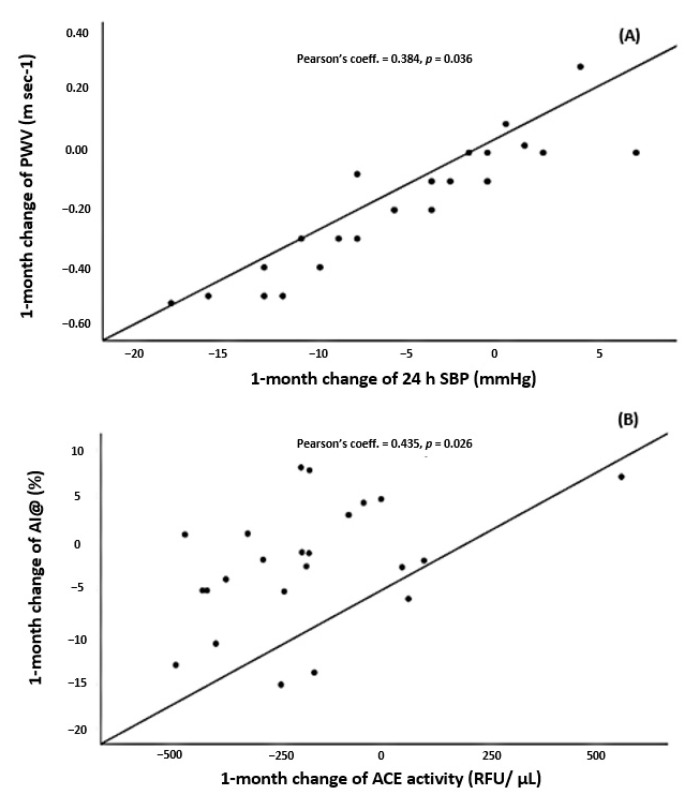
Arterial stiffness (AS) is an independent predictor of cardiovascular risk. We aimed to analyze changes (Δ) in AS 1-month post-bariatric surgery (BS) and search for possible pathophysiological mechanisms. Patients with severe obesity (43% hypertensives) were prospectively evaluated before and 1-month post-BS, with AS assessed by pulse-wave velocity (PWV), augmentation index (AIx@75) and pulse pressure (PP). Ambulatory 24 h blood pressure (BP), anthropometric data, renin-angiotensin-aldosterone system (RAAS) components and several adipokines and inflammatory markers were also analyzed. Overall reduction in body weight was mean (interquartile range (IQR)) = 11.0% (9.6-13.1). A decrease in PWV, AIx@75 and PP was observed 1-month post-BS (all, < 0.01). There were also significant Δ in BP, RAAS components, adipokines and inflammatory biomarkers. Multiple linear regression adjusted models showed that Δaldosterone was an independent variable (B coeff.95%CI) for final PWV (B = -0.003, -0.005 to 0.000; = 0.022). Angiotensin-converting enzyme (ACE)/ACE2 and ACE were independent variables for final AIx@75 (B = 0.036, 0.005 to 0.066; = 0.024) and PP (B = 0.010, 0.003 to 0.017; = 0.01), respectively. There was no correlation between ΔAS and anthropometric changes nor with Δ of adipokines or inflammatory markers except high-sensitivity C-reactive protein (hs-CRP). Patients with PWV below median decreased PWV (mean, 95%CI = -0.18, -0.25 to -0.10; < 0.001) and both AIx@75 and PP at 1-month, but not those with PWV above median. In conclusion, there is an improvement in AS 1-month post-BS that correlates with ΔBP and Δrenin-angiotensin-aldosterone components. The benefit is reduced in those with higher PWV.
动脉僵硬度(AS)是心血管疾病风险的独立预测指标。我们旨在分析减重手术后1个月时AS的变化(Δ),并探寻可能的病理生理机制。对重度肥胖患者(43%为高血压患者)在减重手术前及术后1个月进行前瞻性评估,通过脉搏波速度(PWV)、增强指数(AIx@75)和脉压(PP)评估AS。还分析了24小时动态血压(BP)、人体测量数据、肾素 - 血管紧张素 - 醛固酮系统(RAAS)成分以及多种脂肪因子和炎症标志物。总体体重减轻均值(四分位间距(IQR))= 11.0%(9.6 - 13.1)。减重手术后1个月观察到PWV、AIx@75和PP均下降(均P < 0.01)。BP、RAAS成分、脂肪因子和炎症生物标志物也有显著变化。多元线性回归校正模型显示,Δ醛固酮是最终PWV的独立变量(B系数 95%置信区间)(B = -0.003,-0.005至0.000;P = 0.022)。血管紧张素转换酶(ACE)/ACE2和ACE分别是最终AIx@75(B = 0.036,0.005至0.066;P = 0.024)和PP(B = 0.010,0.003至0.017;P = 0.01)的独立变量。除高敏C反应蛋白(hs - CRP)外,ΔAS与人体测量变化、脂肪因子或炎症标志物的变化均无相关性。PWV低于中位数的患者在1个月时PWV下降(均值,95%置信区间 = -0.18,-0.25至 -0.10;P < 0.001),AIx@75和PP也下降,但PWV高于中位数的患者则不然。总之,减重手术后1个月AS有所改善,这与ΔBP和Δ肾素 - 血管紧张素 - 醛固酮成分相关。PWV较高的患者获益减少。