Castañer O, Pérez-Vega K A, Álvarez S, Vázquez S, Casajoana A, Blanchart G, Gaixas S, Schröder H, Zomeño M D, Subirana I, Muñoz-Aguayo D, Fitó M, Benaiges D, Goday A, Oliveras A
Cardiovascular Risk and Nutrition Research Group, Hospital del Mar Research Institute, Barcelona, Spain.
Network Biomedical Research Center Consortium (CIBER), M.P. Epidemiology and Public Health (CIBEResp), Instituto de Salud Carlos III, Madrid, Spain.
Front Cardiovasc Med. 2024 Nov 7;11:1469433. doi: 10.3389/fcvm.2024.1469433. eCollection 2024.
Bariatric surgery (BS) is the most effective intervention for severe obesity, leading to sustained weight loss, reduced obesity-related comorbidities, and cardiovascular mortality.
To assess changes in high-density lipoprotein (HDL) functions [cholesterol efflux capacity (CEC) and anti-inflammatory capacity] at different follow-up times in patients with severe obesity undergoing BS.
A prospective observational study within a cohort of consecutively enrolled patients with severe obesity scheduled to undergo BS. In total, 62 participants (77% women), with a mean age of 42.1 years (SD 9.33 years) underwent BS. Regarding the surgical procedure, 27 (43.5%) underwent sleeve gastrectomy and 35 (56.5%) Roux-en-Y gastric bypass. All patients were evaluated preoperatively and at 1, 3, 6, and 12 months after surgery.
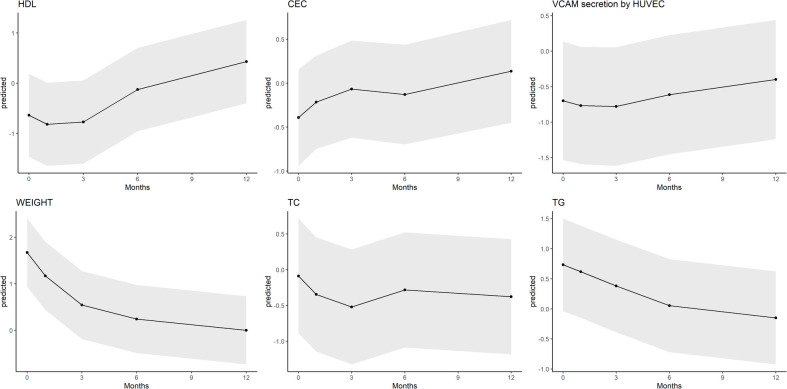
A decrease in body mass index and an improvement in the systemic lipid profile, indicated by reductions in total cholesterol, low-density lipoprotein cholesterol (LDLc), and remnant cholesterol, and an increase in HDL cholesterol (HDLc) was observed (all trend < 0.001). Time-series comparisons vs. baseline showed that, in general, anthropometric measures, glycemia, total cholesterol, LDLc, and remnant cholesterol decreased at all follow-ups, whereas HDLc and triglyceride concentrations significantly improved vs. baseline from 6 months, reaching at 12 months the highest HDLc levels (29.6%, < 0.001) and the lowest circulating triglycerides (-30%, < 0.001). Although HDL's anti-inflammatory ability worsens after surgery, the HDL-mediated CEC linearly increased after surgery (for both trend < 0.013).
BS improves the lipid profile both quantitatively and qualitatively after 1 year, specifically enhancing HDL-mediated cholesterol efflux capacity, which may contribute to a reduced cardiovascular risk in individuals with severe obesity.
减重手术是治疗重度肥胖最有效的干预措施,可实现持续减重,降低肥胖相关合并症及心血管疾病死亡率。
评估重度肥胖患者接受减重手术后不同随访时间高密度脂蛋白(HDL)功能[胆固醇流出能力(CEC)和抗炎能力]的变化。
对一组连续入组的计划接受减重手术的重度肥胖患者进行前瞻性观察研究。共有62名参与者(77%为女性),平均年龄42.1岁(标准差9.33岁)接受了减重手术。手术方式方面,27例(43.5%)接受袖状胃切除术,35例(56.5%)接受 Roux-en-Y 胃旁路术。所有患者在术前及术后1、3、6和12个月进行评估。
观察到体重指数下降,总胆固醇、低密度脂蛋白胆固醇(LDLc)和残余胆固醇降低,高密度脂蛋白胆固醇(HDLc)升高,提示全身脂质谱改善(所有趋势<0.001)。与基线的时间序列比较显示,总体而言,所有随访时人体测量指标、血糖、总胆固醇、LDLc和残余胆固醇均下降,而HDLc和甘油三酯浓度自6个月起较基线显著改善,12个月时达到最高HDLc水平(29.6%,<0.001)和最低循环甘油三酯水平(-30%,<0.001)。虽然术后HDL的抗炎能力恶化,但术后HDL介导的CEC呈线性增加(两者趋势<0.013)。
减重手术1年后可在数量和质量上改善脂质谱,特别是增强HDL介导的胆固醇流出能力,这可能有助于降低重度肥胖个体的心血管风险。