Feng Chenyang, Li Ruixue, Shamim Abu Ahmed, Ullah Md Barkat, Li Mengjie, Dev Rubee, Wang Yijing, Zhao Tingting, Liao Jing, Du Zhicheng, Ling Yuheng, Lai Yingsi, Hao Yuantao
Department of Medical Statistics, School of Public Health, Sun Yat-Sen University, Guangzhou, China.
Department of Information, Sun Yat-Sen University Cancer Center, Guangzhou, 510060, China.
BMC Public Health. 2021 Feb 12;21(1):342. doi: 10.1186/s12889-021-10360-4.
Reproductive tract infections (RTIs) have become major but silent public health problems devastating women's lives in Bangladesh. Accurately and precisely identifying high-risk areas of RTIs through high-resolution risk maps is meaningful for resource-limited settings.
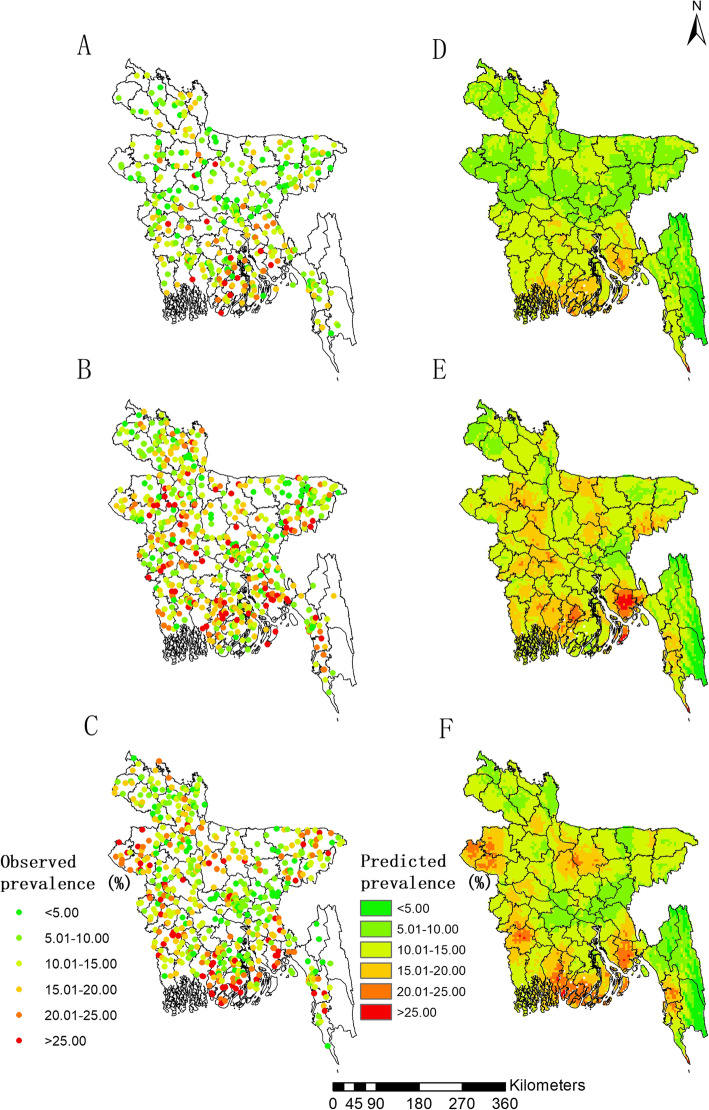
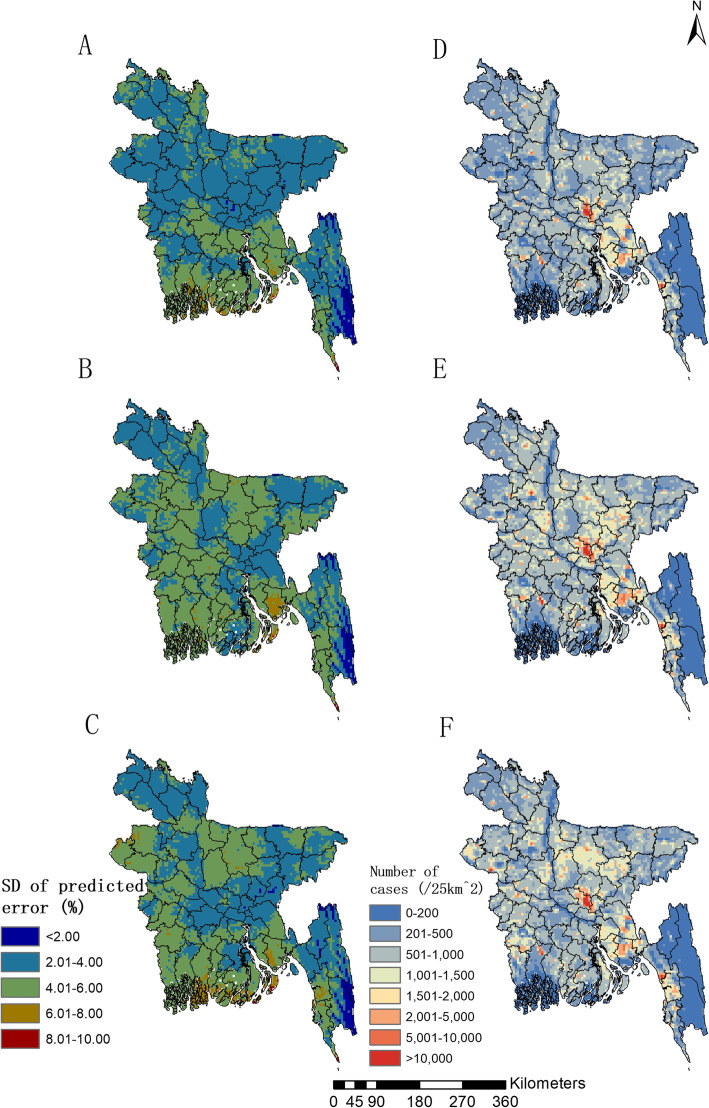
We obtained data reported with RTI symptoms by women of childbearing age in the years 2007, 2011 and 2014 from Bangladesh Demographic and Health Survey. High-spatial Environmental, socio-economic and demographic layers were downloaded from different open-access data sources. We applied Bayesian spatial-temporal models to identify important influencing factors and to estimate the infection risk at 5 km spatial resolution across survey years in Bangladesh.
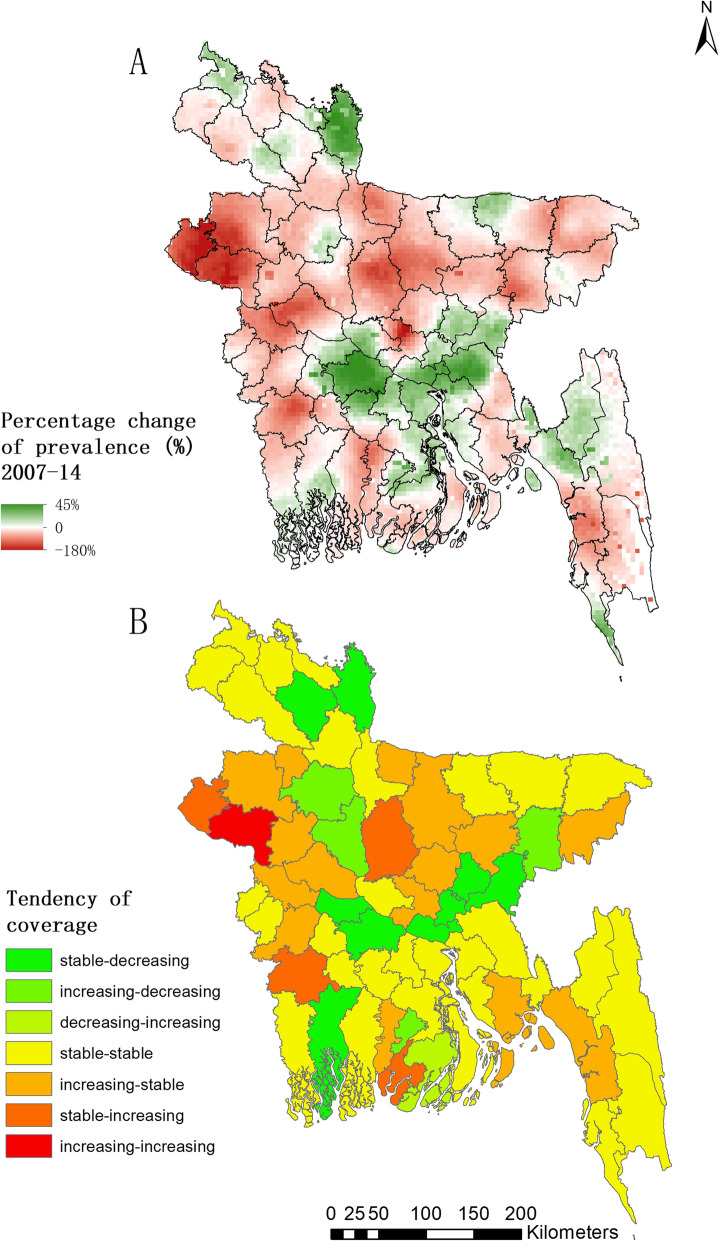
We estimated that in Bangladesh, there were approximate 11.1% (95% Bayesian credible interval, BCI: 10.5-11.7%), 13.9% (95% BCI: 13.3-14.5%) and 13.4% (95% BCI: 12.8-14.0%) of women of childbearing age reported with RTI symptoms in 2007, 2011 and 2014, respectively. The risk of most areas shows an obvious increase from 2007 to 2011, then became stable between 2011 and 2014. High risk areas were identified in the southern coastal areas, the western Rajshahi Division, the middle of Khulna Division, and the southwestern Chittagong Division in 2014. The prevalence of Rajshahi and Nawabganj District were increasing during all the survey years.
The high-resolution risk maps of RTIs we produced can guide the control strategies targeted to priority areas cost-effectively. More than one eighth of women of childbearing age reported symptoms suggesting RTIs and the risk of RTIs varies in different geographical area, urging the government to pay more attention to the worrying situation of female RTIs in the country.
生殖道感染(RTIs)已成为孟加拉国严重但不为人知的公共卫生问题,严重影响着女性的生活。通过高分辨率风险地图准确精确地识别生殖道感染的高风险区域,对于资源有限的地区具有重要意义。
我们从孟加拉国人口与健康调查中获取了2007年、2011年和2014年育龄妇女报告的有生殖道感染症状的数据。从不同的开放获取数据源下载了高空间分辨率的环境、社会经济和人口层面的数据。我们应用贝叶斯时空模型来识别重要影响因素,并估计孟加拉国各调查年份5公里空间分辨率下的感染风险。
我们估计,在孟加拉国,2007年、2011年和2014年分别有大约11.1%(95%贝叶斯可信区间,BCI:10.5 - 11.7%)、13.9%(95% BCI:13.3 - 14.5%)和13.4%(95% BCI:12.8 - 14.0%)的育龄妇女报告有生殖道感染症状。大多数地区的风险从2007年到2011年明显上升,然后在2011年到2014年之间趋于稳定。2014年,在南部沿海地区、西部拉杰沙希专区、库尔纳专区中部和西南部吉大港专区发现了高风险区域。在所有调查年份中,拉杰沙希和纳瓦布甘杰区的患病率都在上升。
我们制作的生殖道感染高分辨率风险地图能够以具有成本效益的方式指导针对优先区域的控制策略。超过八分之一的育龄妇女报告有提示生殖道感染的症状,且生殖道感染风险在不同地理区域有所不同,这促使政府更加关注该国女性生殖道感染的令人担忧的状况。