Louf Jean-François, Lu Nancy B, O'Connell Margaret G, Cho H Jeremy, Datta Sujit S
Department of Chemical and Biological Engineering, Princeton University, Princeton, NJ 08544, USA.
Department of Mechanical Engineering, University of Nevada, Las Vegas, NV 89154, USA.
Sci Adv. 2021 Feb 12;7(7). doi: 10.1126/sciadv.abd2711. Print 2021 Feb.
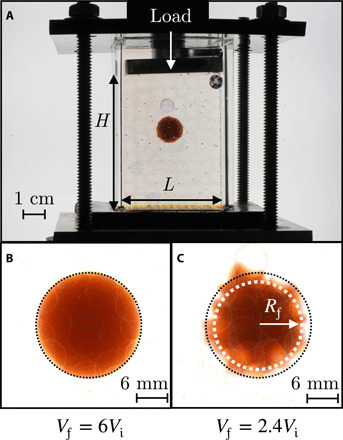
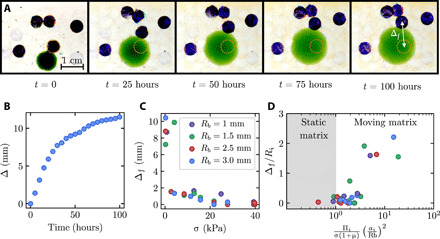
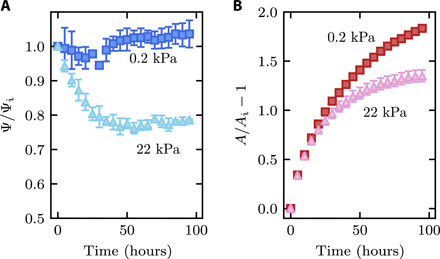
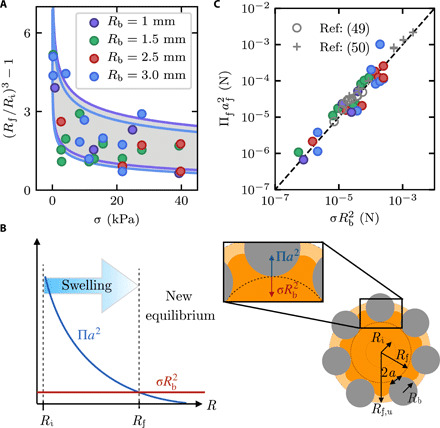
Hydrogels hold promise in agriculture as reservoirs of water in dry soil, potentially alleviating the burden of irrigation. However, confinement in soil can markedly reduce the ability of hydrogels to absorb water and swell, limiting their widespread adoption. Unfortunately, the underlying reason remains unknown. By directly visualizing the swelling of hydrogels confined in three-dimensional granular media, we demonstrate that the extent of hydrogel swelling is determined by the competition between the force exerted by the hydrogel due to osmotic swelling and the confining force transmitted by the surrounding grains. Furthermore, the medium can itself be restructured by hydrogel swelling, as set by the balance between the osmotic swelling force, the confining force, and intergrain friction. Together, our results provide quantitative principles to predict how hydrogels behave in confinement, potentially improving their use in agriculture as well as informing other applications such as oil recovery, construction, mechanobiology, and filtration.
水凝胶有望在农业中作为干旱土壤中的水源,有可能减轻灌溉负担。然而,在土壤中的受限状态会显著降低水凝胶吸收水分和膨胀的能力,限制了它们的广泛应用。不幸的是,其根本原因仍然未知。通过直接观察三维颗粒介质中受限水凝胶的膨胀情况,我们证明水凝胶的膨胀程度取决于水凝胶因渗透膨胀产生的力与周围颗粒传递的约束力之间的竞争。此外,介质本身会因水凝胶的膨胀而发生结构重组,这由渗透膨胀力、约束力和颗粒间摩擦力之间的平衡所决定。总之,我们的研究结果提供了定量原理,以预测水凝胶在受限状态下的行为,这有可能改善它们在农业中的应用,并为其他应用(如石油开采、建筑、力学生物学和过滤)提供参考。