Equipe de Neuro-Ethologie Sensorielle (ENES), Centre de Recherche en Neurosciences de Lyon (CRNL), CNRS, INSERM, University of Lyon/Saint-Étienne, Saint-Étienne, France.
Institute of Psychology, University of Wrocław, Wrocław, Poland.
Nat Commun. 2021 Feb 12;12(1):968. doi: 10.1038/s41467-021-21008-7.
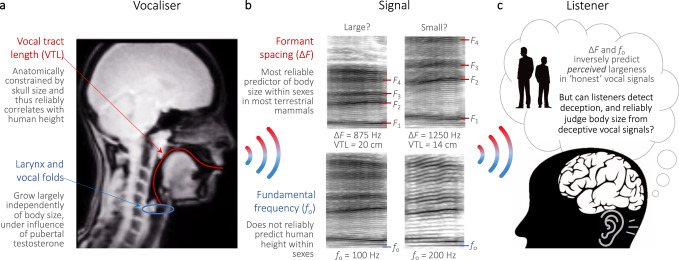
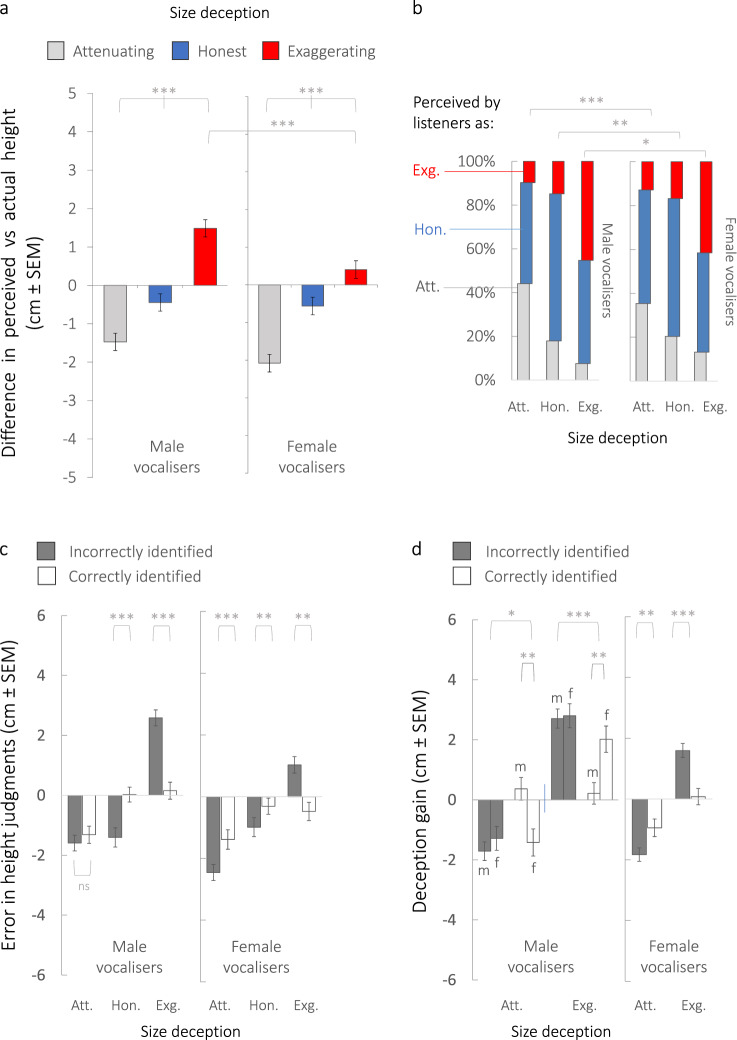
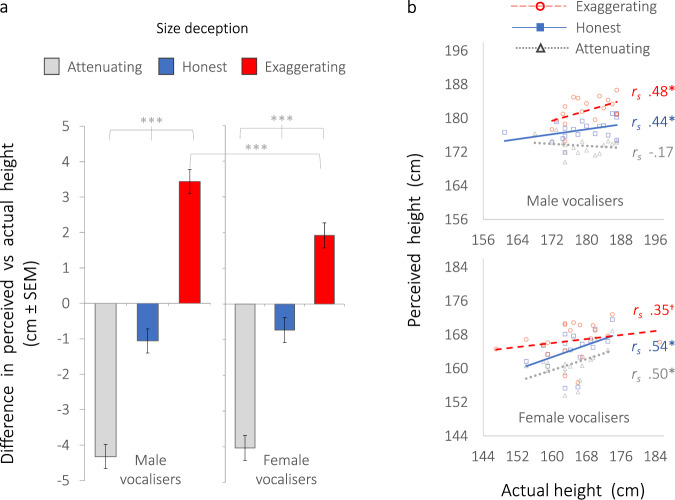
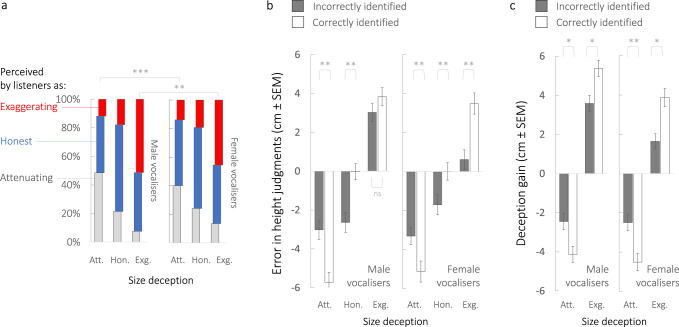
How can deceptive communication signals exist in an evolutionarily stable signalling system? To resolve this age-old honest signalling paradox, researchers must first establish whether deception benefits deceivers. However, while vocal exaggeration is widespread in the animal kingdom and assumably adaptive, its effectiveness in biasing listeners has not been established. Here, we show that human listeners can detect deceptive vocal signals produced by vocalisers who volitionally shift their voice frequencies to exaggerate or attenuate their perceived size. Listeners can also judge the relative heights of cheaters, whose deceptive signals retain reliable acoustic cues to interindividual height. Importantly, although vocal deception biases listeners' absolute height judgments, listeners recalibrate their height assessments for vocalisers they correctly and concurrently identify as deceptive, particularly men judging men. Thus, while size exaggeration can fool listeners, benefiting the deceiver, its detection can reduce bias and mitigate costs for listeners, underscoring an unremitting arms-race between signallers and receivers in animal communication.
欺骗性的通讯信号怎么可能存在于进化稳定的信号系统中呢?为了解决这个由来已久的诚实信号悖论,研究人员首先必须确定欺骗是否对欺骗者有利。然而,虽然在动物王国中广泛存在声音夸大的现象,并且可以假设其具有适应性,但尚未确定其在影响听众方面的有效性。在这里,我们表明,人类听众可以检测到由自愿改变声音频率以夸大或减弱其感知大小的发声者产生的欺骗性声音信号。听众还可以判断骗子的相对身高,其欺骗性信号保留了可靠的个体间身高的声学线索。重要的是,尽管声音欺骗会使听众产生偏见,从而使欺骗者受益,但听众会为他们正确识别为欺骗者的发声者重新校准其身高评估,尤其是男性判断男性时。因此,虽然夸大体型可以欺骗听众,使欺骗者受益,但听众对其的检测可以减少偏见并减轻听众的代价,从而凸显了动物交流中信号发送者和接收者之间持续不断的军备竞赛。