Raine Jordan, Pisanski Katarzyna, Oleszkiewicz Anna, Simner Julia, Reby David
School of Psychology, University of Sussex, Brighton, UK.
School of Psychology, University of Sussex, Brighton, UK; Institute of Psychology, University of Wrocław, Wrocław, Poland.
iScience. 2018 Jun 29;4:273-280. doi: 10.1016/j.isci.2018.05.002. Epub 2018 Jun 28.
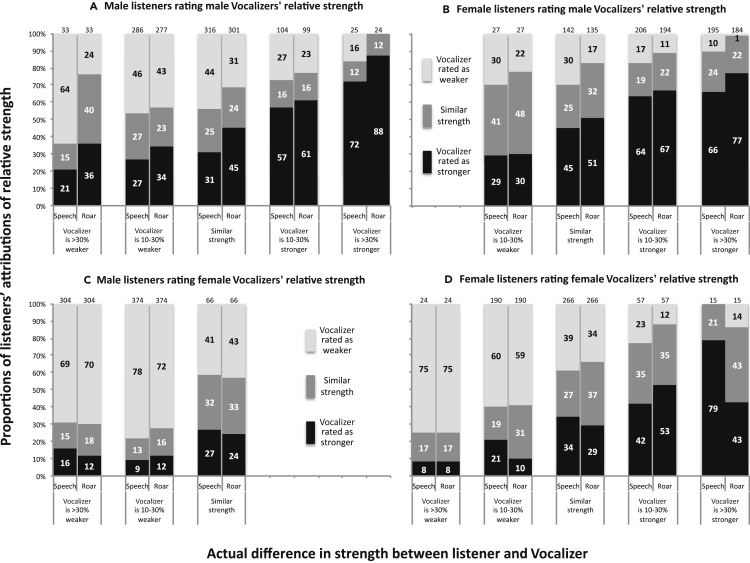
Although animal vocalizations and human speech are known to communicate physical formidability, no previous study has examined whether human listeners can assess the strength or body size of vocalizers relative to their own, either from speech or from nonverbal vocalizations. Here, although men tended to underestimate women's formidability, and women to overestimate men's, listeners judged relative strength and height from aggressive roars and aggressive speech accurately. For example, when judging roars, male listeners accurately identified vocalizers who were substantially stronger than themselves in 88% of trials, and never as weaker. For male vocalizers only, roars functioned to exaggerate the expression of threat compared to aggressive speech, as men were rated as relatively stronger when producing roars. These results indicate that, like other mammals, the acoustic structure of human aggressive vocal signals (and in particular roars) may have been selected to communicate functional information relevant to listeners' survival.
尽管动物发声和人类言语都被认为能传达身体的威慑力,但之前没有研究考察过人类听众是否能从言语或非言语发声中评估发声者相对于自己的力量或体型大小。在此,虽然男性往往低估女性的威慑力,而女性往往高估男性的威慑力,但听众能从攻击性吼声和攻击性言语中准确判断相对力量和身高。例如,在判断吼声时,男性听众在88%的试验中能准确识别出比自己强壮得多的发声者,且从未将其判断为比自己弱。仅对于男性发声者而言,与攻击性言语相比,吼声在夸大威胁表达方面发挥了作用,因为男性发出吼声时被认为相对更强壮。这些结果表明,与其他哺乳动物一样,人类攻击性发声信号(尤其是吼声)的声学结构可能已被选择用于传达与听众生存相关的功能信息。