Center for Drug Evaluation and Research, United State Food and Drug Administration, Silver Spring, MD, USA.
Department of Pharmaceutical Sciences, University of Maryland School of Pharmacy, Baltimore, MD, USA.
Nat Commun. 2021 Feb 12;12(1):984. doi: 10.1038/s41467-021-21262-9.
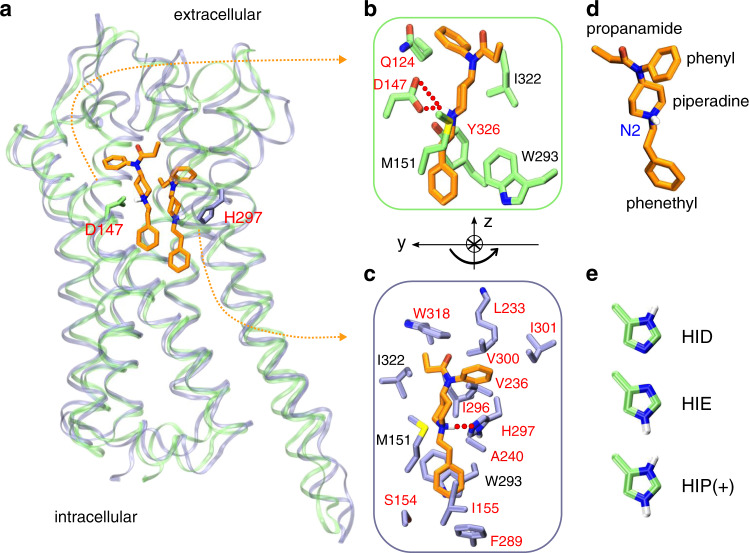
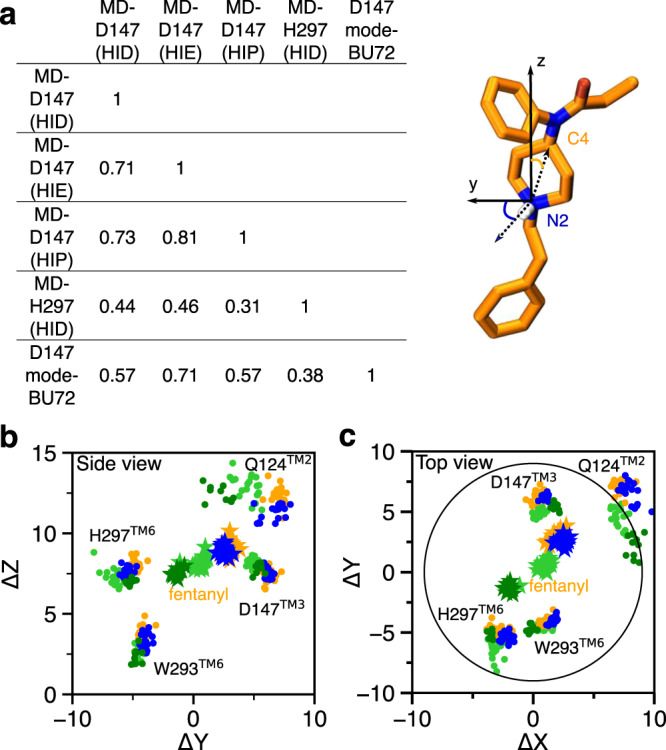
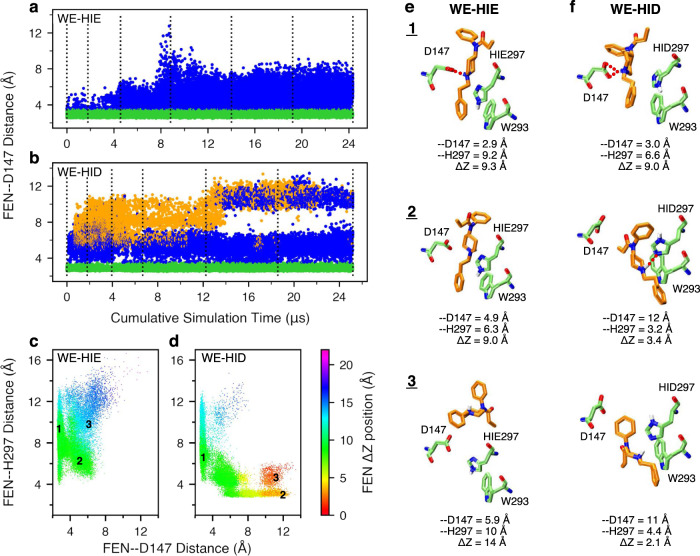
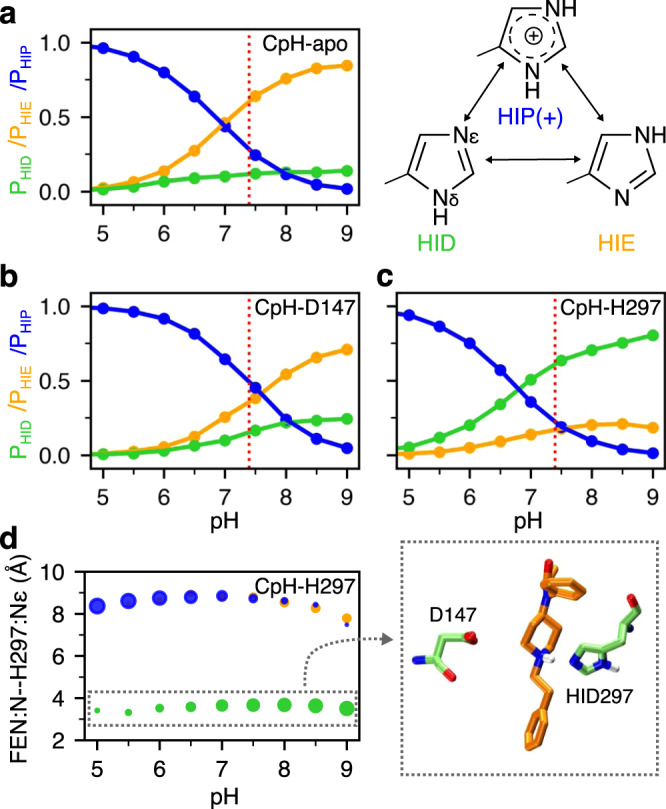
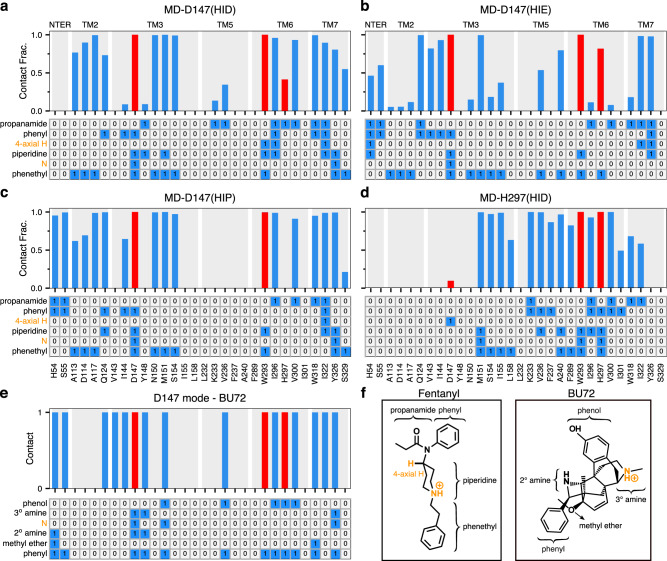
Roughly half of the drug overdose-related deaths in the United States are related to synthetic opioids represented by fentanyl which is a potent agonist of mu-opioid receptor (mOR). In recent years, X-ray crystal structures of mOR in complex with morphine derivatives have been determined; however, structural basis of mOR activation by fentanyl-like opioids remains lacking. Exploiting the X-ray structure of BU72-bound mOR and several molecular simulation techniques, we elucidated the detailed binding mechanism of fentanyl. Surprisingly, in addition to the salt-bridge binding mode common to morphinan opiates, fentanyl can move deeper and form a stable hydrogen bond with the conserved His297, which has been suggested to modulate mOR's ligand affinity and pH dependence by previous mutagenesis experiments. Intriguingly, this secondary binding mode is only accessible when His297 adopts a neutral HID tautomer. Alternative binding modes may represent a general mechanism in G protein-coupled receptor-ligand recognition.
美国大约有一半的药物过量相关死亡与芬太尼为代表的合成阿片类药物有关,芬太尼是μ-阿片受体(mOR)的强效激动剂。近年来,已经确定了 mOR 与吗啡衍生物结合的 X 射线晶体结构;然而,芬太尼类阿片类药物激活 mOR 的结构基础仍然缺乏。利用 BU72 结合的 mOR 的 X 射线结构和几种分子模拟技术,我们阐明了芬太尼的详细结合机制。令人惊讶的是,除了与吗啡喃类阿片类药物共有的盐桥结合模式外,芬太尼还可以更深地移动并与保守的 His297 形成稳定的氢键,先前的突变实验表明 His297 通过这种氢键调节 mOR 的配体亲和力和 pH 依赖性。有趣的是,只有当 His297 采用中性 HID 互变异构体时,才能采用这种二级结合模式。替代结合模式可能代表 G 蛋白偶联受体-配体识别的一般机制。