Majeed Ronja, Faust Ira, Hüppe Michael, Hermann Christiane
Abteilung Klinische Psychologie und Psychotherapie, Justus-Liebig-Universität Gießen, Otto-Behaghel-Str. 10F, 35394, Gießen, Deutschland.
Klinik für Anästhesiologie und Intensivmedizin, Universität zu Lübeck, Ratzeburger Allee 160, 23538, Lübeck, Deutschland.
Schmerz. 2021 Dec;35(6):401-411. doi: 10.1007/s00482-021-00537-6. Epub 2021 Feb 12.
Experiential avoidance is a core process variable in the concept of Acceptance and Commitment Theory (ACT) and has been connected to various disorders. A widely used instrument for the measurement of experiential avoidance is the Acceptance and Action Questionnaire II (AAQ-II). Recently, a pain-specific version for chronic pain patients was introduced in the Netherlands (AAQ-II‑P). High scores indicate strong pain-related experiential avoidance. The aim of the current study was to measure pain-related experiential avoidance in a sample of chronic pain patients using the German translation of the AAQ-II‑P and to analyze its psychometric qualities.
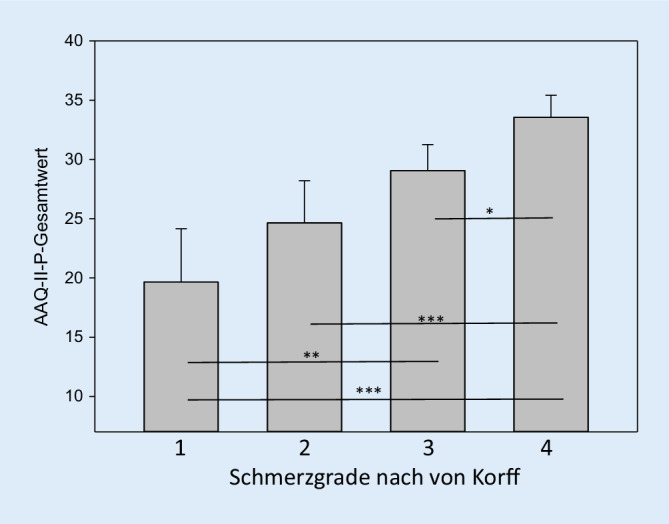
After a forward-backward translation procedure of the AAQ-II and adaptation to the pain context, a sample of N = 168 patients from a multidisciplinary pain center answered the German version of the AAQ-II‑P. Additional questionnaires were administered to measure specific constructs of interest: chronic pain grade (CPG), pain catastrophizing (PCS), health-related quality of life (SF-12), psychopathology (HADS-D), personality (BFI‑K) and mindfulness (KIMS-S). Reliability, factorial validity and construct validity of the AAQ-II‑P were identified.
The AAQ-II‑P had high internal consistency (α = 0.89) and the one-factor solution explained 61% of the total variance. Correlations to personality and mindfulness subscales were low (maxima: r = 0.44 with neuroticism and r = -0.43 with acceptance). High correlations were shown for catastrophizing (r = 0.75), depression (r = 0.73) and anxiety (r = 0.66). Also, there was a substantial correlation to health-related quality of life, specifically the psychological total scale (r = -0.58).
The German AAQ-II‑P has good reliability. Regarding factorial structure and construct validity, it is highly comparable to the original version. Direction and magnitude of the relationship to adjacent constructs mostly measure up to our expectations. Chronic pain patients inclined to pain-related experiential avoidance tend to indicate more pain catastrophizing and show restricted quality of life regarding psychological variables. Apparently, pain-related experiential avoidance can be relevant for popular target variables in psychotherapy.
经验性回避是接纳与承诺疗法(ACT)概念中的一个核心过程变量,并且与多种障碍有关。一种广泛用于测量经验性回避的工具是接纳与行动问卷第二版(AAQ-II)。最近,荷兰推出了针对慢性疼痛患者的特定疼痛版本(AAQ-II-P)。高分表明与疼痛相关的经验性回避程度较高。本研究的目的是使用AAQ-II-P的德文翻译版本测量慢性疼痛患者样本中与疼痛相关的经验性回避,并分析其心理测量学特性。
在对AAQ-II进行前后翻译程序并使其适应疼痛情境后,来自一个多学科疼痛中心的N = 168名患者样本回答了AAQ-II-P的德文版本。还发放了其他问卷以测量感兴趣的特定构念:慢性疼痛等级(CPG)、疼痛灾难化(PCS)、健康相关生活质量(SF-12)、精神病理学(HADS-D)、人格(BFI-K)和正念(KIMS-S)。确定了AAQ-II-P的信度、因子效度和结构效度。
AAQ-II-P具有较高的内部一致性(α = 0.89),单因素解解释了总方差的61%。与人格和正念子量表的相关性较低(最大值:与神经质的相关性r = 0.44,与接纳的相关性r = -0.43)。与灾难化(r = 0.75)、抑郁(r = 0.73)和焦虑(r = 0.66)显示出高度相关性。此外,与健康相关生活质量,特别是心理总量表也存在显著相关性(r = -0.58)。
德文版AAQ-II-P具有良好的信度。在因子结构和结构效度方面,它与原始版本高度可比。与相邻构念关系的方向和强度大多符合我们的预期。倾向于与疼痛相关的经验性回避的慢性疼痛患者往往表现出更多的疼痛灾难化,并且在心理变量方面生活质量受限。显然,与疼痛相关经验性回避可能与心理治疗中常见的目标变量相关。