Department of Freshwater and Marine Ecology, Institute for Biodiversity and Ecosystem Dynamics, University of Amsterdam, Amsterdam, The Netherlands.
School of Biological Sciences, University of Queensland, Brisbane, Australia.
Microbiome. 2021 Feb 14;9(1):44. doi: 10.1186/s40168-020-00984-w.
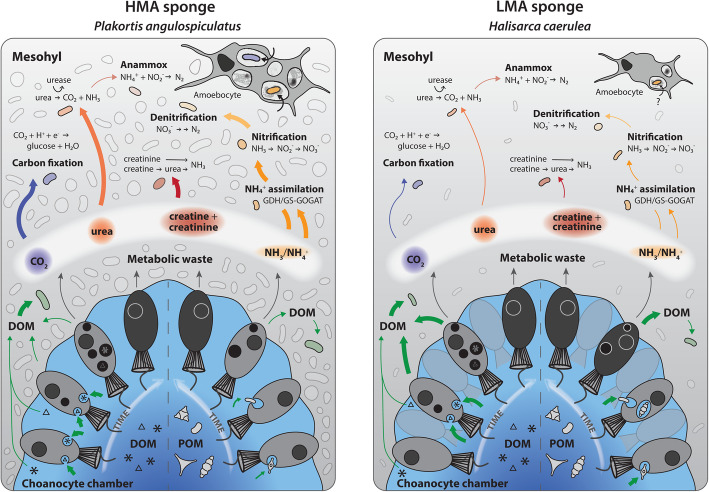
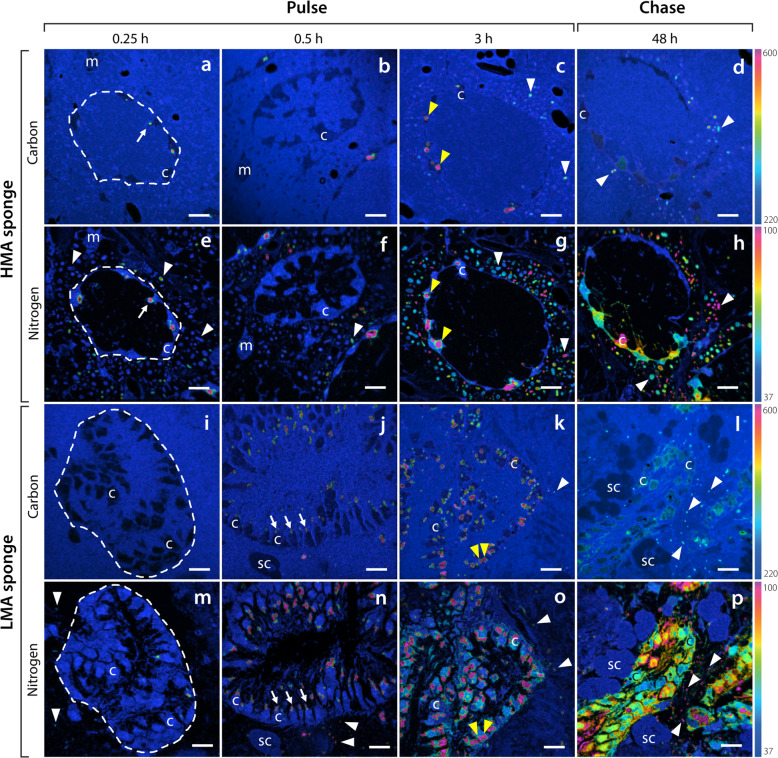
Sponges are increasingly recognised as key ecosystem engineers in many aquatic habitats. They play an important role in nutrient cycling due to their unrivalled capacity for processing both dissolved and particulate organic matter (DOM and POM) and the exceptional metabolic repertoire of their diverse and abundant microbial communities. Functional studies determining the role of host and microbiome in organic nutrient uptake and exchange, however, are limited. Therefore, we coupled pulse-chase isotopic tracer techniques with nanoscale secondary ion mass spectrometry (NanoSIMS) to visualise the uptake and translocation of C- and N-labelled dissolved and particulate organic food at subcellular level in the high microbial abundance sponge Plakortis angulospiculatus and the low microbial abundance sponge Halisarca caerulea.
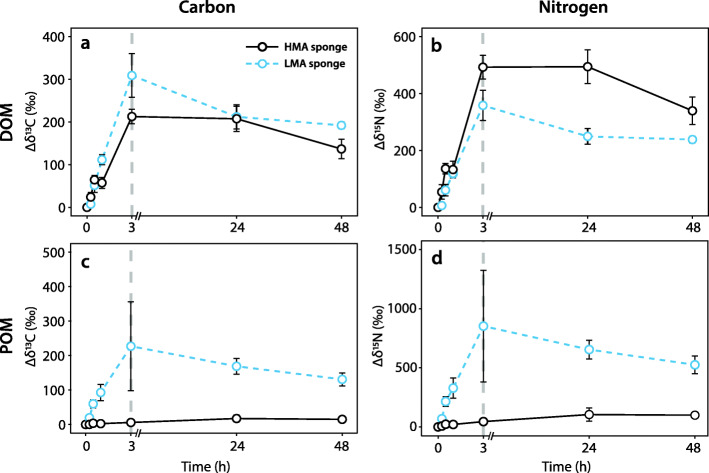
The two sponge species showed significant enrichment of DOM- and POM-derived C and N into their tissue over time. Microbial symbionts were actively involved in the assimilation of DOM, but host filtering cells (choanocytes) appeared to be the primary site of DOM and POM uptake in both sponge species overall, via pinocytosis and phagocytosis, respectively. Translocation of carbon and nitrogen from choanocytes to microbial symbionts occurred over time, irrespective of microbial abundance, reflecting recycling of host waste products by the microbiome.
Here, we provide empirical evidence indicating that the prokaryotic communities of a high and a low microbial abundance sponge obtain nutritional benefits from their host-associated lifestyle. The metabolic interaction between the highly efficient filter-feeding host and its microbial symbionts likely provides a competitive advantage to the sponge holobiont in the oligotrophic environments in which they thrive, by retaining and recycling limiting nutrients. Sponges present a unique model to link nutritional symbiotic interactions to holobiont function, and, via cascading effects, ecosystem functioning, in one of the earliest metazoan-microbe symbioses. Video abstract.
海绵动物在许多水生栖息地中越来越被认为是关键的生态系统工程师。由于其无与伦比的处理溶解和颗粒有机物质(DOM 和 POM)以及其多样而丰富的微生物群落的特殊代谢谱的能力,它们在营养循环中起着重要作用。然而,确定宿主和微生物组在有机养分吸收和交换中的作用的功能研究是有限的。因此,我们将脉冲追踪同位素示踪技术与纳米级二次离子质谱(NanoSIMS)相结合,以在高微生物丰度海绵 Plakortis angulospiculatus 和低微生物丰度海绵 Halisarca caerulea 的亚细胞水平上可视化 C 和 N 标记的溶解和颗粒有机食物的吸收和转运。
这两种海绵物种在时间推移过程中显著富集了 DOM 和 POM 衍生的 C 和 N 进入其组织中。微生物共生体积极参与 DOM 的同化,但宿主过滤细胞(领细胞)似乎是两种海绵物种中 DOM 和 POM 吸收的主要部位,通过胞饮作用和吞噬作用分别进行。碳和氮从领细胞向微生物共生体的转运随时间发生,与微生物丰度无关,反映了微生物组对宿主废物的再循环。
在这里,我们提供了经验证据,表明高微生物丰度海绵和低微生物丰度海绵的原核群落从它们与宿主相关的生活方式中获得营养益处。高效滤食宿主与其微生物共生体之间的代谢相互作用可能为海绵共生体在贫营养环境中提供竞争优势,通过保留和再循环有限的营养物质。海绵提供了一个独特的模型,将营养共生相互作用与整个生物共生体的功能联系起来,并通过级联效应影响生态系统功能,这是最早的后生动物-微生物共生之一。视频摘要。