RD3 Marine Symbioses, GEOMAR Helmholtz Centre for Ocean Research Kiel, Düsternbrooker Weg 20, 24105, Kiel, Germany.
School of Biological Sciences, University of Queensland, St. Lucia, QLD, 4072, Australia.
ISME J. 2020 Oct;14(10):2554-2567. doi: 10.1038/s41396-020-0706-3. Epub 2020 Jun 29.
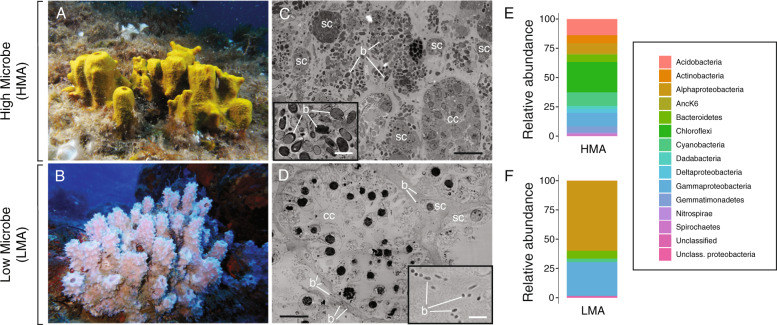
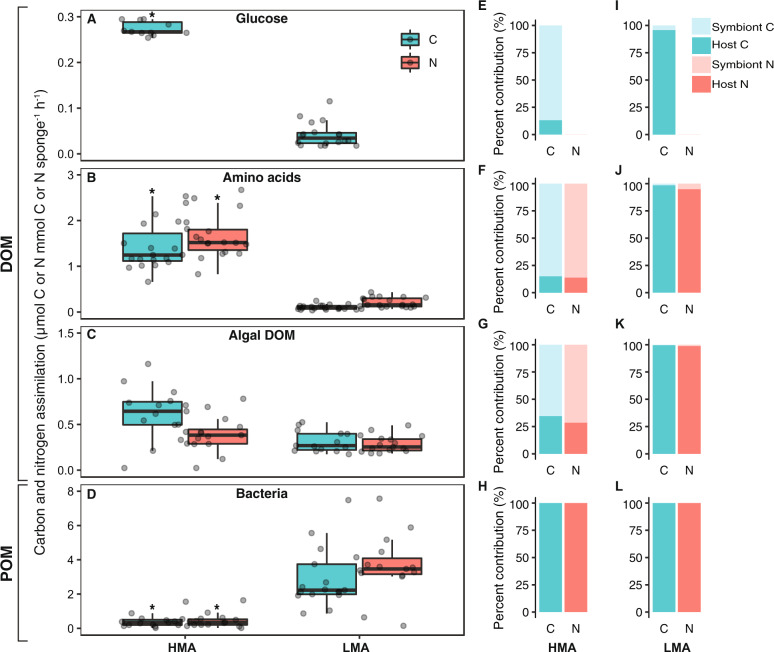
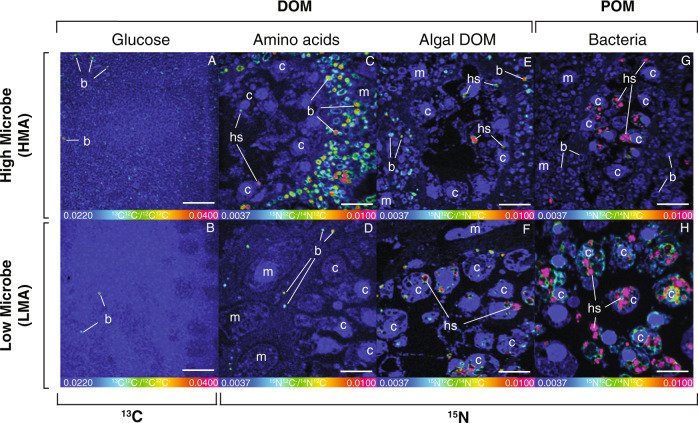
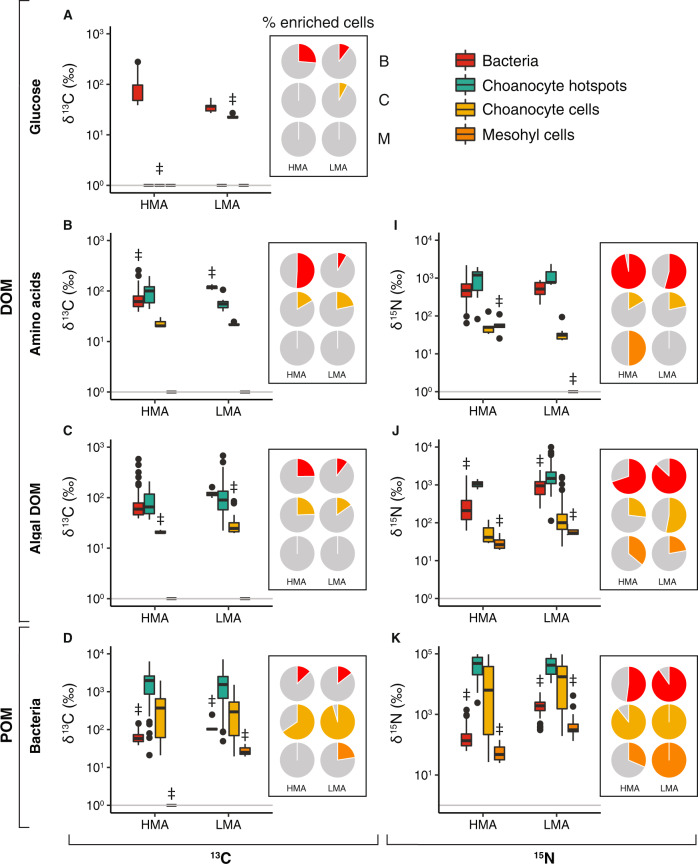
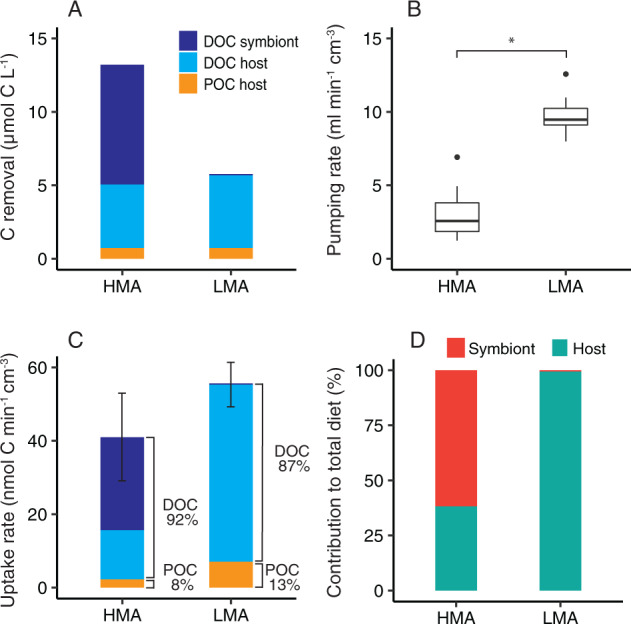
Sponges are the oldest known extant animal-microbe symbiosis. These ubiquitous benthic animals play an important role in marine ecosystems in the cycling of dissolved organic matter (DOM), the largest source of organic matter on Earth. The conventional view on DOM cycling through microbial processing has been challenged by the interaction between this efficient filter-feeding host and its diverse and abundant microbiome. Here we quantify, for the first time, the role of host cells and microbial symbionts in sponge heterotrophy. We combined stable isotope probing and nanoscale secondary ion mass spectrometry to compare the processing of different sources of DOM (glucose, amino acids, algal-produced) and particulate organic matter (POM) by a high-microbial abundance (HMA) and low-microbial abundance (LMA) sponge with single-cell resolution. Contrary to common notion, we found that both microbial symbionts and host choanocyte (i.e. filter) cells and were active in DOM uptake. Although all DOM sources were assimilated by both sponges, higher microbial biomass in the HMA sponge corresponded to an increased capacity to process a greater variety of dissolved compounds. Nevertheless, in situ feeding data demonstrated that DOM was the primary carbon source for both the LMA and HMA sponge, accounting for ~90% of their heterotrophic diets. Microbes accounted for the majority (65-87%) of DOM assimilated by the HMA sponge (and ~60% of its total heterotrophic diet) but <5% in the LMA sponge. We propose that the evolutionary success of sponges is due to their different strategies to exploit the vast reservoir of DOM in the ocean.
海绵是已知最古老的现存动物-微生物共生体。这些无处不在的底栖动物在海洋生态系统中发挥着重要作用,在溶解有机物质 (DOM) 的循环中起着重要作用,DOM 是地球上最大的有机物质来源。通过微生物处理的 DOM 循环的传统观点受到了这种高效滤食宿主与其多样化和丰富的微生物组之间相互作用的挑战。在这里,我们首次定量研究了宿主细胞和微生物共生体在海绵异养中的作用。我们结合稳定同位素示踪和纳米二次离子质谱法,以单细胞分辨率比较了高微生物丰度 (HMA) 和低微生物丰度 (LMA) 海绵对不同来源 DOM(葡萄糖、氨基酸、藻类产生的)和颗粒有机物质 (POM) 的处理。与普遍的观念相反,我们发现微生物共生体和宿主领细胞(即过滤细胞)都积极参与 DOM 的吸收。尽管所有 DOM 来源都被两种海绵同化,但 HMA 海绵中更高的微生物生物量对应于处理更大种类的溶解化合物的能力增加。尽管如此,原位喂养数据表明 DOM 是 LMA 和 HMA 海绵的主要碳源,占其异养饮食的 90%。微生物占 HMA 海绵同化的 DOM 的大部分(65-87%)(以及其总异养饮食的60%),但在 LMA 海绵中 <5%。我们提出,海绵的进化成功是由于它们利用海洋中大量 DOM 资源的不同策略。