Department of Internal Medicine, Niigata Prefectural Tokamachi Hospital, Japan.
Department of Internal Medicine, Uonuma City Koide Hospital, Japan.
Intern Med. 2021;60(4):525-532. doi: 10.2169/internalmedicine.4660-20. Epub 2021 Feb 15.
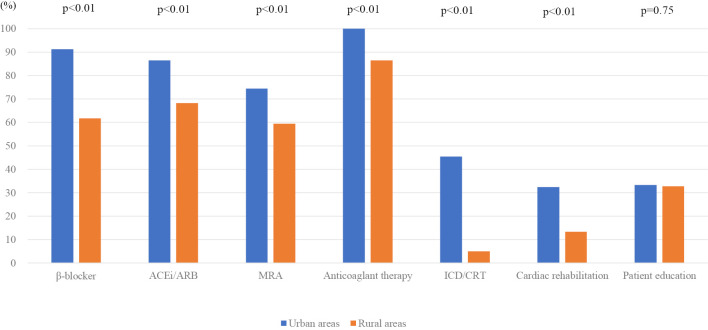
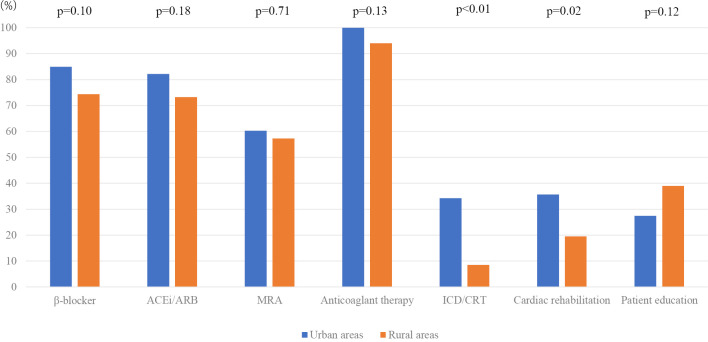
Objective The incidence of chronic heart failure (CHF) is likely to keep increasing in Japan as the population ages, placing increased burdens on medical facilities, particularly on the limited numbers of rural hospitals. We explored the appropriateness of CHF treatment in rural areas in Japan. Methods We compared rates of adherence to therapeutic guidelines for CHF between residents with a left ventricular ejection fraction <35% living in urban areas (n = 207) and those in rural areas (n = 180). Treatments included pharmacological [beta-blockers, angiotensin-converting enzyme inhibitors (ACEi)/angiotensin II receptor blocker (ARB), mineralocorticoid receptor antagonist (MRA) and anticoagulants for atrial fibrillation] and non-pharmacological [implantable cardioverter defibrillator (ICD)/cardiac resynchronization therapy (CRT), cardiac rehabilitation and HF education] approaches. Patients This study included 387 patients with CHF, prior myocardial infarction or cardiomyopathy, and a left ventricular ejection fraction (LVEF) <35% as determined by echocardiography. Results The respective rates of treatments administered in urban and rural areas were as follows: beta-blockers, 91.3% vs. 61.7% (p<0.05); ACEi/ARB, 86.5% vs. 68.3% (p<0.05); MRA, 74.4% vs. 59.4% (p<0.01); anticoagulants, 100% vs. 86.5%, (p<0.05); ICD/CRT, 45.4% vs. 5.0% (p<0.05); cardiac rehabilitation, 32.4% vs. 13.3% (p<0.05) and HF education, 33.3% vs. 32.8% (p=0.75). Conclusion Regional disparities in treatment for CHF persist, even in Japan. Improvements in the use of guideline-directed treatment in rural areas might improve the outcomes for CHF patients.
随着人口老龄化,日本慢性心力衰竭(CHF)的发病率可能会继续上升,这给医疗设施,尤其是农村医院带来了更大的负担。我们探讨了日本农村地区 CHF 治疗的适宜性。
我们比较了左心室射血分数(LVEF)<35%的居住在城市(n=207)和农村(n=180)地区的 CHF 患者对治疗指南的依从性。治疗包括药物治疗[β受体阻滞剂、血管紧张素转换酶抑制剂(ACEi)/血管紧张素 II 受体阻滞剂(ARB)、盐皮质激素受体拮抗剂(MRA)和心房颤动的抗凝剂]和非药物治疗[植入式心脏复律除颤器(ICD)/心脏再同步治疗(CRT)、心脏康复和心力衰竭教育]。
这项研究包括 387 名 CHF、既往心肌梗死或心肌病患者,且超声心动图检查 LVEF<35%。
城市和农村地区治疗的比例分别为:β受体阻滞剂,91.3%比 61.7%(p<0.05);ACEi/ARB,86.5%比 68.3%(p<0.05);MRA,74.4%比 59.4%(p<0.01);抗凝剂,100%比 86.5%(p<0.05);ICD/CRT,45.4%比 5.0%(p<0.05);心脏康复,32.4%比 13.3%(p<0.05);心力衰竭教育,33.3%比 32.8%(p=0.75)。
即使在日本,CHF 治疗的区域差异仍然存在。改善农村地区指南指导治疗的使用可能会改善 CHF 患者的结局。