Muhammad Izhar, Shalmani Abdullah, Ali Muhammad, Yang Qing-Hua, Ahmad Husain, Li Feng Bai
State Key Laboratory of Crop Stress Biology for Arid Areas, College of Agronomy, Northwest A&F University, Yangling, China.
State Key Laboratory of Crop Stress Biology for Arid Areas, College of Life Sciences, Northwest A&F University, Yangling, China.
Front Plant Sci. 2021 Jan 28;11:615942. doi: 10.3389/fpls.2020.615942. eCollection 2020.
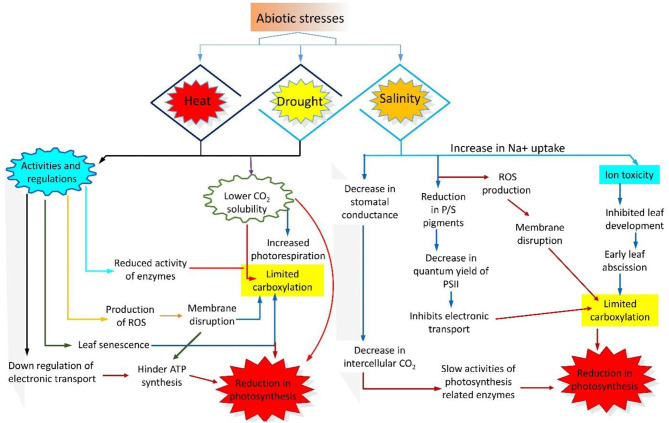
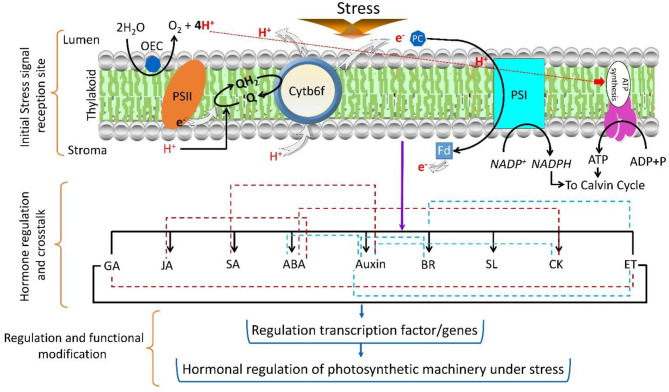
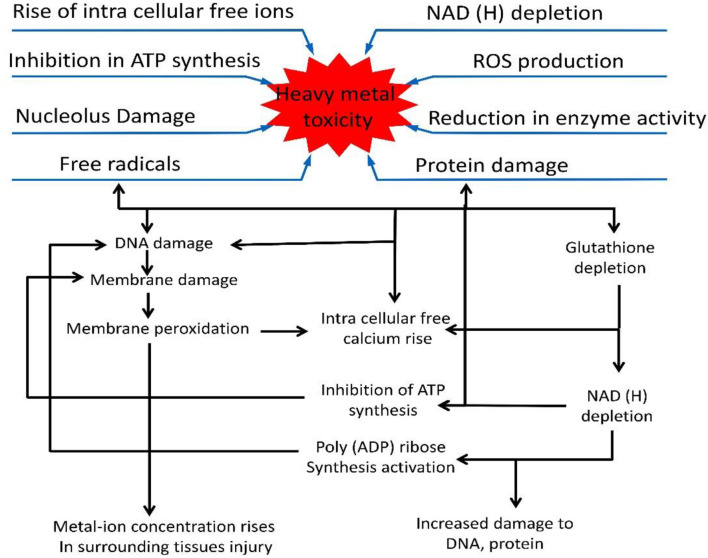
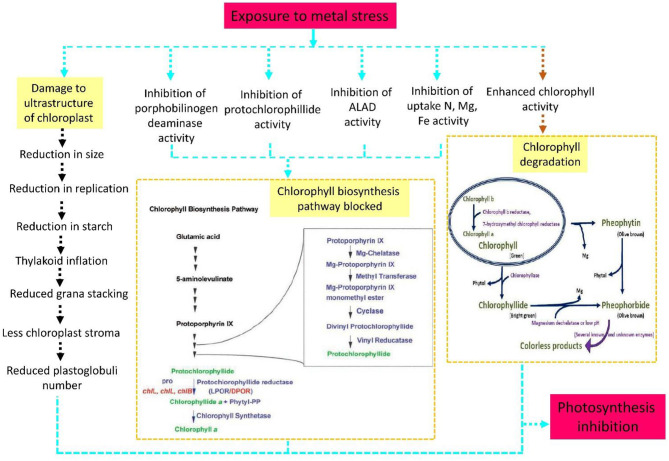
Photosynthesis sustains plant life on earth and is indispensable for plant growth and development. Factors such as unfavorable environmental conditions, stress regulatory networks, and plant biochemical processes limits the photosynthetic efficiency of plants and thereby threaten food security worldwide. Although numerous physiological approaches have been used to assess the performance of key photosynthetic components and their stress responses, though, these approaches are not extensive enough and do not favor strategic improvement of photosynthesis under abiotic stresses. The decline in photosynthetic capacity of plants due to these stresses is directly associated with reduction in yield. Therefore, a detailed information of the plant responses and better understanding of the photosynthetic machinery could help in developing new crop plants with higher yield even under stressed environments. Interestingly, cracking of signaling and metabolic pathways, identification of some key regulatory elements, characterization of potential genes, and phytohormone responses to abiotic factors have advanced our knowledge related to photosynthesis. However, our understanding of dynamic modulation of photosynthesis under dramatically fluctuating natural environments remains limited. Here, we provide a detailed overview of the research conducted on photosynthesis to date, and highlight the abiotic stress factors (heat, salinity, drought, high light, and heavy metal) that limit the performance of the photosynthetic machinery. Further, we reviewed the role of transcription factor genes and various enzymes involved in the process of photosynthesis under abiotic stresses. Finally, we discussed the recent progress in the field of biodegradable compounds, such as chitosan and humic acid, and the effect of melatonin (bio-stimulant) on photosynthetic activity. Based on our gathered researched data set, the logical concept of photosynthetic regulation under abiotic stresses along with improvement strategies will expand and surely accelerate the development of stress tolerance mechanisms, wider adaptability, higher survival rate, and yield potential of plant species.
光合作用维持着地球上的植物生命,对植物的生长发育不可或缺。诸如不利的环境条件、胁迫调控网络和植物生化过程等因素会限制植物的光合效率,进而威胁全球粮食安全。尽管已经采用了众多生理学方法来评估关键光合组分的性能及其胁迫响应,但是这些方法不够全面,不利于在非生物胁迫下对光合作用进行战略性改进。由于这些胁迫导致的植物光合能力下降与产量降低直接相关。因此,详细了解植物的响应以及更好地理解光合机制有助于培育即使在胁迫环境下也能高产的新型作物。有趣的是,信号传导和代谢途径的破解、一些关键调控元件的鉴定、潜在基因的表征以及植物激素对非生物因子的响应,都增进了我们对光合作用的认识。然而,我们对自然环境剧烈波动下光合作用动态调节的理解仍然有限。在此,我们详细概述了迄今为止关于光合作用的研究,并强调了限制光合机制性能的非生物胁迫因素(高温、盐度、干旱、强光和重金属)。此外,我们综述了非生物胁迫下参与光合作用过程的转录因子基因和各种酶的作用。最后,我们讨论了壳聚糖和腐殖酸等可生物降解化合物领域的最新进展,以及褪黑素(生物刺激剂)对光合活性的影响。基于我们收集的研究数据集,非生物胁迫下光合调节的逻辑概念以及改进策略将得到拓展,并肯定会加速植物物种胁迫耐受机制、更广泛适应性、更高存活率和产量潜力的发展。