Karumannil Sameera, Khan Tanveer Alam, Kappachery Sajeesh, Gururani Mayank Anand
Biology Department, College of Science, UAE University, Al Ain P.O. Box 15551, United Arab Emirates.
Plants (Basel). 2023 Aug 15;12(16):2948. doi: 10.3390/plants12162948.
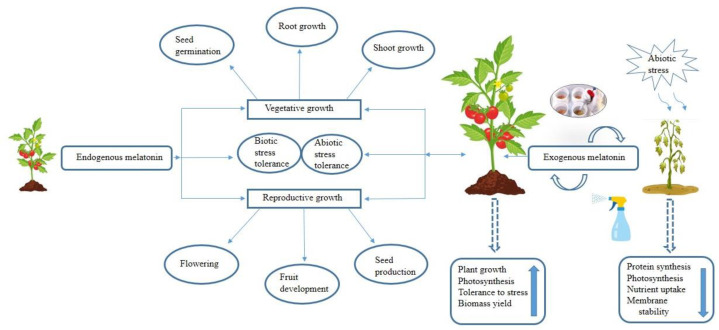
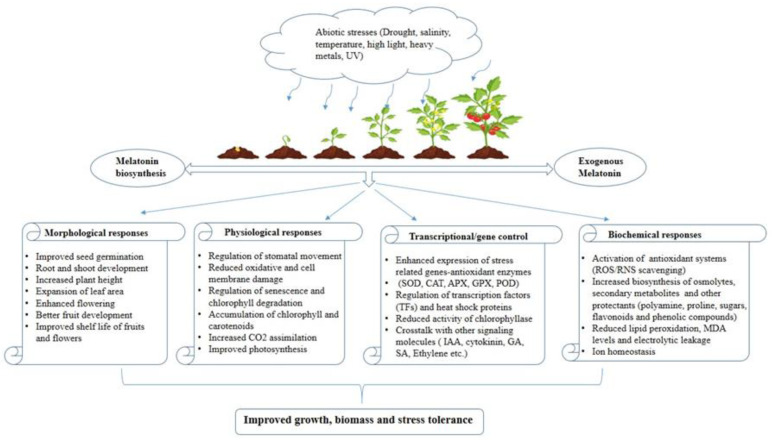
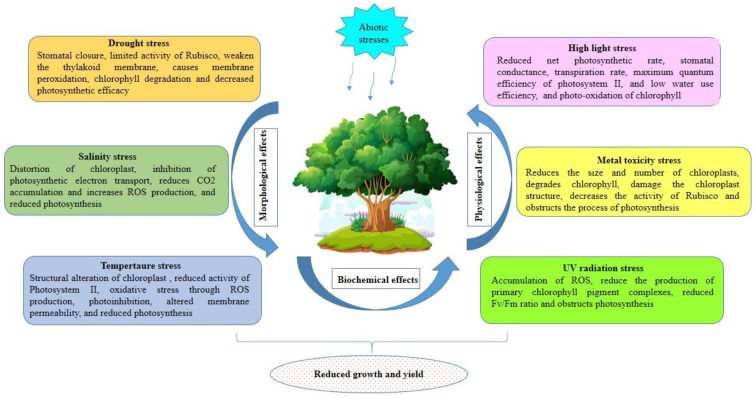
Inhospitable conditions that hinder plant growth and development encompass a range of abiotic stresses, such as drought, extreme temperatures (both low and high), salinity, exposure to heavy metals, and irradiation. The cumulative impact of these stresses leads to a considerable reduction in agricultural productivity worldwide. The generation of reactive oxygen species (ROS) is a shared mechanism of toxicity induced by all these abiotic stimuli in plants, resulting in oxidative damage and membrane instability. Extensive research has shed light on the dual role of melatonin in plants, where it serves as both a growth regulator, fostering growth and development, and a potent protector against abiotic stresses. The inherent potential of melatonin to function as a natural antioxidant positions it as a promising biostimulant for agricultural use, bolstering plants' abilities to withstand a wide array of environmental challenges. Beyond its antioxidant properties, melatonin has demonstrated its capacity to regulate the expression of genes associated with the photosynthetic process. This additional characteristic enhances its appeal as a versatile chemical agent that can be exogenously applied to plants, particularly in adverse conditions, to improve their resilience and optimize photosynthetic efficiency in every phase of the plant life cycle. An examination of the molecular mechanisms underlying the stress-protective effects of exogenous melatonin on the photosynthetic machinery of plants under various abiotic stresses is presented in this paper. In addition, future prospects are discussed for developing stress-tolerant crops for sustainable agriculture in challenging environments.
阻碍植物生长发育的恶劣条件包括一系列非生物胁迫,如干旱、极端温度(低温和高温)、盐度、重金属暴露和辐射。这些胁迫的累积影响导致全球农业生产力大幅下降。活性氧(ROS)的产生是植物中所有这些非生物刺激诱导毒性的共同机制,导致氧化损伤和膜不稳定。广泛的研究揭示了褪黑素在植物中的双重作用,它既是一种生长调节剂,促进生长和发育,又是一种有效的抗非生物胁迫保护剂。褪黑素作为一种天然抗氧化剂的内在潜力使其成为一种有前途的农业生物刺激剂,增强植物抵御各种环境挑战的能力。除了其抗氧化特性外,褪黑素还显示出调节与光合作用过程相关基因表达的能力。这一额外特性增强了它作为一种通用化学剂的吸引力,这种化学剂可以外源施用于植物,特别是在不利条件下,以提高其恢复力,并在植物生命周期的每个阶段优化光合效率。本文研究了外源褪黑素在各种非生物胁迫下对植物光合机制的胁迫保护作用的分子机制。此外,还讨论了在具有挑战性的环境中开发耐胁迫作物以实现可持续农业的未来前景。