Tumajer Jan, Kašpar Jakub, Kuželová Hana, Shishov Vladimir V, Tychkov Ivan I, Popkova Margarita I, Vaganov Eugene A, Treml Václav
Department of Physical Geography and Geoecology, Faculty of Science, Charles University, Prague, Czechia.
Institute of Botany and Landscape Ecology, University of Greifswald, Greifswald, Germany.
Front Plant Sci. 2021 Jan 28;12:613643. doi: 10.3389/fpls.2021.613643. eCollection 2021.
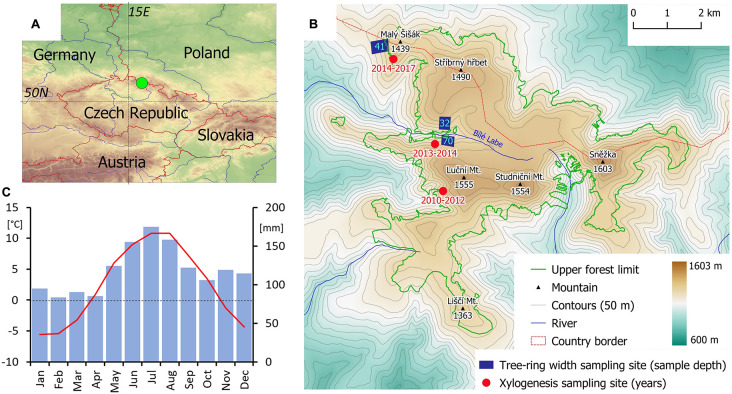
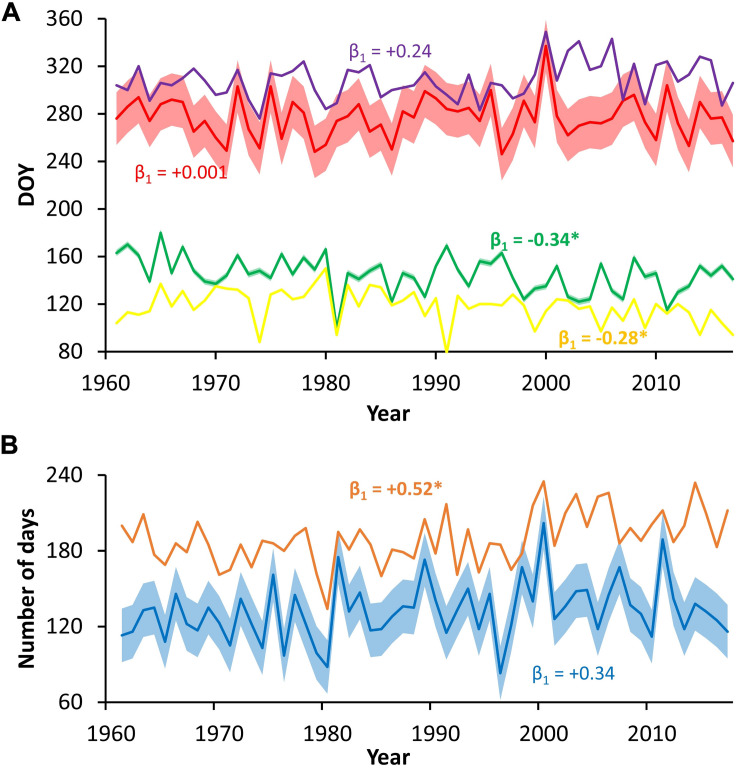
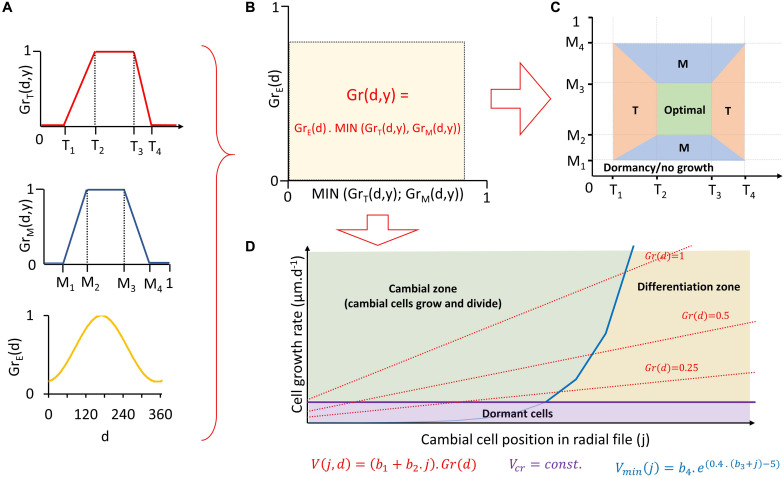
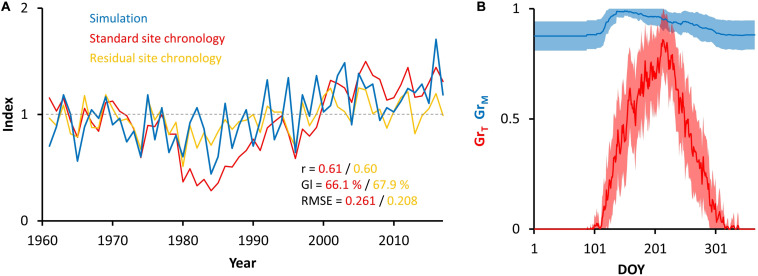
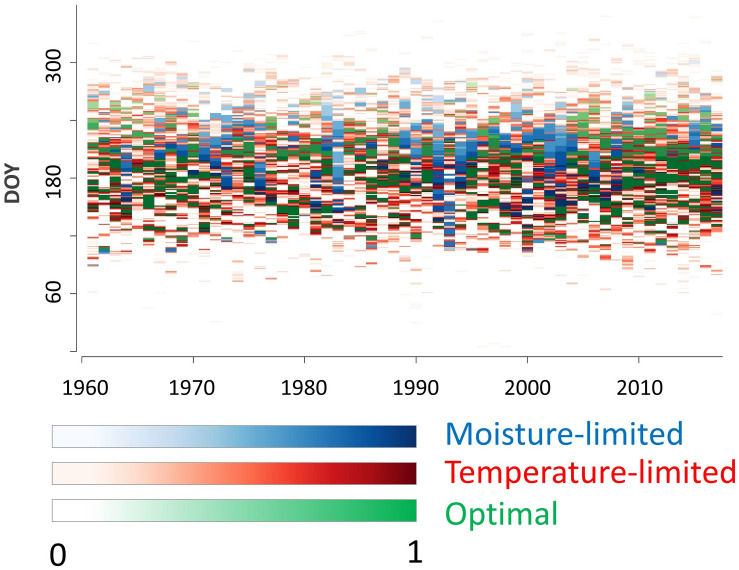
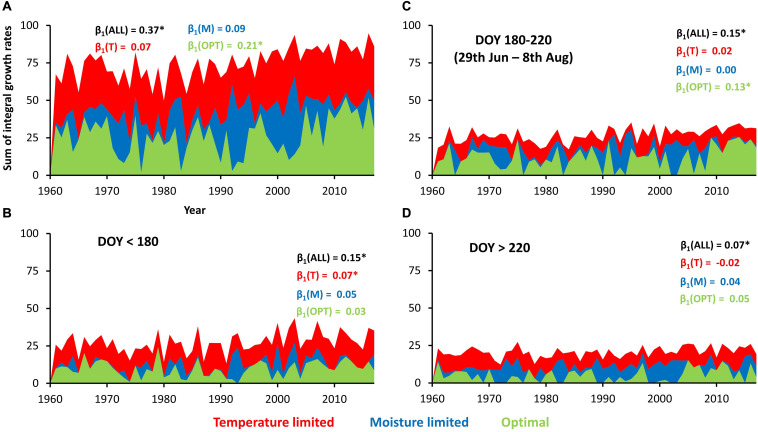
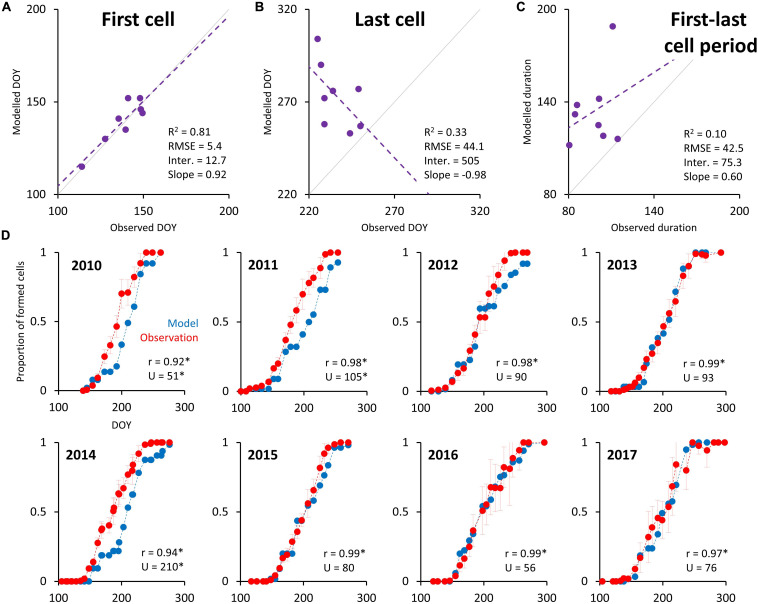
Significant alterations of cambial activity might be expected due to climate warming, leading to growing season extension and higher growth rates especially in cold-limited forests. However, assessment of climate-change-driven trends in intra-annual wood formation suffers from the lack of direct observations with a timespan exceeding a few years. We used the Vaganov-Shashkin process-based model to: (i) simulate daily resolved numbers of cambial and differentiating cells; and (ii) develop chronologies of the onset and termination of specific phases of cambial phenology during 1961-2017. We also determined the dominant climatic factor limiting cambial activity for each day. To asses intra-annual model validity, we used 8 years of direct xylogenesis monitoring from the treeline region of the Krkonoše Mts. (Czechia). The model exhibits high validity in case of spring phenological phases and a seasonal dynamics of tracheid production, but its precision declines for estimates of autumn phenological phases and growing season duration. The simulations reveal an increasing trend in the number of tracheids produced by cambium each year by 0.42 cells/year. Spring phenological phases (onset of cambial cell growth and tracheid enlargement) show significant shifts toward earlier occurrence in the year (for 0.28-0.34 days/year). In addition, there is a significant increase in simulated growth rates during entire growing season associated with the intra-annual redistribution of the dominant climatic controls over cambial activity. Results suggest that higher growth rates at treeline are driven by (i) temperature-stimulated intensification of spring cambial kinetics, and (ii) decoupling of summer growth rates from the limiting effect of low summer temperature due to higher frequency of climatically optimal days. Our results highlight that the cambial kinetics stimulation by increasing spring and summer temperatures and shifting spring phenology determine the recent growth trends of treeline ecosystems. Redistribution of individual climatic factors controlling cambial activity during the growing season questions the temporal stability of climatic signal of cold forest chronologies under ongoing climate change.
由于气候变暖,形成层活动可能会发生显著变化,导致生长季节延长和生长速率提高,尤其是在寒冷限制的森林中。然而,评估气候变化驱动的年内木材形成趋势存在困难,因为缺乏超过数年时间跨度的直接观测数据。我们使用基于Vaganov-Shashkin过程的模型来:(i)模拟形成层和分化细胞的每日解析数量;(ii)编制1961 - 2017年期间形成层物候特定阶段开始和结束的年表。我们还确定了每天限制形成层活动的主要气候因子。为了评估年内模型的有效性,我们使用了来自捷克共和国克尔科诺谢山树线地区的8年直接木质部形成监测数据。该模型在春季物候阶段和管胞产生的季节动态方面表现出较高的有效性,但其对秋季物候阶段和生长季节持续时间的估计精度有所下降。模拟结果显示,形成层每年产生的管胞数量呈增加趋势,每年增加0.42个细胞。春季物候阶段(形成层细胞生长和管胞增大的开始)在一年中显著提前出现(每年提前0.28 - 0.34天)。此外,与主导气候控制对形成层活动的年内重新分配相关,整个生长季节的模拟生长速率显著增加。结果表明,树线处较高的生长速率是由(i)温度刺激的春季形成层动力学强化,以及(ii)由于气候适宜天数增加,夏季生长速率与夏季低温限制效应脱钩所驱动的。我们的结果突出表明,春季和夏季温度升高对形成层动力学产生刺激以及春季物候的变化决定了树线生态系统近期的生长趋势。生长季节中控制形成层活动的各个气候因子的重新分配,对当前气候变化下寒温带森林年表气候信号的时间稳定性提出了质疑。