Bannon Sarah A, Routbort Mark J, Montalban-Bravo Guillermo, Mehta Rohtesh S, Jelloul Fatima Zahra, Takahashi Koichi, Daver Naval, Oran Betul, Pemmaraju Naveen, Borthakur Gautam, Naqvi Kiran, Issa Ghayas, Sasaki Koji, Alvarado Yesid, Kadia Tapan M, Konopleva Marina, Shamanna Rashmi Kanagal, Khoury Joseph D, Ravandi Farhad, Champlin Richard, Kantarjian Hagop M, Bhalla Kapil, Garcia-Manero Guillermo, Patel Keyur P, DiNardo Courtney D
Department of Clinical Cancer Genetics, The University of Texas M. D. Anderson Cancer Center, Houston, TX, United States.
Department of Hematopathology, The University of Texas M. D. Anderson Cancer Center, Houston, TX, United States.
Front Oncol. 2021 Jan 28;10:582213. doi: 10.3389/fonc.2020.582213. eCollection 2020.
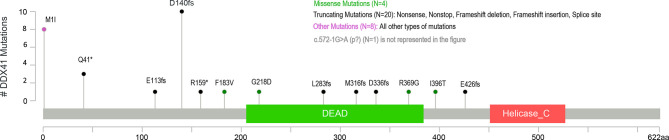
Previously considered rare, inherited hematologic malignancies are increasingly identified. Germline mutations in the RNA helicase predispose to increased lifetime risks of myeloid neoplasms with disease often occurring later in life which presents challenges for germline recognition. To improve identification of germline , individuals presenting with ≥1 alteration on an institutional MDS/AML next-generation sequencing based panel with at least one at >40% variant allele frequency were flagged for review and genetic counseling referral. Of 5,801 individuals, 90 (1.5%) had ≥1 mutation(s) identified. Thirty-eight (42%) patients with a median age of 66 years were referred for genetic counseling; thirty-one were male (81.5%). Thirty-five (92%) referred patients elected to pursue germline evaluation and in 33/35 (94%) a germline variant was confirmed. Twenty-two patients (66%) with germline variants reported antecedent cytopenias, seven (21%) had a prior history of malignancy, and twenty-seven (82%) reported a family history of cancer. Predictive genetic testing for healthy family members under consideration as stem cell transplant donors was successfully performed in 11 family members, taking an average of 15 days. Near-heterozygous mutations identified on next-generation sequencing, particularly nonsense/frameshift variants or those at recurrent germline "hot spots" are highly suggestive of a germline mutation. Next-generation sequencing screening is a feasible tool to screen unselected myeloid neoplasms for germline mutations, enabling timely and appropriate care.
以前被认为罕见的遗传性血液系统恶性肿瘤越来越多地被发现。RNA解旋酶中的种系突变会增加患髓系肿瘤的终生风险,疾病通常在晚年发生,这给种系识别带来了挑战。为了改进种系的识别,对在机构基于下一代测序的骨髓增生异常综合征/急性髓系白血病检测板上出现≥1个改变且至少有一个变异等位基因频率>40%的个体进行标记,以便进行审查和转介进行遗传咨询。在5801名个体中,有90名(1.5%)被鉴定出≥1个突变。38名(42%)患者(中位年龄66岁)被转介进行遗传咨询;31名是男性(81.5%)。35名(92%)被转介的患者选择进行种系评估,其中33/35名(94%)确认存在种系变异。22名(66%)有种系变异的患者报告有既往血细胞减少症,7名(21%)有既往恶性肿瘤病史,27名(82%)报告有癌症家族史。对被考虑作为干细胞移植供体的健康家庭成员进行的预测性基因检测在11名家庭成员中成功完成,平均耗时15天。在下一代测序中鉴定出的近杂合突变,特别是无义/移码变异或那些位于种系“热点”的突变,高度提示种系突变。下一代测序筛查是一种可行的工具,可用于筛查未选择的髓系肿瘤中的种系突变,从而实现及时和适当的治疗。